
Drain Root Removal: A Homeowner’s Complete Guide
Sunday morning in a 1948 Mar Vista bungalow starts normally. Coffee is brewing, the dishwasher is humming, and the kitchen sink makes a soft glug-glug that the homeowner keeps meaning to investigate. In the laundry room, the floor drain burps when the washing machine empties. Last Tuesday, the guest bathroom toilet rose an inch before settling back down.
Those symptoms can feel too minor to justify a plumbing call. Together, they're often an early warning that the sewer lateral is narrowing, sometimes because tree roots have entered through an aging joint or crack. Drain root removal can restore flow, but it rarely ends the problem by itself. The lasting question is why roots entered in the first place, and whether that opening can be sealed.
Table of Contents
- That Gurgle in the Kitchen Sink Is Trying to Tell You Something
- How Tree Roots Actually Find Their Way Into a Drain Line
- Spotting the Warning Signs Before the Drain Stops Completely
- What a Camera Inspection Really Shows and Why It Matters
- Mechanical Cutting, Hydro Jetting, and Chemical Killers Compared
- Pipe Lining and Full Replacement When Cleaning Is Not Enough
- Prevention, Maintenance, and When to Call a Licensed Plumber
That Gurgle in the Kitchen Sink Is Trying to Tell You Something
A partial sewer blockage behaves differently from a clogged sink trap. A sink trap affects one fixture. A root-filled lateral affects the shared path that carries wastewater away from several fixtures, so the first clues often appear in different rooms.
When the washing machine discharges, it sends a large volume of water into the drain line. If a root mat has reduced the usable opening, water slows as it reaches that restriction. Air trapped around the obstruction has to move somewhere, so it bubbles back through a floor drain, tub, toilet, or sink. That's the soft gurgle you hear.
The sequence matters:
- Kitchen sink: A glug after the dishwasher or another fixture drains can indicate air movement in a shared branch or downstream line.
- Laundry floor drain: Burping during washer discharge suggests the line is struggling with a larger flow.
- Lowest toilet: A water level that rises and then drops may mean the obstruction is farther downstream than the toilet itself.
- Multiple fixtures: Problems appearing together point away from a single hair, grease, or paper clog.
The guide to a gurgling toilet can help you separate a local fixture issue from a broader drainage problem, but repeated symptoms across the house deserve more than plunging.
What the water is doing underground
Roots don't form a solid plug immediately. Fine roots enter through a defect, branch inside the pipe, and create a rough net that catches paper, grease, and sediment. As that material accumulates, the opening becomes less forgiving.
Roots are a widespread sewer maintenance problem, not an unusual edge case. A U.S. Forest Service review reports that roots are associated with more than 50% of sewer blockages, and the same review describes root-related costs reaching SEK 3 million annually in Malmö. It also reports root intrusions in 97% of surveyed Danish towns and cities and 99% of Swedish urban areas. The U.S. Forest Service review places a single Los Angeles house in a much larger infrastructure pattern.
Practical rule: One slow sink is usually a fixture problem. Several low fixtures reacting to the same discharge deserve a sewer-line diagnosis.
The gurgle isn't the blockage itself. It's the pressure event created when water and air meet a narrowing passage. If you respond while the line still drains, a plumber may be able to inspect and clear it before wastewater reaches the floor.
How Tree Roots Actually Find Their Way Into a Drain Line
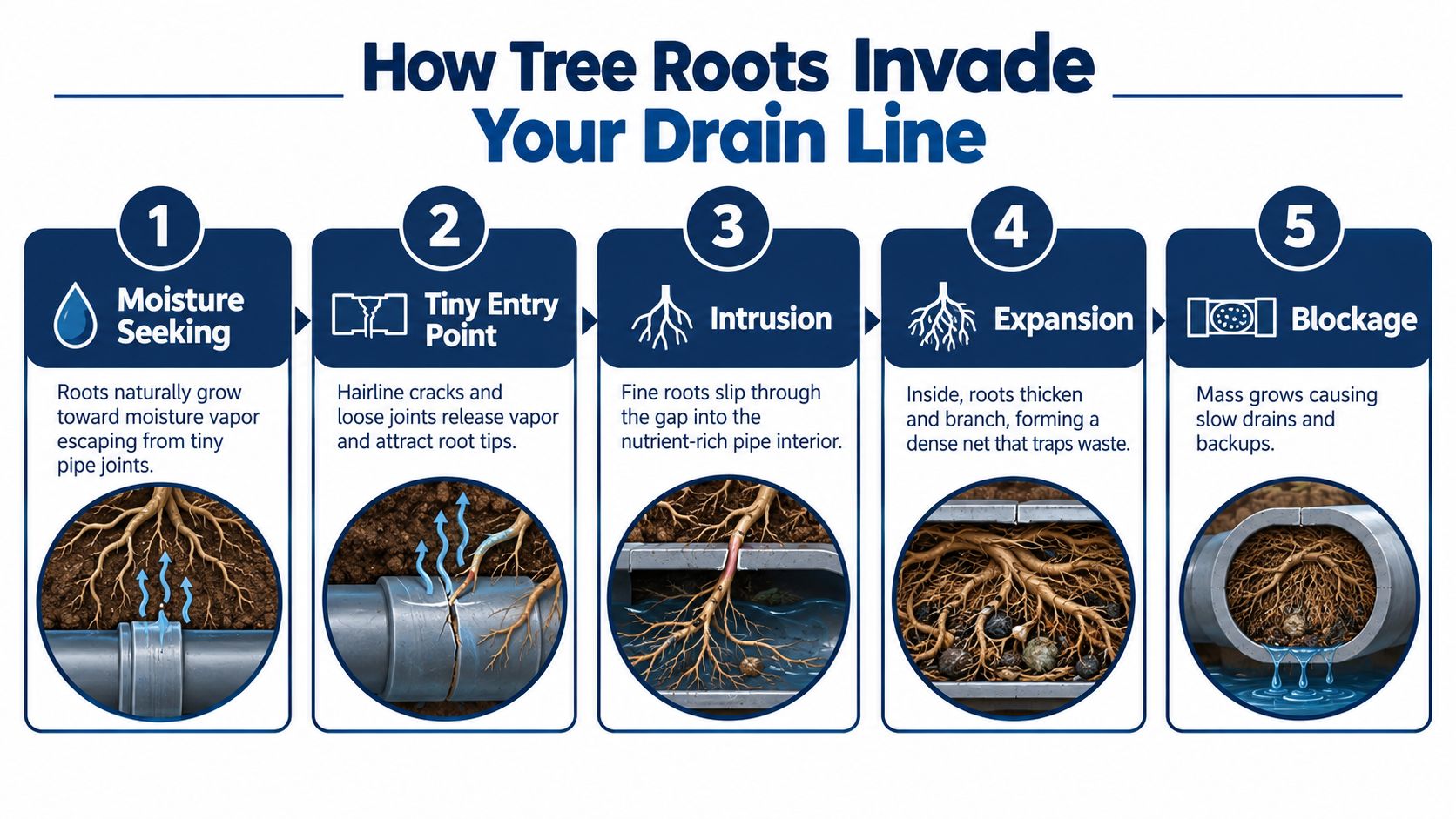
Tree roots aren't deliberately searching for your sewer. They follow moisture, oxygen, and nutrients through the soil. A leaking joint gives them a signal, especially during dry periods when the damp zone around a drain line stands out from the surrounding ground.
Think of a garden hose with a loose collar. You might not see the small leak from a distance, but moisture escapes at the connection. A root tip responds to that damp pocket in much the same practical way. It grows through the soil and bedding toward the defect, then slips through a crack, open joint, or hole.
The path from soil to pipe interior
- Moisture escapes. A deteriorated joint or crack releases vapor and dampness into the surrounding soil.
- Fine roots follow it. Feeder roots grow through the bedding toward the wet area.
- A root enters. A small opening is enough if the root can reach the pipe's interior.
- The root branches. Inside the line, moisture and wastewater support continued growth.
- The mass catches debris. Paper and grease collect around the rough roots until flow slows.
Experimental work on PVC stormwater and sewer pipes found that all tested species penetrated cracks larger than 0.66 mm, while only some species entered cracks as small as 0.04 mm. The work also found that larger openings and more holes increased intrusion likelihood. The published experimental research explains why sealing the entry pathway matters more than just cutting what's visible inside.
Why older Los Angeles laterals see this problem
Older properties may have vitrified clay with mortar or bell joints, transite, or Orangeburg. These materials can deteriorate, shift, deform, or develop openings over time. PVC generally has fewer vulnerable joints when properly installed, but it can still admit roots if a joint separates or the pipe is damaged.
A survey cited in the research literature found 0.661 root intrusions per joint in PVC compared with 0.080 per joint in concrete, and it identified older, smaller-diameter pipes as more vulnerable. The pipe intrusion survey also reflects why utilities use inspection and targeted clearing instead of waiting for a complete blockage.
The pipe interior offers darkness, moisture, nutrients, and protection from disturbance. Cutting the root mat opens the channel, but unless the crack or joint is repaired, the same conditions remain.
Spotting the Warning Signs Before the Drain Stops Completely
A technician starts with patterns, not assumptions. The location of the symptom helps identify whether the restriction is in a fixture trap, a branch line, or the main building drain or sewer lateral.
The lowest fixtures often show trouble first because wastewater and air reach them when the downstream line is restricted. Watch for a floor drain that rises during laundry, a first-floor tub that drains slowly when another fixture runs, or a washing machine standpipe that threatens to spill.
What each symptom suggests
- One slow bathroom sink: Hair, soap, or a local trap issue is more likely than roots in the lateral.
- Toilet gurgling only during laundry: The laundry discharge may be pushing air against a partial downstream obstruction.
- Several fixtures slowing together: The restriction is probably farther along the shared drain path.
- A foul smell near the yard or cleanout: Wastewater may be escaping through a defect or sitting in a poorly draining section.
- A wet or unusually green strip: A leaking sewer line can change soil moisture along its route, though irrigation can create the same appearance.
A yard clue doesn't prove root intrusion. Likewise, a gurgling toilet doesn't identify the material or condition of the pipe. These observations tell you where to investigate, not which repair to authorize.
A simple test before you call
Have one person run the washing machine while another listens near the cleanout or lowest floor drain. Note whether the drain burps, whether water rises, and whether the sound occurs only during discharge or continues afterward. Don't remove a cleanout cap if wastewater may be standing behind it. Pressure can release suddenly, and sewage exposure isn't a useful do-it-yourself experiment.
The useful distinction: A plunger may change a local clog. It won't correct a restriction that several fixtures share.
A warning sign is valuable because it gives you time to inspect. Once wastewater backs up onto a floor, the problem becomes a cleanup and sanitation issue as well as a plumbing repair. A camera inspection can identify whether roots are present before repeated clearing turns into a cycle of emergency calls.
What a Camera Inspection Really Shows and Why It Matters
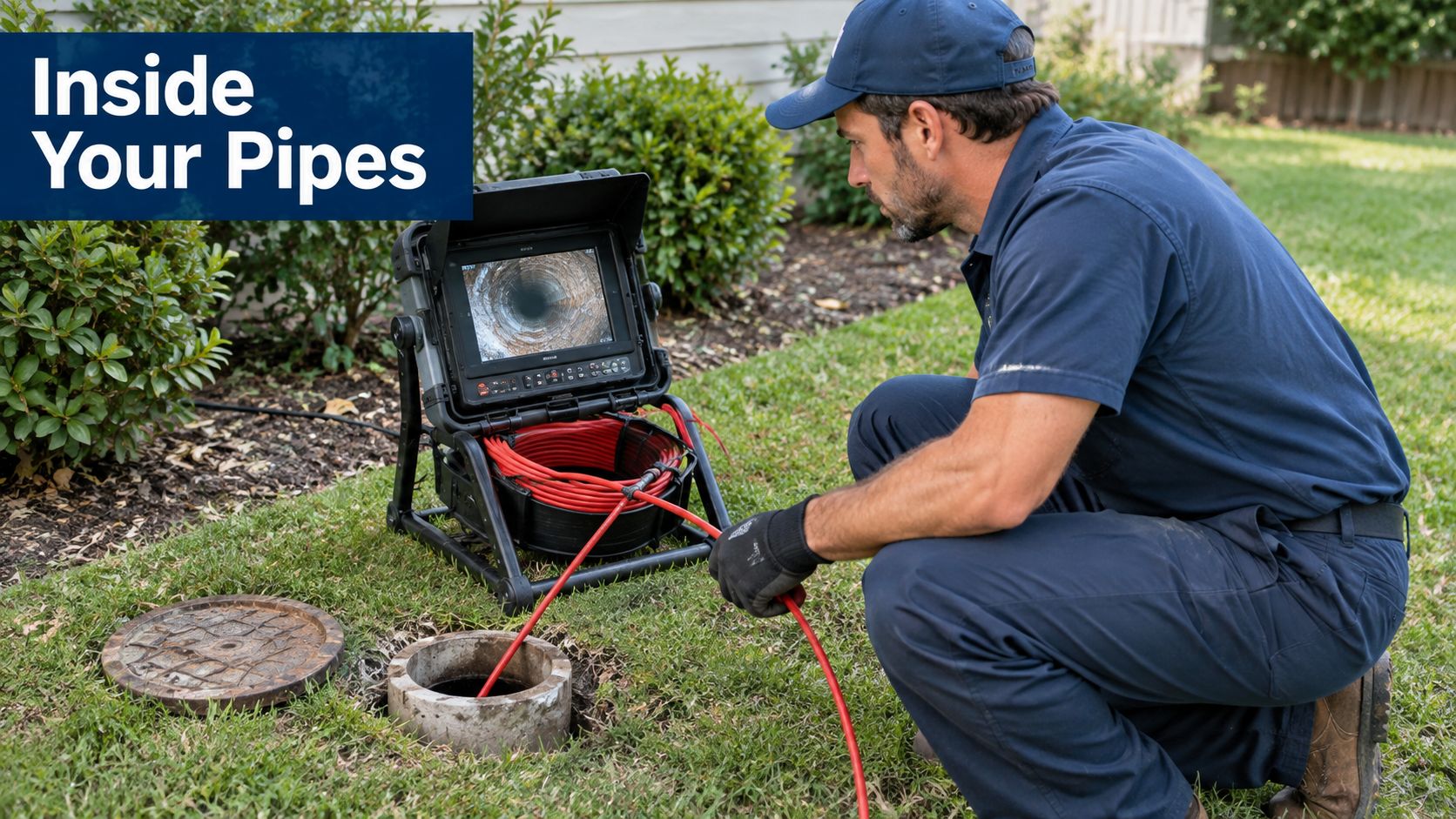
A camera inspection answers the question that root cutting alone can't: what is allowing the roots inside? The technician typically runs water to reproduce the symptom, locates an accessible cleanout, and advances a push-rod or tractor camera through the lateral.
A live view may show a root mat wrapped around a clay bell joint, fine roots entering a hairline crack, an offset joint, grease attached to the root mass, or a section that has partially collapsed. Those conditions don't carry the same repair plan. A clear pipe with a small intrusion may need cleaning and monitoring. A broken or collapsed section needs structural work.
What to ask for on the report
The technician should identify the access point, record the distance to each defect, and describe the pipe material and condition. Ask for the video file, not only a verbal conclusion. A recording lets you compare future inspections and obtain a second opinion without paying to recreate the diagnostic visit.
You can also review EZ Plumbing's sewer camera inspection information to understand the role of video diagnosis before selecting a clearing method.
The footage should help answer four practical questions:
- Are roots present: A root mass has a different appearance from grease, sediment, or a collapsed wall.
- Where do they enter: The distance from the cleanout helps locate the repair area.
- Is the pipe structurally sound: Cracks, offsets, holes, and deformation change the risk of aggressive cleaning.
- Can a durable repair work: Lining requires a pipe that can accept and support the liner, while severe collapse may require replacement.
The table below gives realistic relative trade-offs. Exact pricing depends on access, pipe length, severity, and the contractor's equipment, so treat the cost bands as planning categories rather than a quote.
| Method | Typical Cost (LA) | Disruption Level | Time to Regrowth |
|---|---|---|---|
| Mechanical cutting | Lower initial cost | Low to moderate, usually through a cleanout | Months to a few years if defects remain |
| Hydro jetting | Moderate initial cost | Low at the surface, with equipment access required | Months to a few years if defects remain |
| Chemical root control | Lower initial cost | Low, but product and pipe suitability matter | Temporary suppression, with regrowth possible |
The central trade-off is simple. Clearing restores the passage. Inspection tells you whether the passage will close again.
A camera can also prevent an expensive mistake. Hydro jetting a severely deteriorated line may worsen damage, while cutting into a collapsed section won't restore a missing pipe wall. Diagnosis comes before force.
Mechanical Cutting, Hydro Jetting, and Chemical Killers Compared
The three common clearing methods do different jobs. Mechanical cutters break through dense root mats. Hydro jetting washes and scours the interior. Chemical products may suppress fine regrowth, but they don't close the opening that invited roots inside.
Root Removal Methods Side by Side
| Method | Typical Cost (LA) | Disruption Level | Time to Regrowth |
|---|---|---|---|
| Chain flail or spiral cutter | Lower to moderate | Low to moderate, access through a cleanout | Often months to a few years when the entry defect remains |
| Hydro jetting | Moderate | Low surface disruption, but requires equipment access and a suitable pipe | Often months to a few years when cracks or joints remain open |
| Foaming copper sulfate or dichlobenil treatment | Lower initial cost | Low physical disruption, with label and environmental considerations | Temporary suppression, not permanent prevention |
Mechanical cutting is usually the first response to an active root blockage. A chain flail or spiral cutter shreds the mass and reopens the channel. The limitation is important: the cutter removes roots inside the pipe, not the tree-side root system or the damaged joint. In a fragile clay or Orangeburg line, aggressive equipment can also expose weak sections.
Hydro jetting uses focused water to remove fine roots, grease, and residue from the pipe wall. It can be a useful follow-up after cutting, especially when the root mat has left fibers behind. The Pipeline On guide to hydrojetting for plumbers provides useful technical context on why nozzle choice, access, and pipe condition affect the result. Jetting doesn't repair a crack, offset, belly, or collapse.
Chemical treatments have a narrower role. Foaming products can contact more of the pipe wall than a product that flows along the bottom, while copper sulfate or dichlobenil may slow fine-root growth when used legally and according to the label. Neither option removes a woody root mass or seals the entry point, and misuse can affect vegetation or soil.
Matching the method to the condition
Use mechanical cutting for immediate flow restoration when the camera shows a passable pipe with a concentrated mat. Consider hydro jetting when the line needs broader cleaning and the pipe can safely handle the equipment. Treat chemicals as a bridge or maintenance measure, not as the repair.
For a clearer comparison of cable cutting and water cleaning, review hydro jetting versus snaking before accepting a recommendation. The right question isn't which method sounds strongest. It's which method clears the material without damaging the pipe, and what happens after the line is open.
Pipe Lining and Full Replacement When Cleaning Is Not Enough
Repeated root clearing is a maintenance expense attached to a structural problem. If the camera shows several open joints or cracks, each cleaning removes the symptom while leaving the invitation in place. The practical long-term choices are cured-in-place pipe lining, pipe bursting, or open-trench replacement.
CIPP lining uses a resin-saturated sleeve inserted into the existing pipe and cured in place. It creates a continuous inner surface that seals many joints and small cracks without excavating the full lateral. The trade-off is that the finished passage is slightly smaller, and a liner can't reliably solve a fully collapsed or badly deformed section.
Pipe bursting replaces the old line through access pits. A bursting head breaks the existing pipe while pulling a new pipe into position, so it avoids a continuous trench but still requires working areas at the endpoints. Open-trench replacement remains the fallback when the line has a severe belly, major offset, collapse, or an obstruction that trenchless methods can't bypass.
Lining vs Replacement Trade-Offs
The figures below are planning bands, not guaranteed bids. Site access, depth, length, surface restoration, and the condition shown on camera can move the final price substantially.
| Option | Typical Cost (LA) | Expected Lifespan | Disruption Level |
|---|---|---|---|
| CIPP lining | Moderate to high | Often decades, with some systems designed for 30 to 50 years | Low to moderate, usually limited excavation |
| Pipe bursting | High | Often decades, with some systems designed for 30 to 50 years | Moderate, access pits required |
| Open-trench replacement | High and highly site-dependent | Often decades, with some systems designed for 30 to 50 years | High, surface excavation and restoration |
The expected lifespan range for lining and replacement comes from the assigned background brief, but it shouldn't be treated as a promise for every installation. Ask about the specific liner, resin, pipe material, installation method, and warranty.
Why prevention usually costs less than repetition
You control two practical variables: where trees are planted and how quickly you respond to recurrence. Arboriculture guidance notes that trees are less likely to invade sewers when planted 6 m or more away from existing pipes, so a setback can reduce future exposure, although it can't repair an existing defect. The arboriculture guidance on tree placement and pipe intrusion supports prevention through both landscaping and pipe integrity.
If a line is sound and this is the first root event, clearing plus monitoring can be reasonable. If the same lateral repeatedly catches roots, put the repair money toward sealing or replacing the pathway rather than paying indefinitely for the same reset.
Prevention, Maintenance, and When to Call a Licensed Plumber
Prevention doesn't mean removing every mature tree in the neighborhood. It means mapping the lateral, protecting the pipe, and avoiding new landscaping decisions that place thirsty or fast-growing roots directly over a known defect.
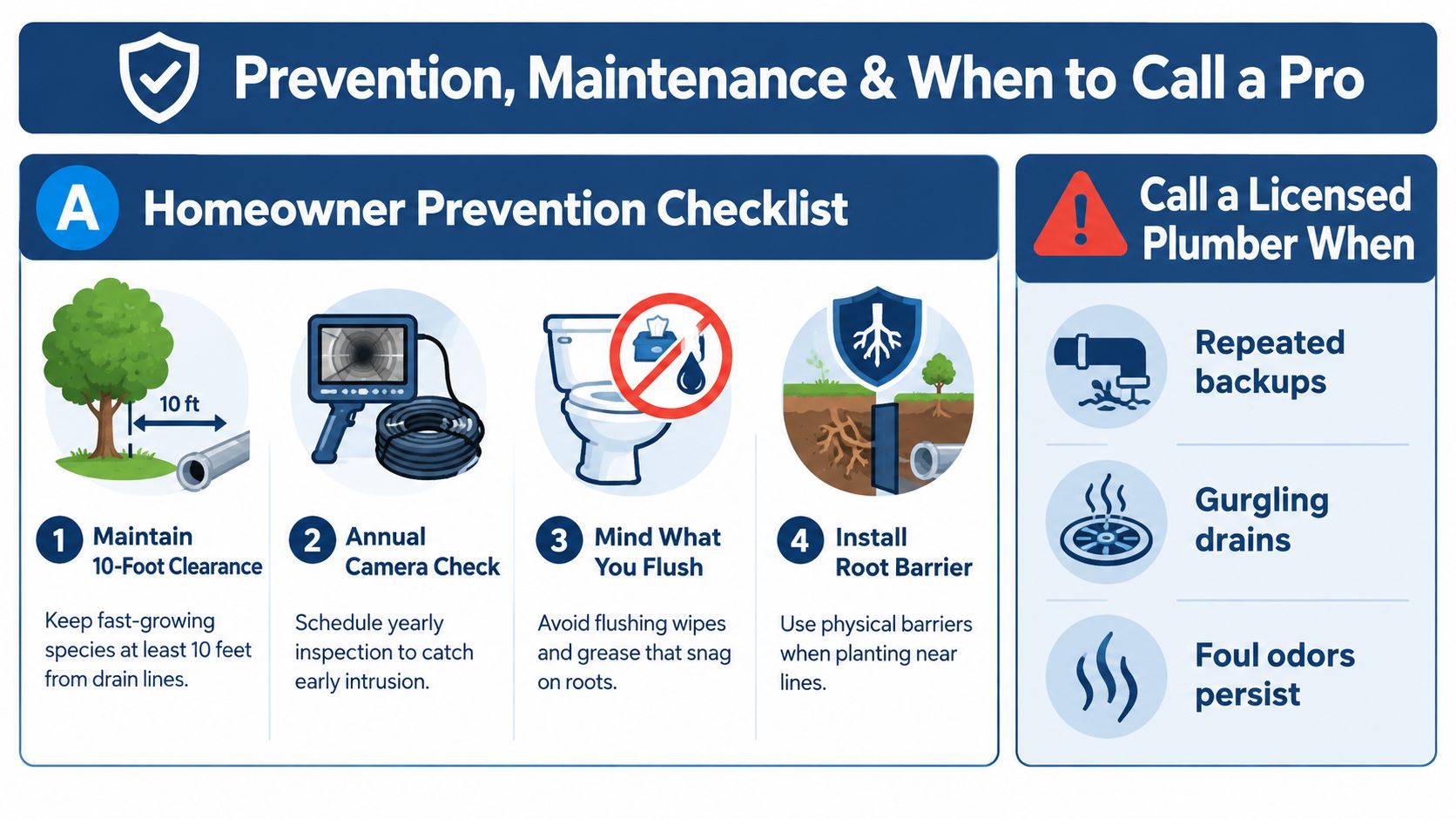
The most durable control is pipe integrity. The practical landscaping control is distance. The assigned maintenance plan calls for 10 feet of lateral clearance from fast-growing species and a camera inspection every 18 to 24 months after root cutting. Those figures are planning guidance from the brief, not a guarantee that roots can't travel farther.
A workable homeowner routine
- Map the lateral: Use a camera report, cleanout location, or professional tracing to understand where the line runs before planting.
- Protect new plantings: Keep fast-growing species away from the sewer route and consider a physical root barrier where appropriate.
- Reduce snagging material: Don't flush wipes, and keep grease out of the drain. Roots already create a rough surface that catches debris.
- Use chemical products cautiously: A labeled foaming root treatment may be a temporary measure between cleanings, but it doesn't replace repair.
- Track recurrence: Record the date, symptom, clearing method, and camera findings so a pattern is visible.
A homeowner who wants broader background on planning maintenance content can review actionable plumbing SEO steps from DigiVisi Ltd., although the plumbing decision itself should come from the pipe condition and inspection footage, not from marketing language.
The decision tree for a recurring line
If this is the first blockage and the camera shows an intact pipe, mechanical cutting or hydro jetting followed by a prevention plan is reasonable. If the same line backs up again within a year, don't repeat the last service without reviewing the camera evidence. Recurrence suggests that the openings, joints, or damaged section need a lining, spot repair, bursting, or replacement plan.
Call a licensed plumber promptly when:
- Several fixtures back up together: The obstruction is likely beyond a single fixture.
- Sewage appears at a cleanout: The line may be full or unable to carry flow.
- The yard turns soggy or develops a green stripe: A leaking or compromised lateral may be changing the soil conditions.
- Indoor sewage odors persist: Wastewater may be escaping somewhere it shouldn't.
- A toilet rises during laundry: The shared line may be restricted downstream.
EZ Plumbing offers mechanical root cutting, hydro jetting to remove remaining root debris, and chemical maintenance treatments as follow-up options. The appropriate combination depends on camera findings and pipe condition, not on choosing the most aggressive treatment.
Roots are manageable when you separate restoring flow from repairing the entry point. Clear first when the pipe is sound, plan rehabilitation when the problem returns, and call a licensed plumber before a partial restriction becomes an indoor backup.
If your Los Angeles drain line is gurgling, backing up, or repeatedly catching roots, EZ Plumbing can inspect the sewer lateral, clear active root growth, and explain whether hydro jetting, maintenance treatment, lining, or replacement fits the condition shown on camera. Schedule an inspection or request service before the next discharge turns a warning sign into sewage cleanup.