
After Hours Plumbing: What to Do Before the Plumber Arrives
At 2 a.m., a plumbing problem doesn't feel like a maintenance issue. It feels like a disaster unfolding in real time. Water is running across the hallway, a ceiling is darkening above the living room, or a toilet is pushing foul water back onto the floor. You're barefoot, the carpet is already squishing underfoot, and you're trying to remember where the main shutoff valve is while wondering whether water is reaching an outlet or the unit below you.
The first few actions matter more than the plumber's estimated arrival time. Stopping the flow, isolating electrical hazards, protecting people, and documenting the damage can limit what happens before a technician gets there. This guide covers the immediate response, safe temporary fixes, the way real 24/7 dispatch works, the actual premium for nights and holidays, contractor screening, prevention, and a phone-ready checklist. For broader emergency-response planning, the emergency response services guide offers useful context beyond plumbing.
If you're dealing with an active leak in Los Angeles, start with this emergency plumbing guide for LA homeowners, then move through the steps below.
Table of Contents
- When the Call Comes at 2 A.M.
- What to Do in the First 15 Minutes
- Quick Fixes You Can Safely Try Tonight
- What After Hours Plumbing Really Costs
- How to Pick a Reliable After Hours Plumber
- Prevention Is the Quietest 24/7 Service
- Your Saved-Phone Emergency Checklist
When the Call Comes at 2 A.M.
The sound usually wakes you before the water does. A faint hiss comes from the upstairs bathroom, followed by the soft patter of drops against the floor. You turn on the hallway light and find water spreading from the bathroom toward the stairs. The carpet gives under your feet. A pinhole in a copper line may be feeding the leak, but from downstairs it looks like the whole ceiling is coming apart.
The water creeps toward an outlet near the baseboard. You think about the sump pump, the electrical panel, and the neighbor below. If you live in a condo or apartment, the question gets more urgent: is the leak staying inside your unit, or has it reached the wall, ceiling, or another residence?
The first priority is control, not diagnosis. You don't need to identify the failed fitting before you stop the water.
A plumber arriving later can replace a pipe, clear a drain, or open a wall. They can't undo hours of saturation in drywall, subfloor, insulation, cabinetry, or electrical components. That's why a live phone answer and clear instructions matter. A genuine after hours plumbing operation should help you stabilize the scene while it sends the right technician.
The next section gives the order I'd use on a call: safety first, water shutoff second, water heater protection third, and containment after that. Later, we'll separate low-risk temporary repairs from dangerous improvisation, explain what “24/7” should mean in dispatch terms, examine current 2026 pricing, and cover prevention systems that can catch a nighttime leak before it becomes a midnight truck roll.
What to Do in the First 15 Minutes
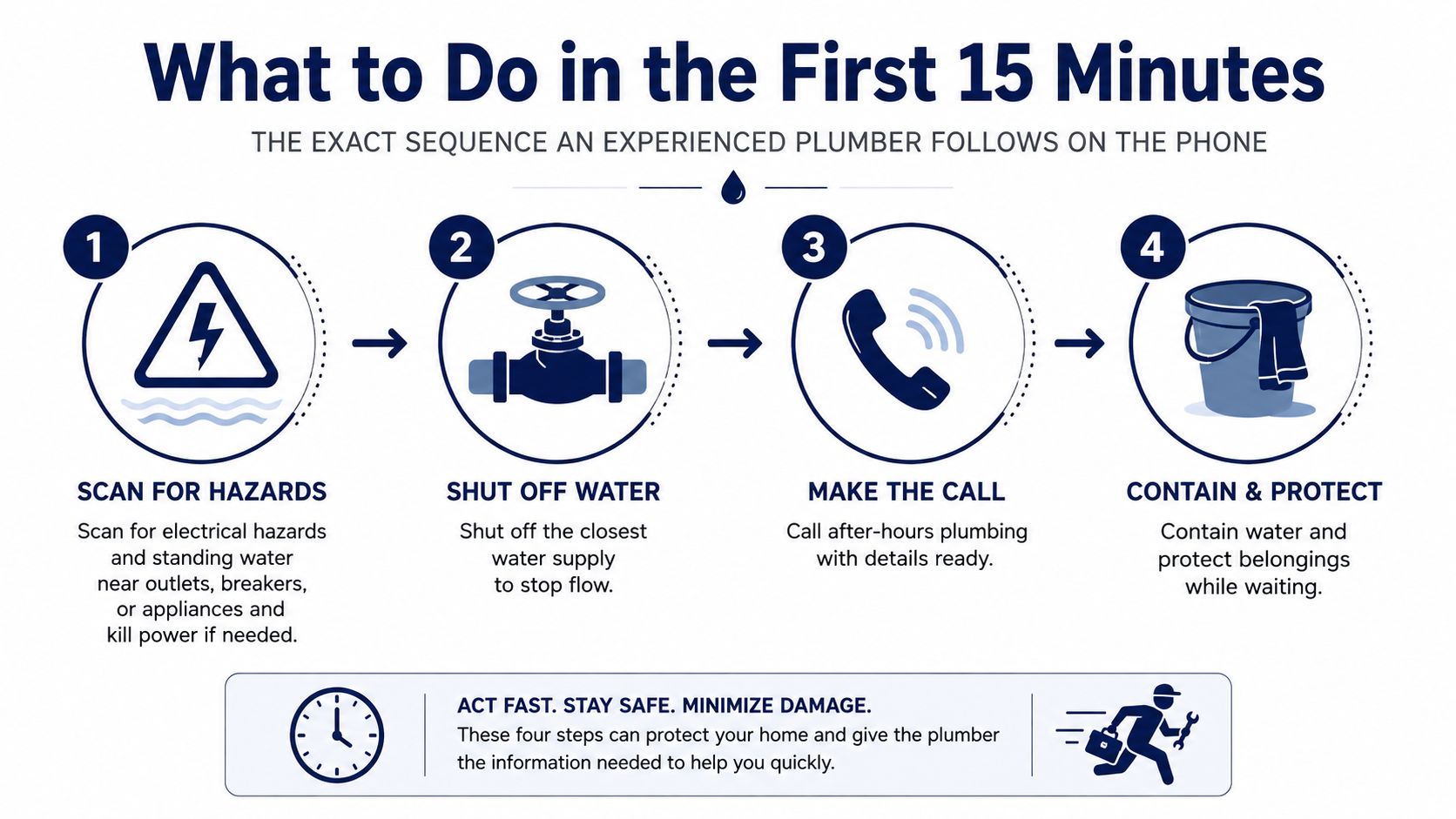
The sequence below is more useful than a random list of emergency tips. Follow it in order, and stop whenever a step puts you near electricity, gas, sewage, or unstable building materials.
Start with people and electricity
Get everyone away from standing water. Don't step into a wet area if water is near outlets, extension cords, appliances, a panel, or a submerged electrical device. If you can reach the affected circuit breaker from a dry location without crossing water, switch it off. If you can't do that safely, leave the area and call for professional help.
Next, identify whether the failure is local or whole-house. A supply line under one sink may have a small fixture shutoff. A burst pipe inside a wall, a failed water heater connection, or water appearing in several rooms usually calls for the main valve.
Shut off the closest reliable valve
Turn a fixture stop clockwise until it closes. For a whole-house leak, use the main shutoff, often near the meter, where the service line enters the property, or in a utility area. Turn the valve gradually. If it becomes firm, don't force it with pliers. A damaged stem can create a larger leak and leave you without a working shutoff.
If you're unsure where the valve is, use this practical guide to shutting off the main water supply. In a building with a shared meter or pressure-regulating equipment, ask the dispatcher before touching a valve that may control other units.
Protect the water heater
A water heater can be damaged if it continues heating without an adequate water supply. For a gas unit, set the control to the manufacturer's vacant or pilot setting. For an electric unit, switch off the dedicated breaker. Don't open gas controls, disconnect lines, or attempt a burner repair during a flood.
After the supply is controlled, open two faucets downstream to relieve residual pressure and let trapped water drain. Then use towels, a wet vacuum, buckets, and plastic sheeting to keep water away from cabinets and furniture. Take photographs before moving soaked materials, including wide shots of the room and close-ups of the source.
For a visual walkthrough, watch the following emergency response video after you've made the area safe:
Quick Fixes You Can Safely Try Tonight
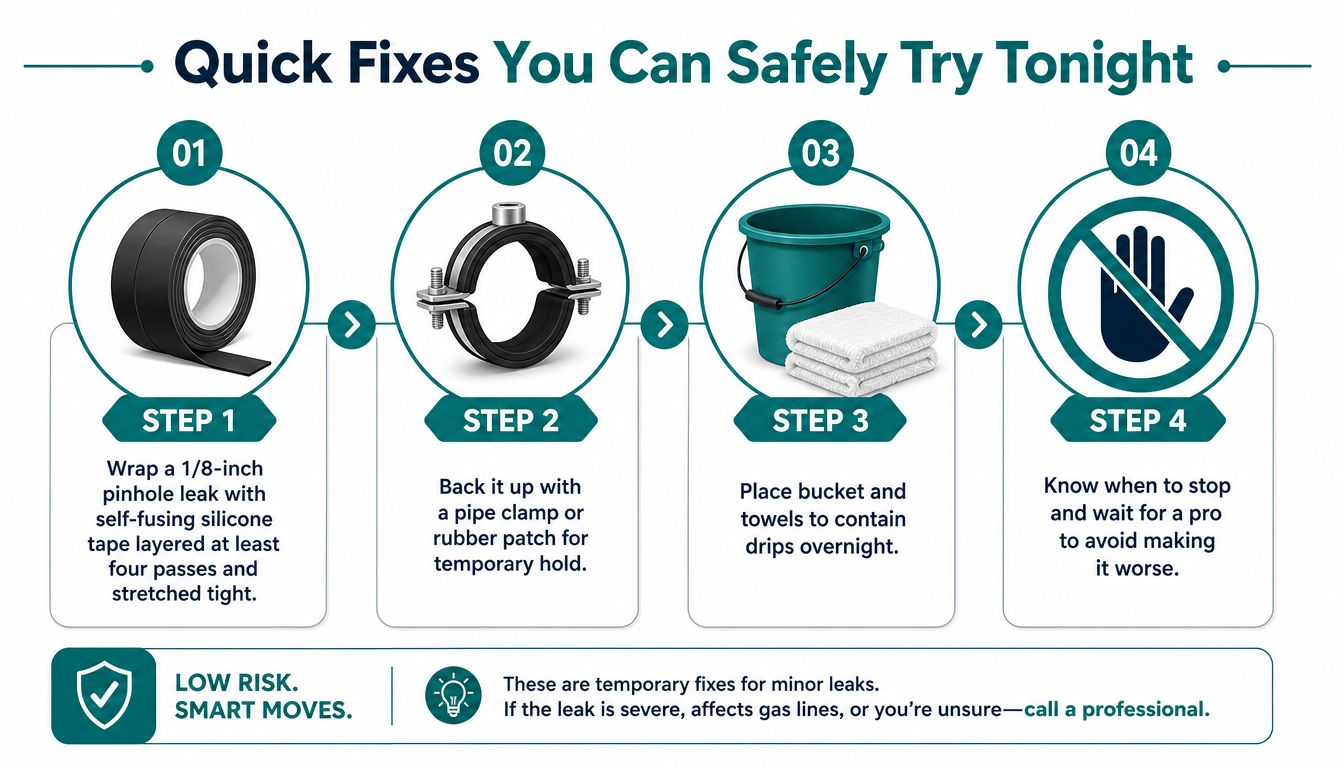
Temporary work is useful only when it reduces flow without creating a second emergency. The right question isn't, “Can I make this look repaired?” It's, “Can I safely slow the damage until a trained person can inspect the failure?”
Low-risk water control
For a small pinhole leak on an accessible pipe, wipe the outside dry and use self-fusing silicone tape. Stretch it tightly while wrapping, overlap each pass, and build several layers around the damaged area. A pipe repair clamp with a rubber patch can add temporary support if the pipe is exposed and you can install the clamp without forcing the line.
A bucket under active dripping is simple but effective. Place towels beneath and around the bucket, change saturated towels before they spread water, and keep containers away from electrical equipment. If water is coming through a ceiling, don't poke the ceiling or cut into it without understanding what's above it. A bulging ceiling can release a large volume of water suddenly.
A single-fixture blockage
A toilet or sink backup confined to one fixture may respond to plunging. Use a flange plunger for a toilet, keep enough water in the bowl to cover the rubber cup, and make controlled vertical strokes rather than violent splashing. Stop if the level rises, if multiple fixtures begin backing up, or if the fixture hasn't cleared after a second careful attempt.
A backup involving several drains is different. It may point to a branch-line or sewer problem, and plunging one fixture can push contaminated water into another. Keep people and pets away from sewage, avoid contact with skin, and tell the dispatcher exactly which fixtures are affected.
What not to attempt
Some common internet fixes turn a manageable service call into a hazardous one:
- Leave gas work alone: Don't adjust gas water heaters, loosen gas fittings, or investigate a gas line with tools. If you smell gas, leave the property and contact the appropriate emergency utility service.
- Skip drain chemicals: Chemical drain cleaner can remain in a trap or pipe and injure the technician who opens it later. Tell the plumber if any chemical has already been used.
- Don't disassemble unfamiliar traps: A P-trap can contain contaminated water, and a brittle connection may break when loosened.
- Don't force stuck valves: Pliers can snap a valve stem or distort the fitting. If the valve won't close by hand, report its location to dispatch.
- Don't open a water-heater cabinet during flooding: Keep the area clear and let a qualified technician handle gas, electrical, and combustion components.
What a real 24/7 line does
A legitimate emergency line starts with a person, not a voicemail box. The dispatcher should ask whether water is actively flowing, whether sewage is present, whether there's a gas odor, whether power is involved, and whether other units or floors are affected.
Industry benchmark guidance calls for a human answer within about two rings, or roughly 10 seconds, followed by callback or dispatch within 5 minutes for a true emergency, as described in emergency plumbing response guidance. That isn't a guarantee of arrival, but it is a useful test of whether the operation is staffed after hours.
Dispatchers rank active flooding, sewage backup, gas odor, and complete water loss in a multi-unit building ahead of a slow drain or a dripping faucet. The technician may call before leaving to confirm the pipe material, shutoff status, access instructions, and whether water is still moving. A stocked truck, an on-call rotation, and accurate triage matter more than a dramatic ad promising an impossible arrival.
Sector benchmarks report emergency response commonly falling between 30 minutes and 2 hours, with strong 24/7 providers often reaching 30 to 60 minutes. The same benchmark source reports an average of 4.1 rings to answer, live answers for 44% of calls, and after-hours live answers for only 10%, which helps explain why voicemail-heavy systems fail homeowners at the moment they need help most. See the plumbing response-time benchmark for that operational context.
What After Hours Plumbing Really Costs
Night service costs more because the technician, dispatcher, vehicle, and limited available capacity are all being used outside ordinary business hours. Current 2026 market data compiled from Angi and other industry sources places emergency plumbing at about 1.5 to 3 times standard business-hour rates, with emergency labor averaging around $170 per hour versus a normal range of roughly $45 to $200 per hour. The same market summary lists weekday evening pricing around $60 to $300 per hour, weekends around $80 to $400 per hour, and holidays around $120 to $600 per hour. See the 2026 emergency repair cost data for the source ranges.
| Job Type | Standard Hours | After Hours / Weekend | Holiday / 2-4 A.M. |
|---|---|---|---|
| Labor | Roughly $45 to $200 per hour | About $60 to $400 per hour depending on timing | About $120 to $600 per hour |
| Emergency dispatch | Usually lower or included by provider policy | Commonly about $75 to $200 trip charge | Emergency call fees can reach roughly $150 to $500 |
| Burst pipe or major water intrusion | Scheduled repair pricing | Midnight calls can reach about $500 to $1,200 before parts | Severe jobs can reach $2,000+ or $4,800 in complex cases |
Those are ranges, not a promise of what your invoice will be. Wall access, water-heater work, sewer equipment, parts, restoration coordination, and building access can change the total. A single-family homeowner may need one technician and a straightforward shutoff. A multifamily property may need access coordination, a building engineer, isolation of a riser, or communication with residents.
A delay can cost more than the premium. Water can damage drywall, flooring, cabinets, insulation, and electrical components while you wait for ordinary hours. Ask for the trip charge, hourly rate, minimum labor policy, and likely stabilization scope before authorizing dispatch. An Los Angeles emergency plumber should be able to explain what the after-hours premium covers before the truck is sent.
How to Pick a Reliable After Hours Plumber
A working phone number isn't proof of a real 24/7 plumbing contractor. Some ads route callers to a lead service that sells the request to another company. You want to know who is answering, who is dispatching, and who will arrive.
Verify the contractor before authorizing work
For a Los Angeles home, check the contractor through the California State License Board and ask for the license number before dispatch. Confirm that the business carries active workers' compensation and general liability insurance. A legitimate provider should also disclose the dispatch or trip fee, identify a physical service address, and explain whether emergency work has a warranty.
Ask these questions in a calm, direct way:
- Who is answering the call: Is this the plumbing company's own dispatcher or an answering service?
- What is the dispatch fee: Does it include diagnosis, travel, or any initial labor?
- What rate applies tonight: Ask for the after-hours labor rate and any minimum.
- Who is coming: Can the company identify the technician or at least confirm employee versus subcontractor status?
- What happens on arrival: Will the technician provide a written estimate before nonessential repair work?
- What is covered afterward: Ask about the workmanship warranty and exclusions.
A homeowner needs speed, clean containment, and a repair that won't fail again when pressure returns. An HOA or commercial manager has another layer of responsibility. Request certificates of insurance, code-compliant documentation, building-engineer coordination, access protocols, and a documented response-time standard if your property requires one.
A low quote that hides the trip charge isn't a low quote. It's an incomplete quote.
Red flags include pressure to authorize unrelated replacement work before the leak is stabilized, vague answers about rates, cash-only demands, refusal to provide a license number, and a technician who cannot explain what the dispatch fee covers. A serious contractor can separate emergency stabilization from the permanent repair, so you can make an informed decision even when the call comes at an inconvenient hour.
Prevention Is the Quietest 24/7 Service
The best after-hours plumbing call is the one that never needs to happen. Leak prevention works in layers, and each layer catches a different failure.
Point-of-use sensors belong under water heaters, washing machines, dishwashers, sinks, and toilets. Basic battery sensors can send phone alerts when they detect moisture. Some local shutoff devices can close the supply to one appliance or fixture, which limits damage without turning off the entire property.
A whole-property automatic shutoff valve sits on the main line and monitors flow. Products such as Flo, Moen, and Phyn can identify unusual patterns, including a toilet that runs during the night, and can close the main when the system detects a likely leak. These systems need correct installation, reliable power or battery backup, and a homeowner who responds to alerts. They can miss leaks that occur outside the monitored plumbing path or develop slowly without producing an obvious flow pattern.
For HOAs and multifamily buildings, prevention can extend to meter-side analytics, riser sensors on upper floors, and integration with a building management system. That setup can help staff identify a problem before water travels through several units, but it requires coordination between the plumbing contractor, property manager, building engineer, and monitoring provider.
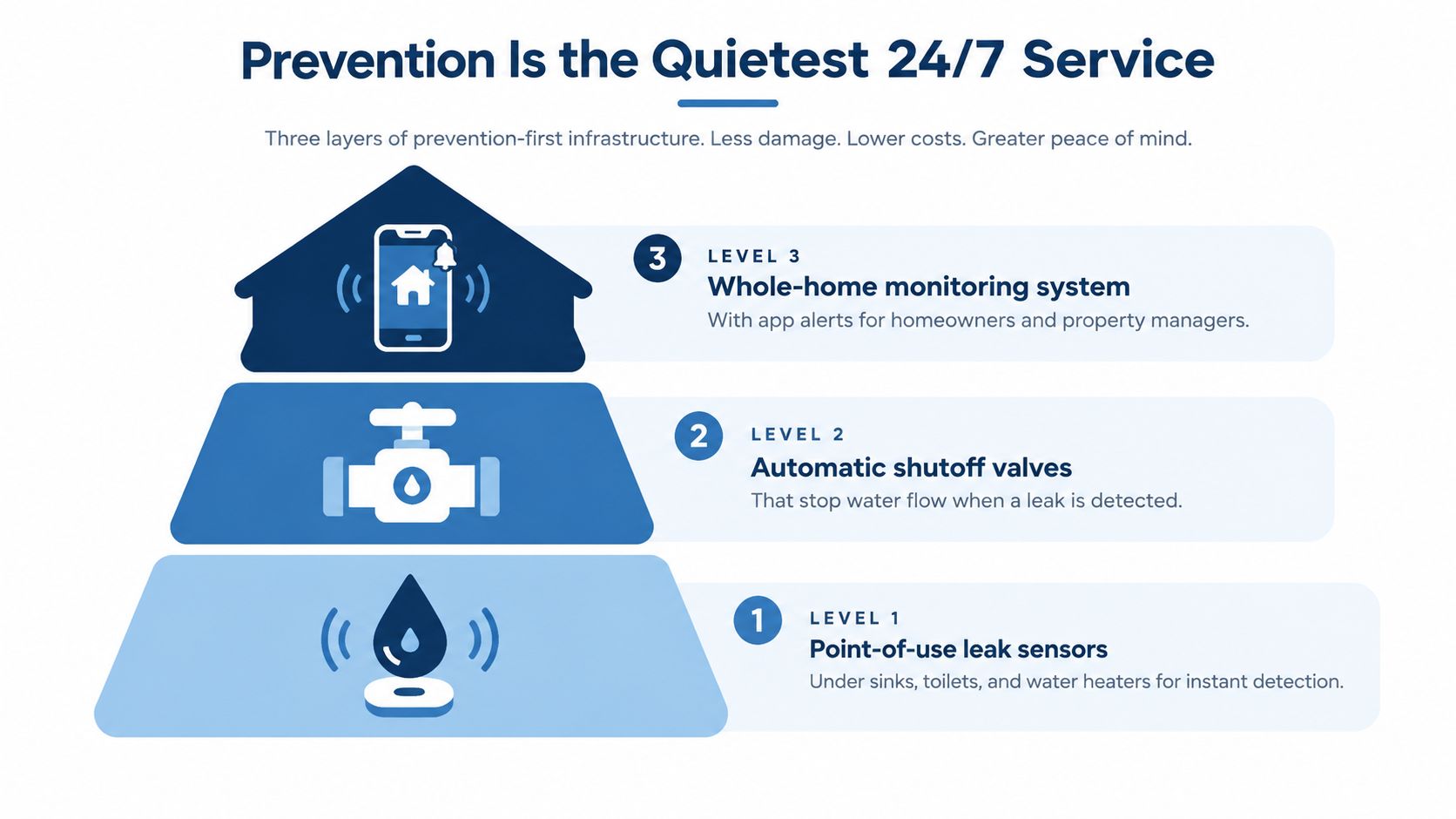
The practical shift is from reactive dispatch to monitored prevention. Water damage remains a major residential loss category, and coverage of emergency plumbing costs and prevention increasingly discusses smart sensors and automatic shutoff equipment. Before buying anything, map what the system can detect, what it can shut off, how alerts reach you, and who responds when the alert arrives.
Your Saved-Phone Emergency Checklist
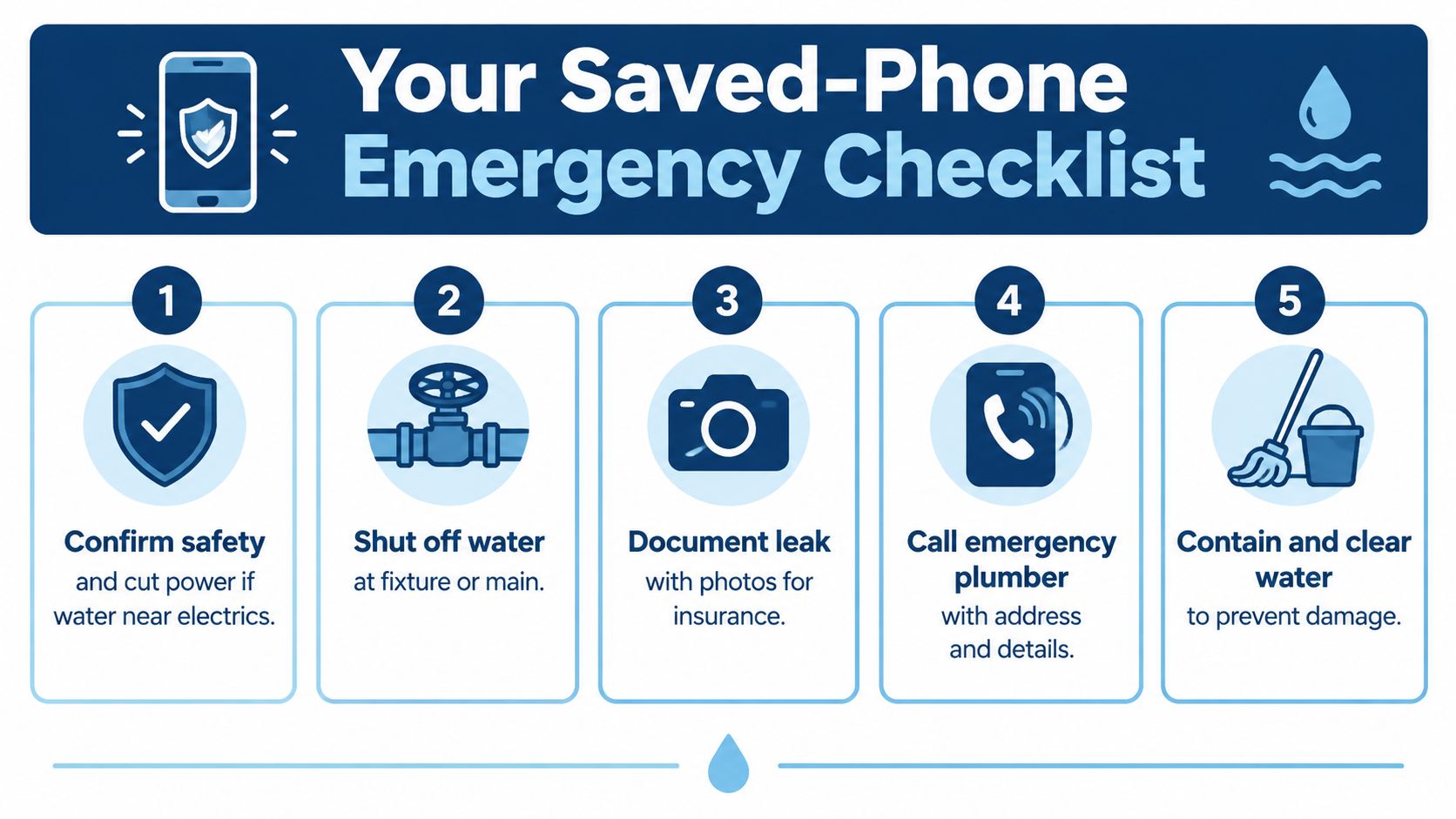
Save this list before you need it. During a real leak, you won't want to search through old messages while water spreads across the floor.
The first fifteen minutes
- Confirm everyone is safe. Keep people and pets away from standing water. Check for outlets, appliances, cords, and electrical panels near the affected area. Cut power only from a dry, safe location.
- Close the water supply. Use the fixture stop for a localized failure. Use the main shutoff for active flooding, a wall leak, or water appearing in multiple areas. If you share a meter or live in a managed building, ask before closing a valve that may affect other units.
- Protect the water heater. Set a gas unit to its manufacturer's vacant or pilot setting. Switch an electric unit off at its breaker. Don't work on gas controls or electrical components.
- Contain the water. Use buckets, towels, a wet/dry vacuum, and plastic sheeting where safe. Keep soaked materials away from outlets and document what you move.
- Photograph the damage. Take wide and close photographs of the source, affected rooms, ceilings, flooring, cabinets, and visible contents before cleanup.
- Call an emergency plumber. Give the address, unit number, shutoff location, pipe material if known, approximate home age, source of the leak, current water status, and any gas, sewage, or electrical concerns.
Call immediately for active flooding, sewage backup, gas odor, a ceiling that is sagging, water near electrical equipment, or complete loss of water in a multi-unit property. Don't wait for morning if the source is uncontrolled or contaminated.
You may be able to monitor a slow drip that is fully isolated, contained, and far from electricity, but only if the affected area remains stable. If the leak grows, the ceiling changes, another fixture backs up, or you can't confirm the shutoff, treat it as an emergency.
EZ Plumbing provides 24/7 emergency dispatch for Los Angeles homes, HOAs, property managers, and commercial properties, including nights, weekends, and holidays with the after-hours premium disclosed in the estimate. Visit EZ Plumbing to request help with active leaks, sewer backups, water heaters, gas leak detection, or other urgent plumbing problems.