
Avoid Permit Callbacks: CPC 608.3 Rules for Expansion Tanks in Los Angeles
If your home has a closed plumbing system, meaning it has a check valve, backflow preventer, or pressure-reducing valve, California code requires an expansion tank on your water heater. CPC 608.3 makes this mandatory, and Los Angeles inspectors enforce it at every water heater permit. If you don’t have one of those closing devices, you may be exempt, but most homes built or updated in the last two decades have at least one.
TL;DR:
- Most Los Angeles homes with check valves, backflow preventers, or pressure-reducing valves require an expansion tank on the water heater due to the system’s closed nature.
- Inspectors routinely verify the presence of protective devices and demand proper sizing, placement, and pre-charging of expansion tanks during permits and inspections.
- Installing the correct size expansion tank depends on manufacturer charts based on heater capacity, water pressure, and temperature rise, not guesswork.
- Common inspection failures include missing tanks on closed systems, improper discharge piping, loose seismic straps, and clearance violations, which are easily preventable.
- Permit costs are typically between $25 and $150, with inspections taking a few days, and licensed plumbers handling diagnosis, installation, and documentation ensure code compliance.
Table of Contents
- Quick Checklist: When You Must Install an Expansion Tank
- What the Code Says: CPC 608.3 and Los Angeles Plumbing Rules
- How to Tell Whether Your Home Has a Closed System
- Sizing, Placement, and Installation Basics (What Installers Follow)
- Permits, Inspections, and Common Code Failures in Los Angeles
- Typical Costs and Timeline for Adding an Expansion Tank in LA
- EZ Plumbing’s Local Perspective and Practical Advice
- How EZ Plumbing Helps: Code-Compliant Expansion Tank Installation in Los Angeles
- Sources
Quick Checklist: When You Must Install an Expansion Tank
Not every home needs an expansion tank, but most modern Los Angeles properties do. Here’s a fast way to check before you call a plumber or pull a permit.
- Look for a check valve, backflow preventer, or pressure-reducing valve (PRV) anywhere on your cold water supply line, often near the water meter or main shutoff.
- If any of those devices is present, your system is “closed,” and CPC 608.3 requires expansion control, typically a thermal expansion tank.
- If you’re replacing or installing a water heater under a Los Angeles plumbing permit, expect the inspector to require an expansion tank whenever the system qualifies as closed.
- Some listed alternative devices can satisfy the code instead of a standard tank, but a licensed plumber should verify that any substitute is properly rated and installed.
Because so many LA homes now have a PRV installed at the meter by LADWP or a backflow preventer required for irrigation systems, this rule touches a large share of properties whether homeowners realize it or not.
What the Code Says: CPC 608.3 and Los Angeles Plumbing Rules
The California Plumbing Code is specific on this point. CPC 608.3 requires an approved device to control thermal expansion whenever a water heater connects to a closed water distribution system, and that rule applies regardless of whether you have a tank-style unit or a tankless water heater. The trigger isn’t the heater. It is whether something downstream, a check valve, PRV, or backflow device, prevents water from flowing backward into the street main when it expands.
Los Angeles enforces the state code but layers on its own administrative requirements through LADWP and city plumbing provisions. These local amendments can touch installation specifics, hot water delivery standards, and inspection sequencing, even though the core expansion tank mandate comes straight from the state code. The Los Angeles Municipal Code also sets the scope for what triggers permit review on repairs and replacements citywide.
If you’re unsure how a local amendment applies to your specific property, the safest move is asking your inspector directly rather than assuming a generic answer from a national plumbing forum applies to your jurisdiction.
How to Tell Whether Your Home Has a Closed System
You don’t need special tools to get a good first read on this. A few minutes of observation, plus one simple test, usually tells you what you’re dealing with.
- Walk your cold water supply line from the meter to the water heater and look for a brass or bronze device with a directional arrow. That’s typically your check valve or PRV.
- Check near your irrigation system or main shutoff for a backflow preventer, often a taller assembly with test cocks.
- If you find a device but aren’t sure it closes the system, ask a licensed plumber to run a pressure test: they’ll monitor a gauge while the water heater runs a full cycle. Rising pressure with no relief confirms a closed system.
- Call LADWP or check your meter box for a tag or marking noting a PRV installation, since utilities sometimes install these at the curb without homeowners noticing.
A licensed plumber can usually confirm closed-system status in one visit using a visual check, a pressure gauge reading, and a short hot water run test, before you ever pull a permit.
Sizing, Placement, and Installation Basics (What Installers Follow)
Expansion tank sizing isn’t guesswork. Manufacturers publish charts tied to tank capacity, incoming water pressure, and temperature rise, and installers are expected to follow them rather than eyeball it.
- Sizing: A small expansion tank often works for a standard medium-capacity water heater, but manufacturer sizing charts determine the exact number based on your specific heater’s capacity and expected temperature rise.
- Placement: The tank installs on the cold inlet side, on the building side of whatever device created the closed system. Orientation and clearance follow the manufacturer’s installation manual.
- Pre-charge: The tank’s air pre-charge should match your home’s incoming static water pressure. Mismatched pre-charge is one of the most common reasons a correctly sized tank still fails to control expansion properly.
- Seismic and leak safety: Tanks need secure strapping per local seismic guidance, placement away from freeze-prone areas (rare in LA, but relevant in higher elevations), and drip protection where leaks could cause water damage.
Pro Tip: Grab a tire pressure gauge and check your expansion tank’s pre-charge before it’s connected to the system. It should read within a few PSI of your home’s static water pressure, not an arbitrary factory default.
Permits, Inspections, and Common Code Failures in Los Angeles
Replacing or installing a water heater in Los Angeles almost always requires a plumbing permit, and that permit triggers a formal inspection before the job is considered closed. Inspectors aren’t just glancing at the unit. They’re checking for a properly sized expansion tank on closed systems, correct temperature and pressure (T&P) valve discharge piping, seismic strapping, and leak-free connections at every joint.
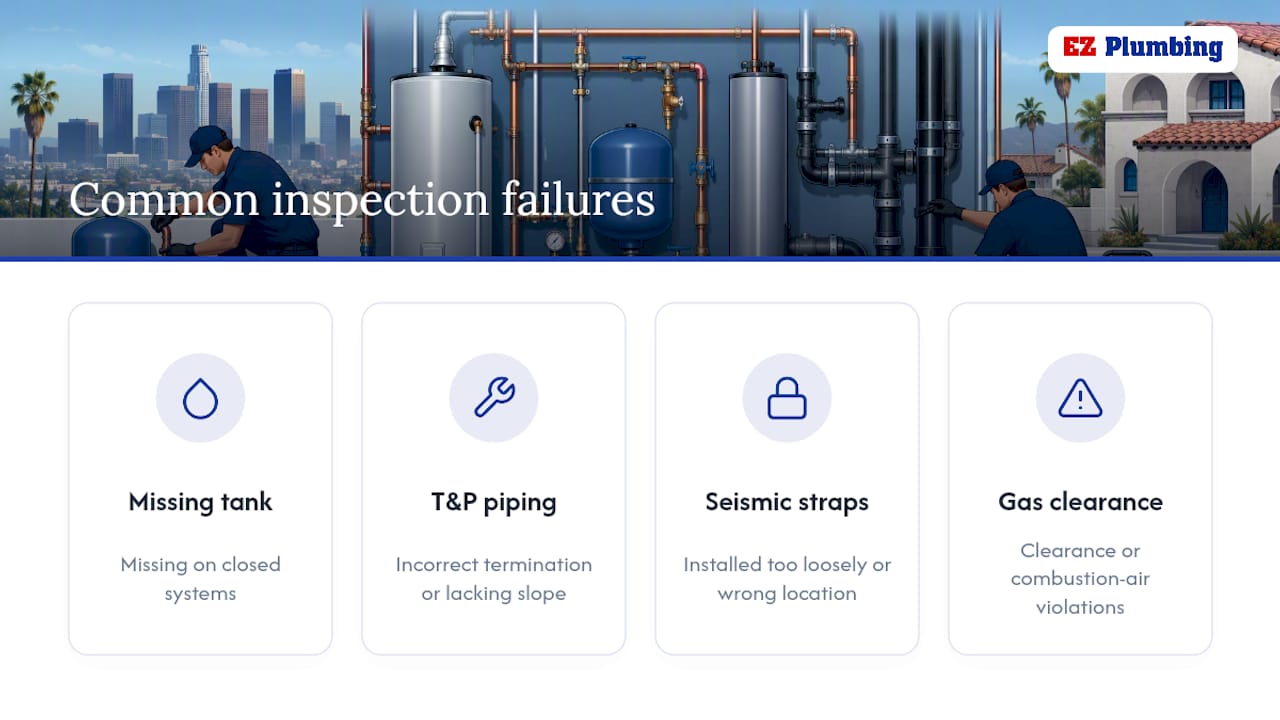
The most common failures on Los Angeles water heater jobs are predictable, and avoidable. A missing expansion tank on a system that’s clearly closed is the top one. Right behind it: T&P discharge piping that terminates incorrectly or lacks proper slope, seismic straps installed too loosely or in the wrong location, and clearance violations around gas connections or combustion air. Inspectors flag these issues often enough that experienced installers treat them as a standard pre-inspection checklist rather than an afterthought.
Typical Costs and Timeline for Adding an Expansion Tank in LA
Adding an expansion tank as a standalone job typically runs a modest amount in parts and labor, though tight access, multi-story installations, or additional permit work can push costs higher. If you’re doing a full water heater replacement, the expansion tank is commonly rolled into that quote rather than billed separately, since it’s already part of a compliant, same-for-same installation.
Permit fees for standard water heater replacements in Los Angeles typically run in the $25 to $150 range, and inspection scheduling usually adds a few days to the timeline depending on your local building office’s workload. Budgeting for the permit and inspection window up front avoids the surprise of an unpermitted install that fails resale disclosure later.
EZ Plumbing’s Local Perspective and Practical Advice
As a licensed contractor working in Los Angeles, professionals typically run the same sequence every time: visual device check, pressure test, sizing chart cross-reference, then permit verification. DIY works for the visual check. It stops being appropriate once gas connections, permit paperwork, seismic strapping, or pre-charge matching enter the picture, since getting any of those wrong risks a failed inspection or a real safety hazard.
How EZ Plumbing Helps: Code-Compliant Expansion Tank Installation in Los Angeles
A licensed contractor can provide Los Angeles homeowners a straight path to a compliant installation without the back-and-forth of researching code sections yourself or guessing whether your system qualifies as closed. They handle the diagnosis, the permit paperwork, and the installation itself, built to meet exactly what LA inspectors check for on-site.
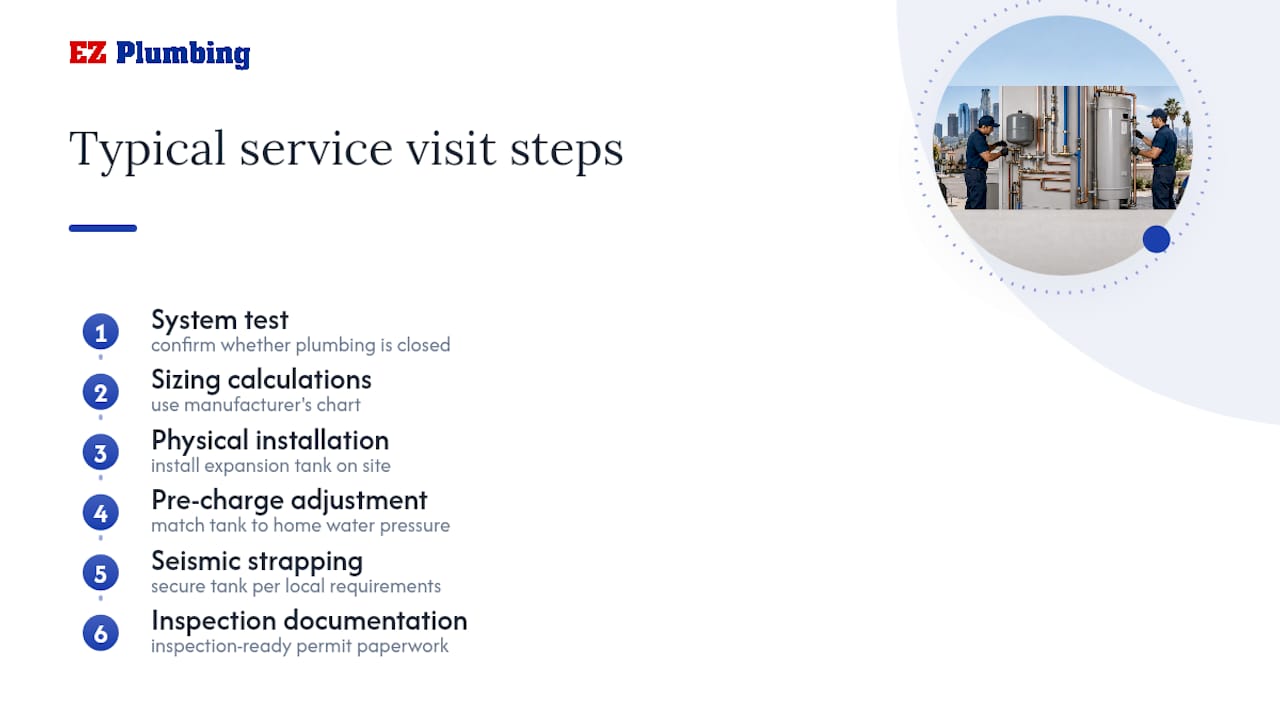
A typical service visit includes a system test to confirm whether your plumbing is closed, sizing calculations pulled from the manufacturer’s chart, the physical installation, pre-charge adjustment to match your home’s water pressure, seismic strapping, and inspection-ready documentation so your permit closes without a callback. Whether you’re replacing an aging tank-style heater or considering a switch to a tankless system, the same expansion control rules apply, and we build the installation around your specific setup rather than a generic template.
If you’re not sure whether your home needs an expansion tank, or you know it does and want it done right the first time, request an estimate through our water heater installation services page and we’ll get a licensed plumber out to confirm your system and quote the work.
Sources
The requirements covered here trace back to a handful of primary sources worth bookmarking if you’re pulling your own permit or working with an inspector directly.
- Water Heater Expansion Tank Requirements in California – LegalClarity
- How to Get a Water Heater Permit in Los Angeles, CA (2026 Guide)
- Water heater thermal expansion tanks — A.O. Smith manual
Treat the official code text as the final word, and check with your local building department for anything jurisdiction-specific that these sources don’t cover.
Recommended
Recent EZ Plumbing Jobs in Los Angeles
Real, recent work from our crews — updated automatically as jobs complete.