
Tankless Water Heater Problems and What to Do
You turn on the shower before work, wait for the familiar burner sound, and get cold water instead. The display may be flashing an error code, the teenager may be shouting from the second bathroom, and another fixture may make the temperature swing from hot to lukewarm. That frustrating scene is common enough, but the cause usually isn't mysterious.
In Los Angeles, I start with two amplifiers that generic troubleshooting guides often miss: mineral-heavy supply water and older gas-line sizing in pre-1990 homes. Either condition can turn a minor restriction into a shutdown, ignition failure, or inconsistent shower. The practical job is to identify the symptom, check only what you can safely reach, and recognize when the appliance needs a licensed technician.
Table of Contents
- The Morning Your Tankless Heater Stops Cooperating
- How a Tankless Water Heater Actually Works
- The Seven Tankless Water Heater Problems Homeowners Report Most
- Why Los Angeles Conditions Make These Problems Worse
- Safe DIY Troubleshooting Versus When to Call a Licensed Plumber
- Realistic Repair and Replacement Costs in the LA Market
- A Simple Maintenance Schedule That Prevents Most Problems
- Get It Fixed Fast with EZ Plumbing's 24/7 Service
The Morning Your Tankless Heater Stops Cooperating
The first question isn't “Which part failed?” It's “What changed?” If the unit worked yesterday and now produces no hot water, look at the display before touching anything. A tankless heater records the event that made it stop, and the code often points toward ignition, flame detection, water flow, or venting.
A homeowner can make a useful first pass without opening the cabinet. Check whether the unit has power, whether the gas and water shutoff valves are open, and whether the problem affects every hot-water fixture or only one faucet. One cold shower at a single fixture may involve a mixing valve or cartridge. No hot water anywhere points more strongly toward the heater, its fuel supply, or its flow detection.
Field rule: A reset can clear a temporary lockout. It can't repair a restricted heat exchanger, an undersized gas branch, or a failing sensor.
Older Los Angeles houses deserve extra suspicion. A modern tankless unit may be connected to a gas branch that was adequate for an older storage heater but can't deliver stable combustion during heavy demand. Mineral deposits create a second local headache, especially when the unit has gone too long without a proper flush. The heater may still ignite, but scale can reduce flow, distort temperature readings, and trigger protective shutdowns.
Start with the symptom, not the replacement part
If the burner clicks but never lights, record the code and listen for whether ignition repeats. If water begins hot and then turns cold, note whether another shower, washing machine, or gas appliance started at the same time. If the unit leaks, don't assume the water came from condensation. Trace it from the highest wet connection and keep water away from electrical components.
The safe sequence is simple: observe, verify accessible valves, follow the manufacturer's reset procedure once, and stop if the fault returns. Gas odor, visible scorching, standing water, damaged venting, or repeated ignition attempts belong to a licensed plumber or gas technician.
How a Tankless Water Heater Actually Works
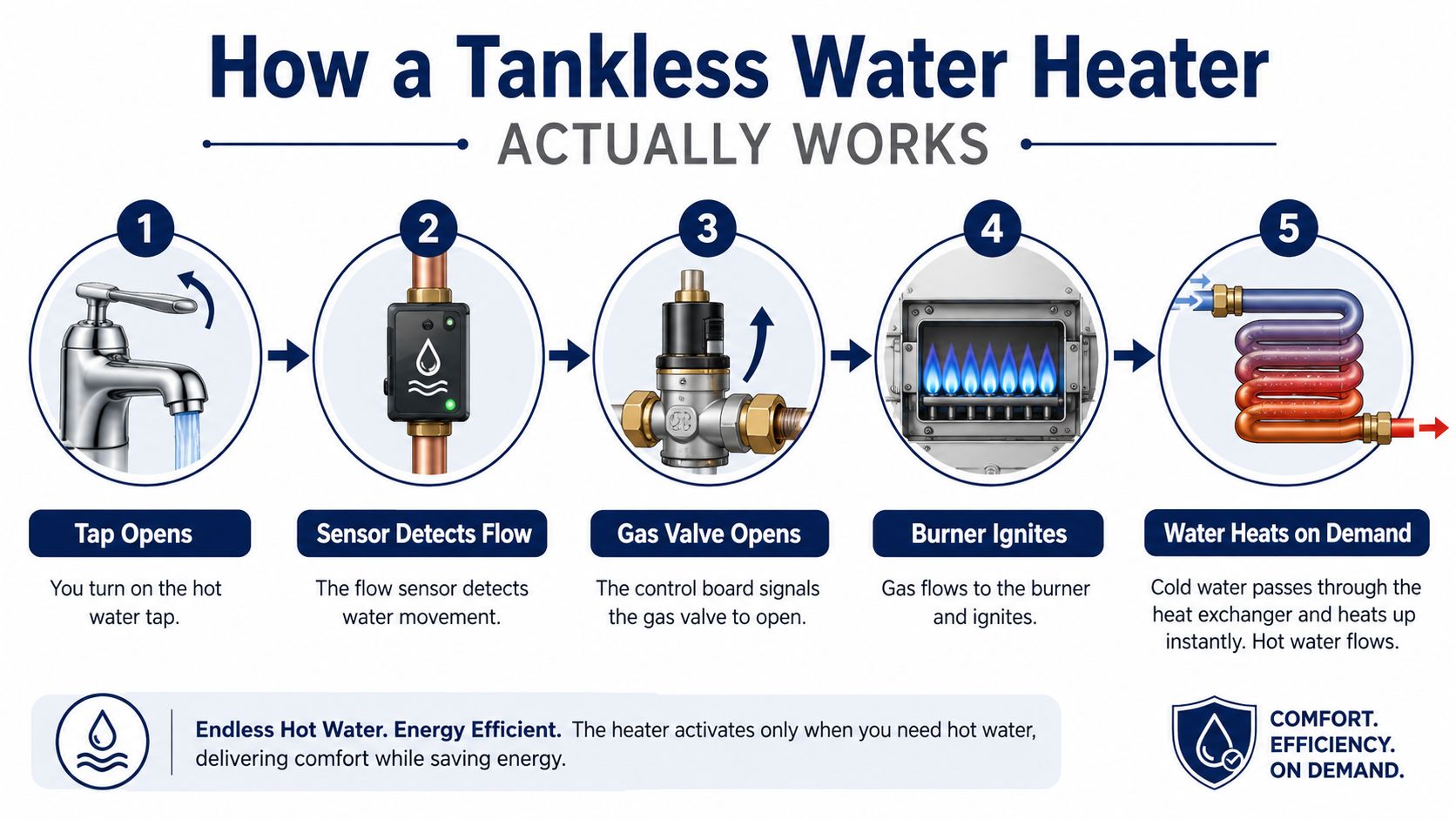
A tankless heater has no reserve of hot water waiting in a cylinder. When you open a tap, water moves through the inlet and a flow sensor detects that movement. The control board then signals the gas valve, the burner ignites, and water passes through a heat exchanger where the flame transfers heat into the flowing stream.
A thermistor measures temperature and helps the control board adjust flame height. That modulation is why the unit can respond to changing demand, but it also means several components must agree at the same time. The flow sensor must detect enough movement, the gas supply must remain stable, the igniter and flame rod must work, and the heat exchanger must pass water without excessive restriction.
Three limits control the experience
The first is activation flow. Many residential models need roughly 0.4 to 0.8 gallons per minute before they fire, according to service guidance on tankless error conditions from Aaron Services. A faucet with a partially closed valve, a clogged aerator, or a low-flow showerhead may fall below that threshold.
The second is minimum sustained flow. Even after ignition, flow must remain stable. If a user turns a fixture down too far, the heater can stop firing, producing the cold-water interruption homeowners often describe as cycling.
The third is temperature rise. The unit must raise incoming water to the selected temperature while moving a particular volume through the exchanger. Colder inlet water, multiple fixtures, scale buildup, and limited gas delivery all reduce the margin available for that temperature rise.
That operating pattern differs from a storage heater. A tank can provide some stored hot water even while its burner is off. A tankless heater responds immediately to every restriction, sensor error, and supply fluctuation. For a broader comparison of equipment categories, hot water system types Melbourne offers useful context on how tankless and storage arrangements differ.
The Seven Tankless Water Heater Problems Homeowners Report Most
Most tankless water heater problems become easier to diagnose when you separate the visible symptom from the component most likely causing it. Don't replace a control board just because the display shows a fault. Start with flow, water quality, combustion, and the unit's installation conditions.
No hot water at all
Symptom: Every hot fixture runs cold, and the unit doesn't complete its ignition sequence.
Likely causes: An interrupted gas supply, ignition failure, power problem, closed water valve, or flow sensor that isn't detecting movement. A clogged inlet filter can also prevent the appliance from seeing the flow it needs.
First action: Confirm power, check the accessible gas and water valves, note the display code, and follow the model-specific reset procedure. On models with an accessible filter, cleaning it may be reasonable if the manual permits it. Call a professional if the code returns or the unit repeatedly attempts ignition.
Fluctuating temperature
A dirty flame rod, a drifting thermistor, unstable flow, or scale inside the exchanger can make the water alternate between hot and cold. Start by checking whether another fixture is drawing hot water and whether the temperature setting changed. Repeated swings with steady demand usually justify professional diagnosis rather than repeated resets.
Low flow or lukewarm water
Scale, a clogged inlet filter, insufficient gas delivery, or a unit that can't meet simultaneous demand can all produce lukewarm water. Clean only an accessible filter and confirm valves are fully open. If the problem appears when another gas appliance runs, don't adjust gas fittings yourself. Have the technician verify supply pressure and line sizing.
Error codes on the display
Codes vary by manufacturer and model. Codes such as 11, 12, 29, and C7 may relate to ignition, flame sensing, condensate or venting, or other diagnostic conditions, but the exact meaning depends on the manual. Record the code, photograph the display, perform the manufacturer's stated reset once, and stop treating it as a generic code if it returns.
Water around the unit
Condensation can appear during operation, but a steady stream, a wet heat-exchanger area, or discharge from a relief line may indicate a water-side leak or pressure problem. Shut off the water supply if the leak is active, switch off power when safe, and don't remove panels to locate the source.
Hard-water scale
Scale insulates the heat exchanger and narrows its passages. A National Water Heater Authority explanation notes that even about one-eighth inch of scale can reduce flow capacity and provoke high-limit shutdowns, making scheduled descaling more useful than waiting for an error code (hard-water effects on water heaters). A homeowner can arrange service, but opening isolation valves and circulating descaler through the exchanger should follow the manufacturer's procedure or be handled by a qualified technician.
Ignition failure or repeated cycling
Carbon on the flame rod, a failing igniter, restricted combustion air, venting trouble, or inadequate gas supply can cause repeated ignition attempts. Keep clear of the burner compartment and gas connections. If the unit smells of gas, sparks visibly, or shows soot or scorching, leave the area and contact the gas utility or a licensed professional.
Why Los Angeles Conditions Make These Problems Worse
Los Angeles conditions don't create a separate category of heater, but they reduce the operating margin of a system that already depends on precise flow and combustion. Mineral buildup is the clearest example. A Pacific Northwest National Laboratory report cites testing in which tankless gas-heater efficiency fell from 80% to 72% over 1.6 years before the units failed from a clogged pressure sensor or another control-device problem and required deliming (PNNL technical report). That evidence connects neglected scale to both performance loss and eventual shutdown.
Older homes add a gas-side complication. In pre-1990 properties, the original branch piping may have been designed around older appliances and a different demand profile. A tankless installation that lacks adequate gas delivery can misfire or operate unstably. Lab testing found that reduced gas supply in an improper installation can cause misfiring, and it also raised concerns about negative-pressure valve models affecting other gas appliances on the same system (tankless system lab testing).
| LA Condition | Affected Tankless Part | Resulting Problem | Typical Neighborhoods |
|---|---|---|---|
| Mineral-heavy supply water | Heat exchanger, inlet filter, flow sensor | Low flow, lukewarm water, high-limit shutdowns | Older homes and hard-water pockets throughout the basin |
| Legacy gas branch sizing | Gas valve, burner, ignition controls | Misfiring, ignition faults, unstable heating | Pre-1990 Craftsman, Mid-Century, and remodeled housing stock |
| Restricted vent or combustion path | Air intake, exhaust, flame-sensing system | Cycling, lockouts, unsafe combustion | Indoor and exterior installations with neglected clearances |
| Simultaneous fixture demand | Flow sensor and modulation controls | Temperature swings or cold-water interruptions | Multi-bathroom homes, rentals, and busy family households |
The local lesson is diagnostic. If flow deteriorates gradually, suspect scale or filtration. If the heater fails when another gas appliance starts, suspect supply capacity. If the unit locks out with venting damage or combustion symptoms, treat it as a safety issue, not a maintenance reminder.
Safe DIY Troubleshooting Versus When to Call a Licensed Plumber
Homeowners can perform a narrow set of checks. They shouldn't open the cabinet, loosen gas fittings, disconnect venting, or circulate cleaning solution through an unfamiliar appliance without the correct isolation setup. The dividing line is risk, not confidence.
The safe homeowner checks
Confirm accessible valves. The gas shutoff and cold-water isolation valve should be fully open. Don't force a stuck valve or manipulate a gas connection.
Check power. Look at the dedicated switch or breaker. If it trips again, leave it off and arrange service rather than repeatedly resetting it.
Follow the manual's reset sequence. Record the error first. Random button pressing can erase useful diagnostic information without addressing the cause.
Clean the inlet filter if the model allows it. Shut off water as directed, remove the accessible filter carefully, rinse away debris, and reinstall it correctly. If the filter cap is seized or water begins leaking, stop.
A manufacturer-guided drain or service procedure can be useful, and this guide to draining a tankless water heater provides relevant background. It doesn't replace the installation manual or professional judgment.
Red flags that end DIY work
Call a licensed plumber or gas technician for gas odor, a leaking relief pipe, scorching, soot, visible sparking, standing water near gas or vent connections, damaged venting, repeated ignition failure, or a code that returns after the prescribed reset. Descaling with a circulation pump, replacing sensors, servicing a condensate neutralizer, checking combustion, and evaluating gas-line capacity require trained handling.
Print this checklist: valves open, power available, code recorded, one manufacturer-approved reset attempted, inlet filter checked only if accessible. If the fault returns or any red flag appears, stop and call.
Realistic Repair and Replacement Costs in the LA Market
The price of a tankless repair depends on access, diagnosis, brand, installation quality, and whether the technician finds a supply problem rather than a failed appliance component. Because the verified information for this guide doesn't provide Los Angeles price data, homeowners should request a written diagnosis and estimate instead of relying on unsupported online ranges.
A proper estimate should separate the immediate repair from required corrections. For example, replacing an igniter won't solve an undersized gas branch, and descaling won't correct a damaged vent or an exchanger that has begun leaking. Ask whether the quote includes testing, permits where required, disposal, parts, and a combustion or gas-supply evaluation.
Compare the decision, not just the part
| Repair Type | Typical Cost Range in LA | DIY Possible? | Repair or Replace? |
|---|---|---|---|
| Inlet-filter cleaning | Varies by access and service arrangement | Sometimes, if the manual permits | Repair or maintain |
| Descaling and heat-exchanger service | Obtain a written local estimate | Limited, model dependent | Usually repair |
| Igniter or flame-rod diagnosis | Obtain a written local estimate | No cabinet work for homeowners | Repair when the unit is otherwise sound |
| Flow-sensor diagnosis or replacement | Obtain a written local estimate | No | Repair after confirming the cause |
| Heat-exchanger replacement | Obtain a written local estimate | No | Compare with replacement after inspection |
| Full unit replacement | Obtain a written installation estimate | No | Consider age, condition, capacity, venting, and gas supply |
The 20-year effective useful life retained for commercial gas tankless heaters in a 2023 California Public Utilities Commission study is a planning benchmark, not a promise for every residential installation. The study also found that observed unit survival suggested a useful life “much higher” than 20 years, reinforcing the importance of installation quality and maintenance when comparing lifecycle decisions (CPUC EUL study).
A sound next step is a documented tankless water heater repair evaluation that distinguishes scale, flow, gas, venting, and component failures before recommending replacement.
A Simple Maintenance Schedule That Prevents Most Problems
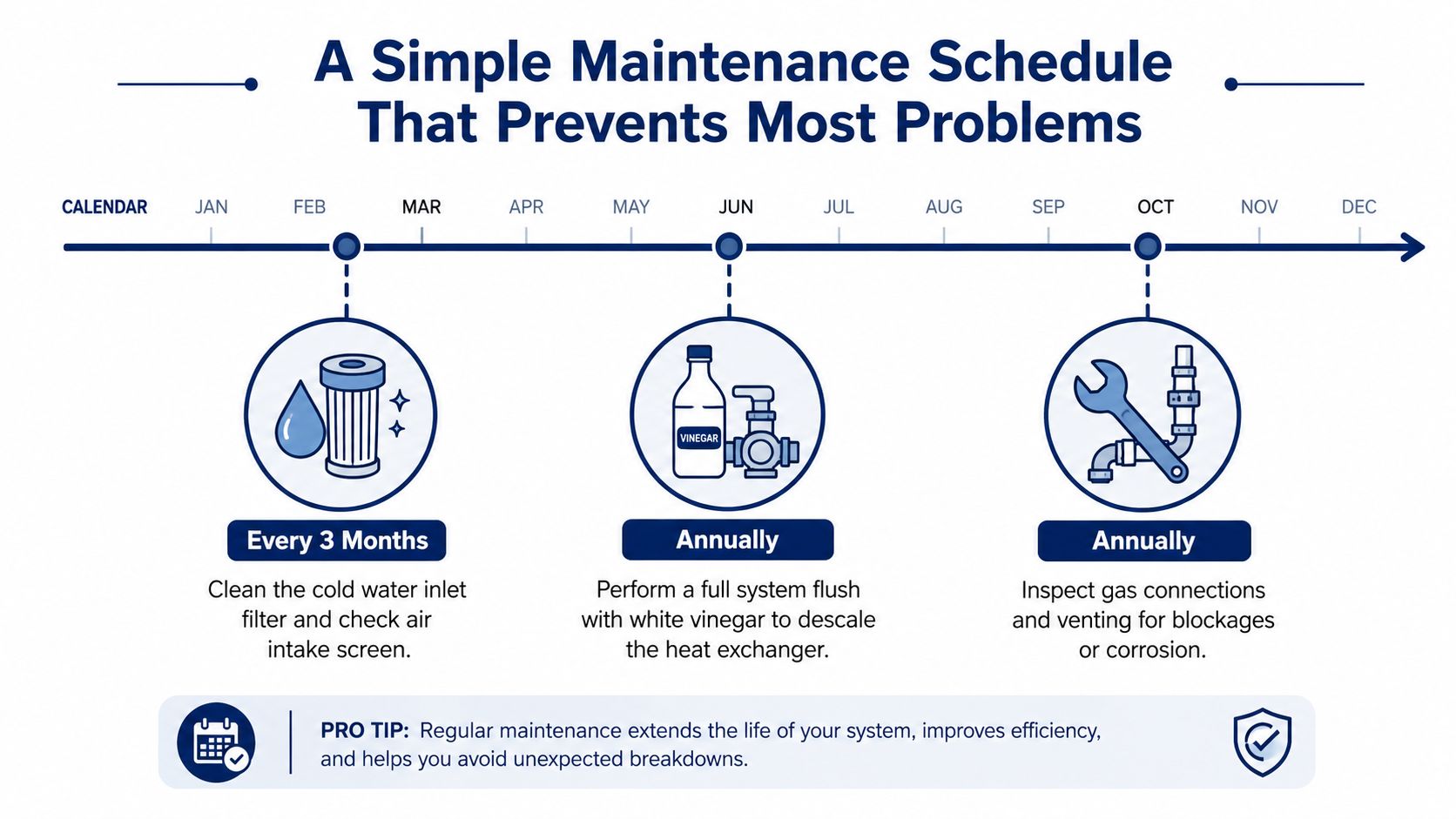
Maintenance works best when it follows the failure mechanism. A quick visual check can catch a leak, while filter cleaning protects flow. Descaling protects the exchanger, and professional combustion and venting checks address hazards a homeowner can't reliably assess by sight.
Small checks throughout the year
- Inspect the area regularly. Look for water beneath fittings, corrosion, soot, or a blocked vent termination. These signs can precede a shutdown or safety event.
- Review the display. Record recurring codes instead of clearing them repeatedly. A pattern gives the technician a better starting point.
- Rinse the accessible inlet filter. Debris at the filter restricts flow and can mimic a failed flow sensor.
- Keep air paths clear. Don't store chemicals, boxes, or combustible materials around the unit or its intake.
For the water side, follow the manufacturer's service interval and use the correct isolation valves. A professional tankless water heater cleaning service can handle a full flush when scale or service history makes the procedure uncertain.
The annual service decision
In hard-water areas, scheduled descaling is more dependable than waiting for low flow or a high-limit fault. The technician should inspect the exchanger, confirm stable ignition, review error history, examine venting, and evaluate gas delivery when symptoms point in that direction. A service record also helps property managers and homeowners decide whether a repair is sensible or whether installation deficiencies need correction.
Don't treat a tankless unit as maintenance-free. Its compact passages and active controls make small restrictions visible quickly, which is useful when the system receives attention before the first cold shower.
Get It Fixed Fast with EZ Plumbing's 24/7 Service
Persistent codes, recurring cold-water interruptions, leaks near the heat exchanger, damaged venting, and ignition failures need more than a reset. Gas odor requires immediate evacuation and contact with the gas utility. A licensed technician can then evaluate the appliance, combustion, gas supply, water flow, and venting as one system.
EZ Plumbing serves Los Angeles communities including Beverly Hills, Santa Monica, West Hollywood, Pasadena, Glendale, Burbank, and the San Fernando Valley. The company handles tankless repair, replacement, installation-related diagnosis, and descaling for homeowners, HOAs, landlords, and commercial properties, with emergency response and planned scheduling available.
Call (818) 908-2710 when the problem is persistent, recurring, or unsafe. Tell dispatch the unit brand, displayed code, symptom, and whether the home has older gas piping or a history of hard-water scale.
If your tankless heater is cycling, leaking, failing to ignite, or losing performance in Los Angeles water conditions, EZ Plumbing can diagnose the actual cause and recommend repair, descaling, gas-line correction, or replacement. Call (818) 908-2710 for 24/7 service and get the system checked before a minor restriction becomes a larger failure.