
Low Water Pressure in Your LA Apartment: What to Do Now
If low water pressure affects only one fixture in your unit, the fix is usually a clogged aerator or a partially closed valve. If every faucet and shower runs weak, the cause sits at the building or municipal level, and your landlord needs to know in writing today. Check LADWP’s pressure data for your address, document what you find, and give your landlord a reasonable window before escalating to LA County.
TL;DR:
- Most low water pressure issues in apartments are fixable by cleaning fixtures or adjusting valves, but building-wide problems require landlord inspection.
- Document pressure problems thoroughly with photos, videos, and pressure gauge readings, as this evidence is critical for legal or municipal complaints.
- Consistently low pressure above 30 psi at the outdoor spigot indicates a municipal or supply-side issue rather than a fixture or internal plumbing fault.
- If pressure remains low after cleaning fixtures and confirming valves are open, a licensed plumber should test risers and inspect for corrosion or leaks.
- Landlords are legally required to maintain proper water pressure under California habitability laws, and renters should escalate issues with formal requests and official reports if unresolved.
Table of Contents
- Two-Minute Checklist for Low Water Pressure in Your Apartment
- What Causes Low Water Pressure in LA Apartments?
- How Do You Troubleshoot Low Water Pressure Safely as a Renter?
- What Are Your Rights When Your Landlord Won’t Fix Low Water Pressure?
- When Should You Call a Licensed Plumber for Low Water Pressure?
- How to Contact LADWP and LA County About Water Pressure Issues
- Why Renters Shouldn’t Wait to Document This Problem
- Get a Licensed Plumber’s Diagnosis Before It Becomes Your Landlord’s Excuse
- Sources
Two-Minute Checklist for Low Water Pressure in Your Apartment
Before you call anyone, run this quick diagnostic. It takes less time than waiting on hold with your property manager.
- Isolate the problem. Turn on the kitchen faucet, then the bathroom sink, then the shower. If only one runs weak, it’s a fixture issue. If all of them do, it’s building-wide.
- Check the obvious culprits. Unscrew the aerator and showerhead and look for mineral buildup or debris. Confirm the angle-stop valve under the sink and the unit’s main shutoff are fully open.
- Scan for leaks. Look under sinks, near the water heater closet, and along ceiling stains that might explain a pressure drop elsewhere in the plumbing.
- Ask around. A quick text to a neighbor tells you fast whether this is your unit’s problem or the whole building’s.
- Document everything. Note the date, time, and which fixtures are affected. Photos and short videos matter more than memory once you’re writing a repair request.
Pro Tip: Keep a running note on your phone every time the pressure drops. A pattern (say, every evening at 7 PM) points to peak-demand strain on shared building plumbing, not a one-off fluke.
What Causes Low Water Pressure in LA Apartments?
Low water pressure in an apartment almost always traces back to one of four places: the fixture, the unit’s internal plumbing, the building’s shared systems, or the municipal supply. Knowing which one you’re dealing with saves you from wasting a repair request on something you could fix in five minutes, or from fighting a fixture-level problem that’s actually a building-wide failure.
At the fixture level, the most common issues are:
- A clogged aerator or showerhead full of mineral scale, especially common given LA’s hard water
- A worn cartridge inside an older single-handle faucet
- A partially closed angle-stop valve, sometimes bumped shut during a prior repair
Inside the unit, a kinked flexible supply line behind the washing machine or under a sink can starve a whole zone of the apartment. At the building level, the causes get more serious: a failing pressure-reducing valve, corroded galvanized risers common in pre-1980s LA buildings, or shared mains that can’t keep up when every unit runs water at once. In older multi-unit properties, vertical plumbing stacks and aging pipe material can create systemic pressure loss that no amount of aerator cleaning will solve, and a licensed plumber typically has to test pressure at the riser itself to isolate where the restriction lives.
Finally, some low-pressure events aren’t building problems at all. LADWP manages water-main work, temporary supply interruptions, and pressure regulation across the city, and typical residential water pressure runs about 30 to 80 psi depending on elevation and distance from the main. If your whole block is affected, the fix isn’t inside your unit at all.
How Do You Troubleshoot Low Water Pressure Safely as a Renter?
Here’s the order to work through, and where to stop before you risk your deposit or your lease.
- Confirm scope first. Run the single-fixture test from the checklist above. If it’s isolated, you’re clear to try a DIY fix. If it’s whole-unit, skip ahead to documentation and your landlord.
- Clean the aerator and showerhead. Unscrew each one, soak the screen in white vinegar for 30 minutes to dissolve scale, rinse, and reinstall. This alone resolves a large share of single-fixture complaints.
- Check valve positions. Under-sink angle stops and the unit’s main shutoff should turn freely and sit fully open. A valve that’s only three-quarters open can cut flow noticeably without looking obviously closed.
- Test with a pressure gauge. A $10 to $15 gauge threaded onto an outdoor spigot or laundry connection gives you a real number. Anything below 30 psi confirms a genuine supply problem rather than a perception issue.
- Know where your access ends. You cannot legally access a building’s main shutoff, shared pressure regulator, or riser plumbing in common areas. Tenants generally lack access to these systems, and attempting to force entry into a locked utility closet can violate your lease even with good intentions.
Pro Tip: If your gauge reads under 30 psi at an outdoor spigot but your neighbor’s unit tests fine, that’s strong evidence of an internal issue rather than a municipal one, exactly the kind of detail worth including in a written repair request.
Once you’ve cleaned fixtures, confirmed valve positions, and tested pressure, you’ve done everything a renter reasonably can. Anything beyond that, corroded risers, a failed regulator, hidden leaks, belongs to your landlord and, eventually, a licensed plumber.
What Are Your Rights When Your Landlord Won’t Fix Low Water Pressure?
California law is specific here. Civil Code Sections 1941.1 and 1941.3 require rental units to have properly working plumbing, including hot and cold running water under adequate pressure. This isn’t a courtesy your landlord extends, it’s a legal habitability standard.
Start with a written repair request, not a phone call or a text that can get lost in a thread. Include:
- The date and time you noticed the problem, plus every recurrence since
- Which fixtures are affected and whether neighbors report the same issue
- Photos or short videos showing weak flow
- A clear, dated request for repair within a reasonable timeframe
LA County treats water supply and inadequate flow as a habitability inspection category, and it can be marked a critical violation during an inspection. Urgent habitability issues generally warrant a faster response than cosmetic repairs, and LA County guidance recommends keeping every piece of correspondence. If management stays unresponsive, your escalation path runs through myLA311, a complaint to LA County Public Health, documented repair-and-deduct where legally applicable, or small claims court as a last resort.
When Should You Call a Licensed Plumber for Low Water Pressure?
Whole-unit pressure loss, a suspected regulator failure, or any hint of a hidden leak means it’s time to bring in a professional rather than keep troubleshooting solo. Here’s what typically separates a renter-fixable issue from one that needs a licensed plumber:
- Pressure stays low across every fixture even after cleaning aerators and confirming valves are open
- You suspect a pressure-reducing valve has failed at the building level
- There are signs of a hidden leak, water stains, unexplained bills, or damp drywall
- The building has older galvanized or early-era copper piping showing visible corrosion
A licensed plumber’s process usually starts with a pressure test at the riser and unit, sometimes followed by a camera inspection to check for scale, corrosion, or blockages deep in the line. Common fixes include hydro-jetting to clear mineral buildup, pressure regulator replacement, and, in heavily corroded systems, a full repipe when descaling only postpones the underlying problem.
Ez-plumbing holds a California C-36 license (#583868) and handles exactly this kind of diagnostic work across the greater LA area, including hydro-jetting and leak detection for multi-unit buildings with aging plumbing.
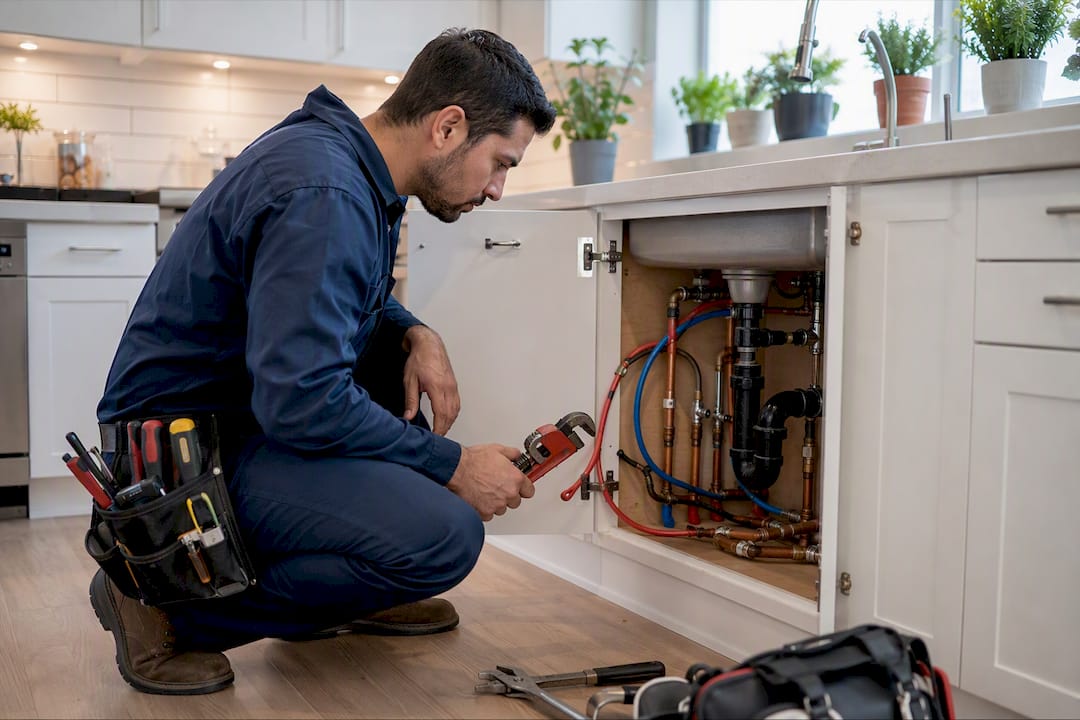
Pro Tip: Ask any plumber you hire for a written estimate and pressure-gauge readings before and after the fix. That documentation is often exactly what a landlord or housing inspector needs to determine responsibility for the repair.
How to Contact LADWP and LA County About Water Pressure Issues
For municipal supply questions, LADWP offers parcel-specific pressure data and a Service Advisory Request, which triggers a hydraulic analysis of your address to confirm expected flow rates and pressure. It’s the clearest way to prove a supply-side limitation rather than a building defect.
For habitability complaints, use myLA311 or file directly with LA County Public Health. Have this ready before you contact either agency:
- Your full address and unit number
- Dates and times pressure has been low
- Photos or video documentation
- Names of neighbors experiencing the same issue, if applicable
Why Renters Shouldn’t Wait to Document This Problem
Most advice on low water pressure treats it as a homeowner’s project: replace this part, adjust that valve, move on. That framework fails renters, because you don’t own the pipes, and half the fixes live behind locked utility doors you’re not allowed to touch. The advice that actually matters here isn’t plumbing advice. It’s documentation advice.
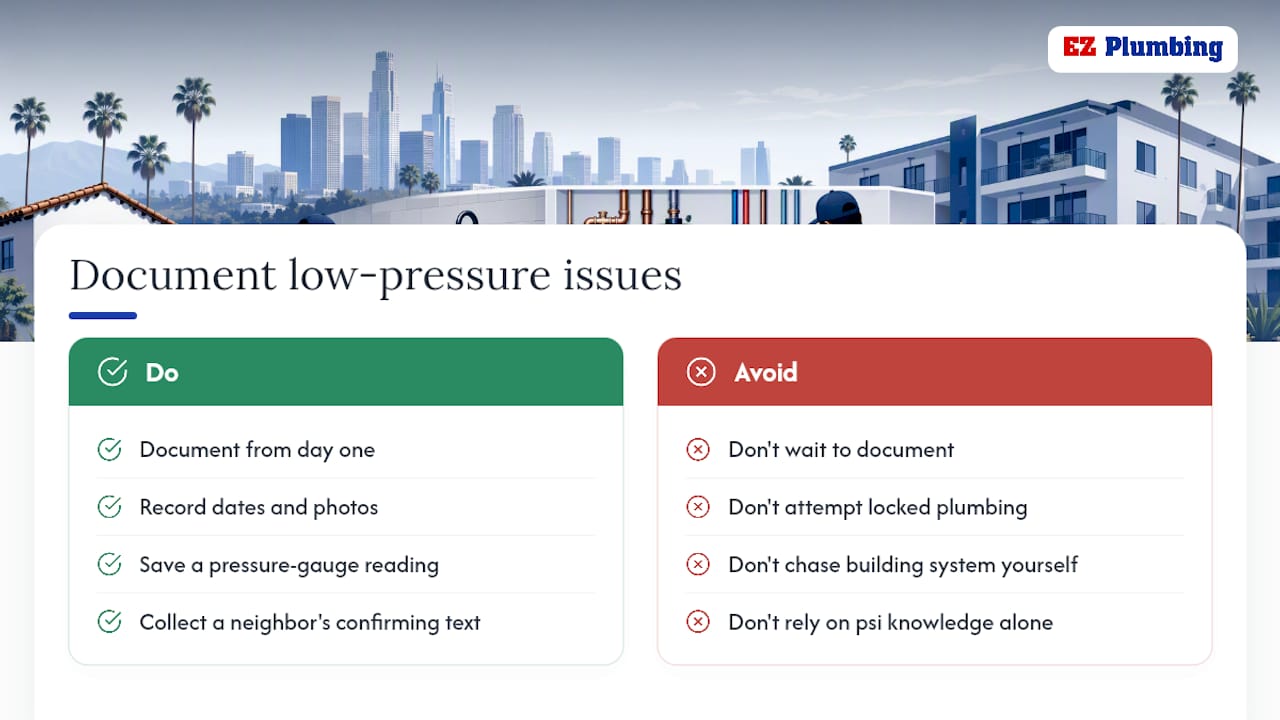
The renters who get fast repairs aren’t the ones who understand psi ranges the best. They’re the ones who wrote things down from day one: dates, photos, a pressure-gauge reading, a neighbor’s confirming text. That paper trail is what turns a vague complaint into a habitability case a landlord has to act on, and it’s what a housing inspector or small claims judge weighs when responsibility is disputed.
The one place conventional wisdom overcorrects is DIY enthusiasm. Cleaning an aerator is fine. Chasing a building-wide pressure problem past the point where you can legally access the plumbing wastes time and risks your lease. Know where your access ends, document past it, and let the professionals and the paperwork do the rest.
— EZ
Get a Licensed Plumber’s Diagnosis Before It Becomes Your Landlord’s Excuse
When aerator cleaning and valve checks don’t move the needle, you need someone who can test pressure at the riser, run a camera inspection, and put findings in writing your landlord can’t dispute. Ez-plumbing brings a California C-36 license, decades of experience with LA’s older multi-unit buildings, and the exact diagnostic tools this kind of case calls for: pressure gauges, camera inspections, and hydro-jetting equipment for scale-choked lines.
Whether the culprit turns out to be a corroded riser, a failed pressure regulator, or a water heater that’s part of the pressure equation, Ez-plumbing documents every finding with photos and a written estimate, the same kind of record LA County inspectors and small claims courts rely on. If your building’s water heater setup is part of the problem, our water heater installation guide walks through what a proper fix looks like. Call Ez-plumbing to schedule a diagnostic visit and get pressure readings on record before your next repair request.
This article is general information, not a substitute for advice from a qualified lawyer. Consult a qualified legal professional about your own circumstances before acting on anything here.
Sources
- Q: As a renter in California do I have the right to ask for hot water and pressure in my apt from the landlords?
- Rental Housing Habitability Inspection Guide | Los Angeles County Department of Public Health – Environmental Health
- Water Pressure – Los Angeles
- Why is my water pressure low? (The Spruce)
- Repairing Your Rental Unit – Consumer & Business (LA County)
Recommended
- Causes of Low Hot Water Pressure and How to Fix Them
- Sudden Drop in Water Pressure? a 2026 Diagnostic Guide
- What Causes Low Hot Water Pressure: Fixes for 2026
- Solve common plumbing problems: practical tips for LA homes
Recent EZ Plumbing Jobs in Los Angeles
Real, recent work from our crews — updated automatically as jobs complete.