
Slab Leak Detection Methods Homeowners Can Trust
Confirm the leak with your water meter, isolate hot versus cold lines, then bring in non-destructive detection (an acoustic sweep plus one confirmatory method) before anyone opens the concrete. That sequence protects your floors and your budget.
Start with these three checks tonight:
- Run the meter test: shut off every fixture and watch the low-flow indicator for 15 to 30 minutes.
- Verify irrigation and appliance connections are actually off, not just assumed off.
- Note whether the sound or dampness tracks to a hot-water zone or a cold-water zone.
If the meter still moves after ruling those out, stop testing on your own and call a licensed leak-detection specialist.
Key Takeaways
Confirming a slab leak with the water meter, isolating hot from cold, and pairing two non-destructive detection methods before any cutting is the single most reliable way to protect your floors and your budget.
| Point | Details |
|---|---|
| Start with the meter test | Shut off every fixture and watch the low-flow indicator for 15 to 30 minutes. |
| Isolate hot versus cold | Cutting the search area in half narrows which line is failing before calling a pro. |
| Never trust one method alone | Acoustic, thermal, and tracer gas each cover a different blind spot. |
| Detection controls the repair cost | Restoration of flooring, not the pipe fix, usually dominates the total bill. |
| Call Ez-plumbing for confirm-first service | Licensed under C-36 #583868, using meter tests, acoustic sweeps, and GPR scans before any cut. |
Table of Contents
- Warning Signs That Point to a Slab Leak
- Quick DIY Checks You Can Run Before Calling a Pro
- Professional Non-Destructive Detection Methods
- How Pros Go From Suspect Area to a Marked Cut Point
- Repair Options and What Drives the Decision
- Safety and Pre-Cut Checks That Come Before Any Slab Work
- When to Stop DIY and Call a Licensed Specialist
- How EZ Plumbing Handles Slab Leak Detection
- Frequently Asked Questions
- Sources
Warning Signs That Point to a Slab Leak
A significant, unexplained jump in the water bill with no change in usage is one of the clearest red flags a homeowner will see before anything else shows up. Watch for warm or damp patches on the flooring, the sound of running water when every fixture is off, a sudden drop in pressure, and cracks in flooring or drywall that appear without an obvious cause.
- Unexplained spike in the water bill
- Warm or unexplained damp spots on the floor
- Audible running water with everything shut off
- Low water pressure at multiple fixtures
- New cracks in flooring, baseboards, or nearby walls
- Musty odor or visible mold near baseboards
Soft flooring, standing water, or a bill that has doubled mean you act now, not next weekend. Before you assume the worst, rule out a running toilet, a leaking irrigation valve, or a water heater weep. Those are common, cheap fixes that mimic slab leak symptoms.
Quick DIY Checks You Can Run Before Calling a Pro
These steps confirm whether you have a hidden leak and help narrow down which line is failing, all without touching a single tool beyond a flashlight and a notepad.
- Run the water meter test. Shut off every fixture, appliance, and irrigation zone, then watch the meter’s low-flow dial for 15 to 30 minutes. Any movement means water is escaping somewhere in the system.
- Rule out the usual suspects. Check toilets for a silent flapper leak, inspect the water heater for a weeping tank, and confirm condensate lines from your HVAC aren’t pooling nearby.
- Isolate hot versus cold at the water heater. Shut off the cold supply into the heater and watch the meter again; then reverse it. This single step cuts your search area roughly in half.
- Try a basic pressure check. If pressure drops noticeably on one line but not the other, that narrows the leak to a specific pressurized supply run rather than a drain issue.
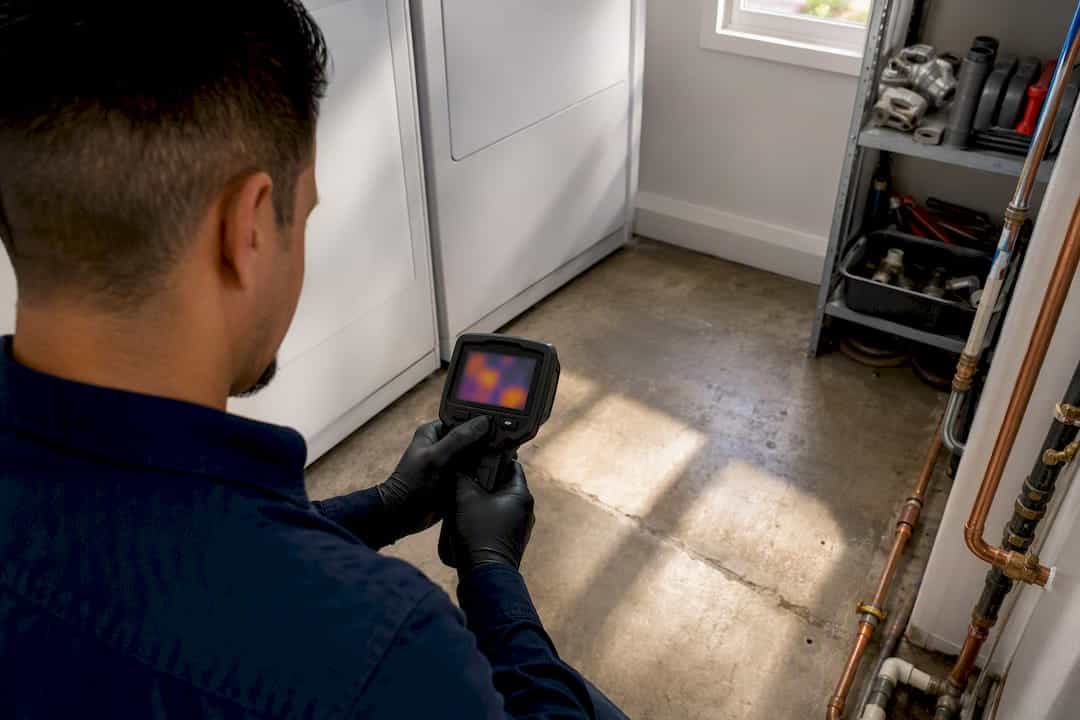
A consumer moisture meter or an infrared camera from a hardware store can support these checks, but both have real limits. Thin concrete slabs, thick carpet, and ambient temperature swings all degrade their readings.
Pro Tip: Isolate your irrigation system first. Sprinkler valves are a leading cause of false slab-leak alarms, and shutting the irrigation main off for 30 minutes can eliminate the mystery entirely.
Professional Non-Destructive Detection Methods
Once your own checks confirm something is wrong, professional technicians use several non-invasive detection methods, each suited to a different type of leak.
**Acoustic listening and correlation is the workhorse for pressurized supply lines. A leak under pressure creates a distinct hiss or rush that specialized microphones pick up through the slab. Correlation software can pinpoint the source to within roughly 6 to 24 inches under good conditions.
Thermal imaging works well for hot-water leaks because escaping hot water changes the slab’s surface temperature in a visible pattern. It’s far less reliable on cold-side leaks, and thick carpet or padding can mask the signature entirely.
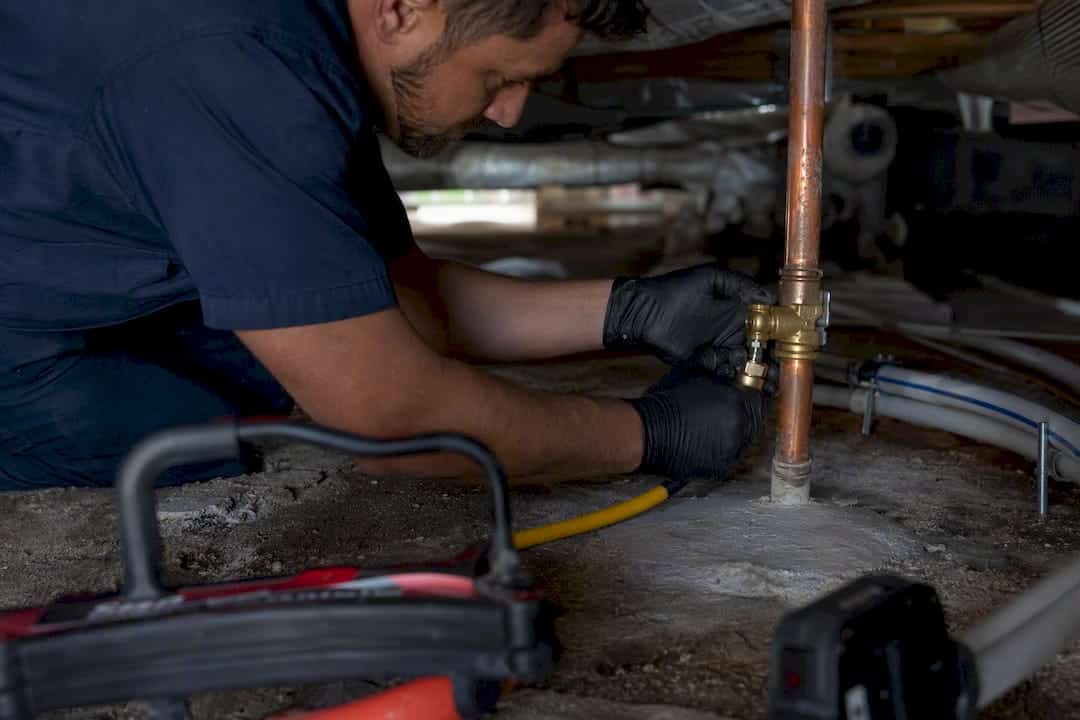
Hydrogen molecules escape through pinhole openings and surface where a sensitive detector can find them, which makes this method the go-to for tiny or unusually quiet leaks that acoustic tools miss.
Technicians also rely on electronic line tracing to map the exact pipe route, pressure isolation and hydrostatic testing to confirm a supply leak versus a drain problem, and CCTV camera inspection when the issue sits in a sewer or drain line rather than a pressurized pipe.
| Method | Best for | Limitation |
|---|---|---|
| Acoustic listening | Pressurized supply leaks | Degraded by thick carpet, ambient noise |
| Thermal imaging | Hot-water line leaks | Weak on cold lines and insulated floors |
| Tracer gas | Tiny, quiet, or plastic-pipe leaks | Requires access points to inject gas |
| Pressure testing | Confirming supply vs. drain issue | Doesn’t pinpoint exact location alone |
| Line tracing | Mapping the exact pipe route | Needs a sonde or trackable fitting |
According to Contractor magazine’s overview of professional detection practice, the reliable workflow combines a meter test, isolation, pressure testing, and a pinpointing tool, confirmed with a second method before anyone marks a cut.
Pro Tip: A single detection method can produce a false positive. Reputable technicians confirm the same suspect area with two different methods, such as acoustic plus tracer gas, before they ever mark the floor for cutting.
How Pros Go From Suspect Area to a Marked Cut Point
The workflow that keeps demolition to a minimum follows a specific order, and skipping steps is how homeowners end up with an oversized hole and a bill to match.
- Confirm the leak exists using the water meter test.
- Isolate hot versus cold and narrow the search to a specific branch line.
- Pressure-test the isolated run to verify it’s the failing section.
- Run an acoustic sweep, thermal scan, or line trace to identify a suspect zone.
- Confirm that zone with a second method, often tracer gas.
- Mark the precise spot only after two methods agree.
Detection accuracy is what separates a one-square-foot repair from a torn-up living room. As one industry resource on slab leak repair puts it, crews that pinpoint the leak accurately can open a single small access point instead of demolishing large sections of finished flooring.
Before the first cut, technicians also map the surrounding pipe route so the opening avoids other utilities, load-bearing elements, and structural steel.
Repair Options and What Drives the Decision
Detection tells you where the leak is; the repair method depends on pipe condition, location, and what it costs to restore the finished floor afterward.
- Spot repair: A small, targeted cut to fix one isolated pinhole. Fast and less expensive, but only sensible when the rest of the pipe is in good shape.
- Trenchless epoxy lining: Coats the interior of the existing pipe without major excavation, useful for accessible runs with localized corrosion.
- Reroute or abandon the slab line: Runs new pipe through walls or the attic instead of under the foundation, avoiding future slab cuts entirely.
- Tunneling or under-slab access: Digs beneath the foundation from the exterior, sometimes chosen to avoid disturbing finished interior flooring.
- Full repipe: Replaces the home’s plumbing system when corrosion has caused, or is likely to cause, multiple leaks over time.
Pipe material and age matter more than most homeowners expect. Galvanized steel and certain older copper installations corrode from the inside out, and one confirmed leak often signals more are coming, which tips the decision toward rerouting or a full repipe rather than a series of spot repairs. As one guide on slab leak repair costs notes, the concrete and floor restoration typically dominates the total bill, not the pipe fix itself, which is exactly why accurate detection matters so much.
| Factor | Why it matters |
|---|---|
| Pipe material and age | Corroded galvanized or old copper often means repeat leaks |
| Leak location | Harder-to-reach spots push cost toward tunneling or rerouting |
| Finish restoration cost | Tile, hardwood, and stone floors raise total project cost |
| Local permit requirements | Structural or plumbing changes may need inspection sign-off |
Safety and Pre-Cut Checks That Come Before Any Slab Work
Before a single core bit touches concrete, a proper safety pass has to happen, because cutting blind into a post-tension slab can be dangerous.
- Scan the target zone with ground-penetrating radar or a rebar/tendon locator.
- Confirm the exact utility and pipe route rather than trusting as-built drawings alone.
- Check whether the slab is load-bearing and whether structural review is needed.
- Verify local permit requirements before any plumbing or structural change begins.
Pro Tip: Post-tension slabs store real force in steel cables inside the concrete. Cutting into one without scanning first isn’t just a repair mistake, it’s a genuine safety hazard, so leave coring and jackhammering to a licensed crew with proper shoring and utility locates. Homeowners dealing with older or shifting foundations may also want to review signs of foundation subsidence that can complicate detection and repair planning.
When to Stop DIY and Call a Licensed Specialist
Call a pro immediately if you see structural cracking, a large and sudden water loss, or if your basic checks leave the source unclear. Suspected post-tension construction or a sewer-line issue also belongs in professional hands from the start.
Before hiring anyone, ask:
- What detection methods will you use, and will you confirm with a second method before cutting?
- Will you scan for tendons, rebar, or conduit before any slab penetration?
- Can you isolate hot versus cold lines during diagnosis?
- Will you provide a written detection report?
- What permit and restoration provisions are included in the quote?
- Get at least one written quote that itemizes detection separately from repair.
- Confirm the company’s license and insurance before scheduling work.
- Ask for the detection method and confirmation method in writing, not just verbally.
Walk away from any quote that skips detection entirely, pushes for a large exploratory opening without confirmatory testing, or can’t produce proof of licensing.
Why Experienced Crews Never Rely on One Detection Method
You can’t fix what you can’t find. A technician who combines acoustic listening, thermal imaging, and tracer gas isn’t being cautious for its own sake. Each method covers a blind spot the others miss, and stacking them is what turns a guess into a marked, confirmed cut point.
Pro Tip: Insist on two-method confirmation and a traced pipe route before anyone agrees on where to cut. That single request is the difference between a repair and a renovation.
A Note From EZ Plumbing on Getting This Right
We approach every slab leak the same way: confirm first, cut last. Our technicians hold a C-36 License (#583868) and follow this detection-first sequence on every job across the greater Los Angeles area, because minimizing floor damage starts long before any concrete comes up.
How EZ Plumbing Handles Slab Leak Detection
Ez-plumbing runs the full confirm-before-cut sequence on every visit: a water meter test, hot versus cold isolation, an acoustic sweep, and a GPR scan when the slab is post-tensioned, all documented in a written detection report before any cutting begins.

Where other outfits might jump straight to jackhammering a wide section of your floor, our licensed technicians treat detection as the job, not a formality before the job. That approach means smaller openings, less restoration, and a lower total bill because you’re not paying to re-tile a room that never needed to be opened. Our team is fully licensed and insured under C-36 License #583868 and works within Los Angeles municipal code on every structural or plumbing change. If you’re seeing warning signs of a slab leak or want a professional leak detection visit scheduled, call Ez-plumbing or book online and we’ll walk you through exactly what the first visit includes before a technician ever arrives.
Frequently Asked Questions
How long can a slab leak go undetected?
A small pinhole leak can run for months before symptoms like a high water bill or damp flooring become obvious, especially on cold-water lines where thermal imaging can’t help spot it early.
What’s the most accurate slab leak detection method?
No single method wins every time. Acoustic listening handles most pressurized leaks, thermal imaging excels on hot lines, and tracer gas catches the tiny or quiet leaks the others miss, which is why professionals combine them.
Can I find a slab leak myself without professional equipment?
You can confirm one exists with a water meter test and narrow it down with hot versus cold isolation, but pinpointing the exact spot for cutting requires acoustic, thermal, or tracer-gas equipment a licensed technician provides.
Does homeowners insurance cover slab leak detection and repair?
Coverage varies significantly by policy and insurer, so check your specific policy’s language on water damage and pipe failure rather than assuming either way.
Why do plumbers scan the slab before cutting?
Post-tension slabs contain steel cables under real tension, and cutting one without a GPR or tendon scan first risks a serious structural and safety failure.
Sources
- Pinpoint the slab leak before you break the floor — Contractor
- Plumbers slab leak repair: Find the leak before you break the floor — LeakTronics (blog)