
Bathroom Faucet Types: A Complete Buyer’s Guide
Bathroom faucets differ across five dimensions: mounting configuration, handle and control style, valve construction, spout profile, and finish material. Getting any one of these wrong can mean a return trip to the hardware store or an incompatible rough-in. For a tight powder room, a single-hole or compact centerset faucet is the practical default. Standard vanities in family bathrooms typically accept a centerset or widespread model. Vessel sinks and above-counter bowls need a tall vessel faucet or wall-mounted unit, and high-traffic bathrooms benefit from touchless sensor operation. Before you shop, run through these three checks:
- Count your sink holes. Most sinks have one, three, or four pre-drilled holes. Your faucet must match, or you need a deck plate to cover extras.
- Measure the spread. The center-to-center distance between outer holes determines whether centerset or widespread fits.
- Check spout reach and clearance. The spout must deliver water over the drain without hitting the backsplash or splashing out of a shallow bowl.
Key Takeaways
Mounting compatibility, specifically hole count and spread, is the single most important factor when choosing a bathroom faucet, because it determines which faucet types physically fit your sink before any other preference matters.
| Point | Details |
|---|---|
| Count holes before shopping | Verify hole count and spread (4" for centerset, 6–16" for widespread) before selecting any faucet. |
| Match spout height to sink type | Vessel sinks need faucets 10–14" tall; gooseneck spouts over shallow basins cause splash. |
| Prefer ceramic-disc valves | Ceramic-disc valves last 20+ years with minimal maintenance, outperforming compression and ball types. |
| Choose finish for your environment | Brushed nickel hides water spots in humid baths; chrome and polished finishes show deposits faster. |
| Call a pro for in-wall or complex work | Wall-mounted faucets, supply-line rerouting, and new rough-ins require a licensed plumber. Ez-plumbing serves the greater Los Angeles area with C-36 licensed, warranty-backed installation. |
Table of Contents
- What are the main types of bathroom faucets by mounting style?
- How does handle style affect usability and accessibility?
- Which valve type gives you the best long-term durability?
- What spout style and height should you choose for your sink?
- How do finish and base material affect durability and maintenance?
- Are special features like touchless sensors and WaterSense worth it?
- How do you choose the right faucet for your bathroom?
- How do you maintain a bathroom faucet and fix common problems?
- When does faucet installation require a licensed plumber?
- What most homeowners get wrong when picking a faucet
- Ez-plumbing handles faucet installation and valve replacement in Los Angeles
- Sources
What are the main types of bathroom faucets by mounting style?
Mounting style is the first decision, and it’s non-negotiable once your sink is set. Wayfair’s buying guide identifies five common mounting types for bathroom sinks: single-hole, centerset, widespread, vessel, and wall-mounted. Each one determines how many holes your sink needs and whether a new rough-in valve is required.
Single-hole faucets use one mounting hole for both the spout and handle, making them the cleanest option for compact sinks. A deck plate (also called an escutcheon) can cover a three-hole sink if you want a single-hole faucet there. Centerset models combine the spout and handles on a single base plate spanning 4 inches, so they fit either a one-hole or three-hole sink without modification. Widespread faucets have separate spout and handle bodies, requiring three holes spaced 6–16 inches apart. They give a more open, upscale look and allow more flexibility in handle placement.
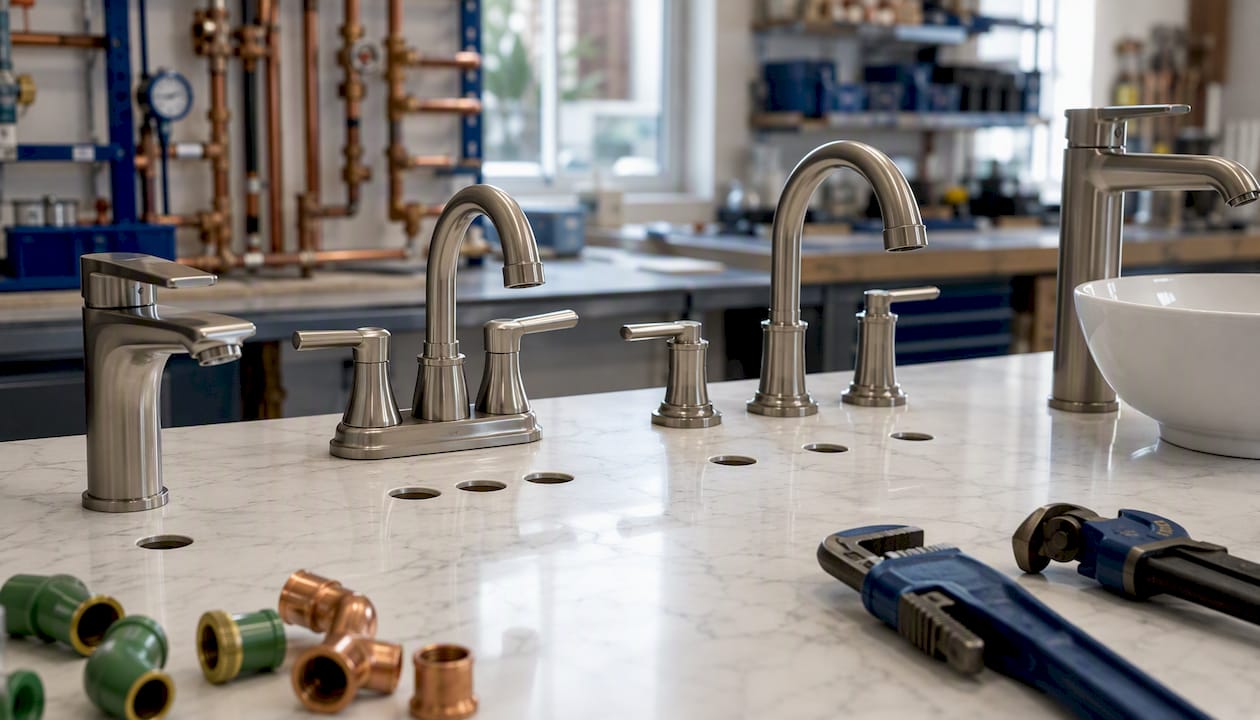
Vessel faucets are taller, typically 10–14 inches, to clear the rim of an above-counter bowl. Using a standard centerset faucet with a vessel sink almost always results in water hitting the rim rather than the basin. Wall-mounted faucets attach to the wall above the sink, leaving the deck completely clear. The trade-off is significant: the supply lines must run inside the wall, which usually requires opening the wall cavity and setting a rough-in valve at the correct height before tile or drywall goes up.
Pro Tip: If you’re retrofitting a wall-mounted faucet into an existing bathroom, budget for wall work. The rough-in valve position is permanent once the wall is closed, so getting the height right the first time matters. A licensed plumber should set that valve.
How does handle style affect usability and accessibility?
Handle configuration controls how you mix hot and cold water and how much effort the faucet requires. The choice has real consequences for families with young children, older adults, or anyone with limited hand strength.
Single-handle faucets use one lever or joystick to control both flow and temperature. You push up for more water and rotate left or right for temperature. They’re fast to operate and easy to install, which is why they dominate family bathrooms. Two-handle faucets have separate hot and cold controls, giving more precise temperature adjustment. They suit widespread configurations and traditional or transitional bathroom styles.
Within those two categories, handle shape matters:
- Lever handles are the most accessible option. They require minimal grip and can be operated with a closed fist or forearm, which is why they appear in ADA-compliant designs.
- Cross handles are traditional and visually distinctive but demand more wrist rotation, which can be uncomfortable for people with arthritis.
- Knob handles require a gripping and turning motion, the least accessible of the common styles.
- Blade and joystick handles are modern, low-profile, and generally easy to operate with one hand.
Ceramic-disc valves pair especially well with lever handles for users with limited grip. The smooth quarter-turn operation of a disc valve requires less force than a compression faucet’s multi-turn mechanism, making the combination a practical choice for accessible bathrooms. The Spruce notes this as a specific advantage for people with limited dexterity.
One practical note on spare holes: if your sink has three holes and you choose a single-handle faucet with a deck plate, the covered holes can sometimes be repurposed for a soap dispenser or a side sprayer. Check the sink manufacturer’s specs before drilling.
Which valve type gives you the best long-term durability?
The valve is the working heart of any faucet. It controls water flow and temperature, and its construction determines how often you’ll need repairs. The Spruce recommends disc and cartridge valves for fewer repairs and smoother operation, while noting that ball and compression valves have more common failure modes.
| Valve Type | How It Works | Typical Lifespan | Common Failure | DIY Repair? |
|---|---|---|---|---|
| Ceramic disc | Two ceramic discs rotate to control flow | 20+ years | Cracked disc (rare) | Moderate |
| Cartridge | Sliding cartridge controls hot/cold mix | 10–20 years | Worn cartridge | Easy |
| Ball | Slotted ball rotates over inlet ports | 8–15 years | O-ring or spring wear | Moderate |
| Compression | Rubber washer compresses against seat | 5–10 years | Washer wear, leaks | Easy |
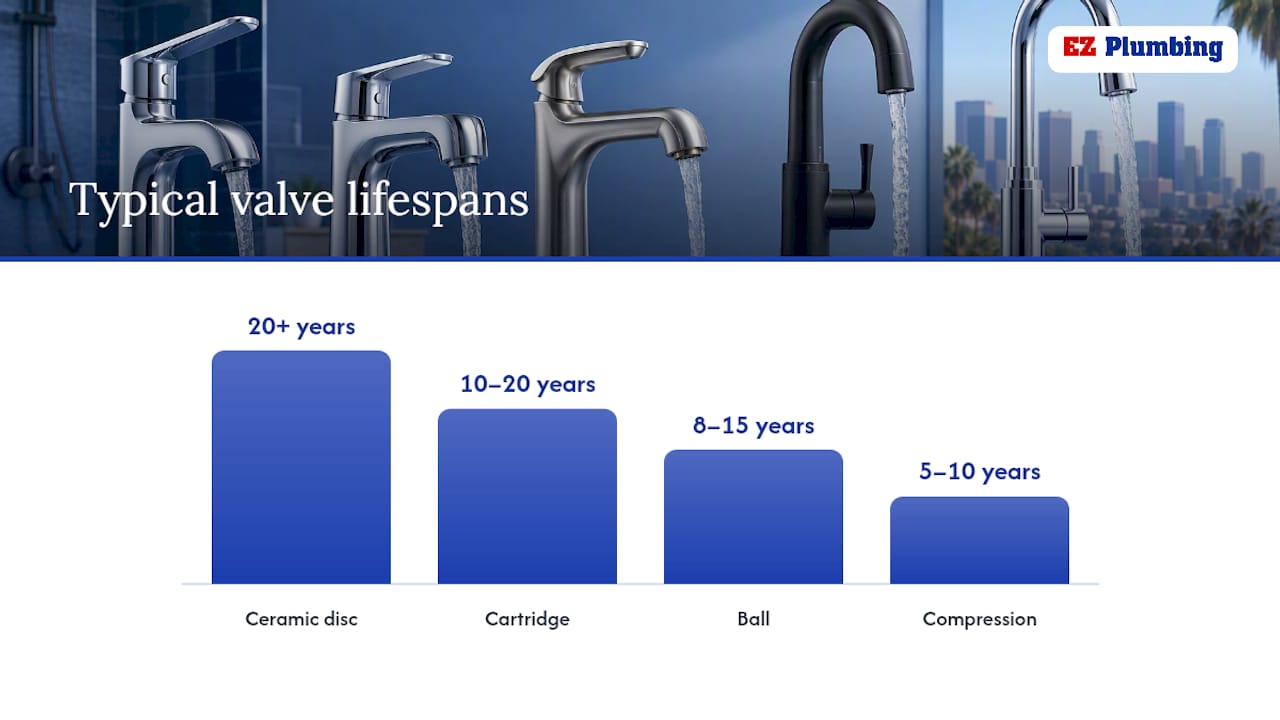
Ceramic disc valves use two precision-ground ceramic discs that rotate against each other to open and close the water path. They’re the most durable option and require almost no maintenance under normal use. When they do fail, the repair typically involves replacing the ceramic cartridge assembly, which can cost more than a cartridge replacement for other valve types.
Cartridge valves are the most common in mid-range faucets. A plastic or brass cartridge slides up and down (or rotates) to mix hot and cold water. Replacement cartridges are widely available and straightforward to swap out, making this the easiest valve to service yourself.
Ball valves use a rotating ball with a slot that aligns with the inlet ports. They’re found in many single-handle faucets and are reliable, but the O-rings, springs, and seats that support the ball wear over time, especially with heavy use or mineral-rich water.
Compression valves are the oldest design, found in older homes and budget faucets. A rubber washer compresses against a brass seat to stop flow. They drip when the washer wears out, which happens regularly. They’re cheap to fix but require more frequent attention.
Pro Tip: For any bathroom where low maintenance is the priority, specify a ceramic-disc valve. The higher upfront cost pays back in fewer service calls. If you’re replacing a faucet in an older home with corroded supply lines, have a plumber inspect the valve and supply connections at the same time.
- Cartridge faucets are the best balance of repairability and cost for most homeowners.
- Compression faucets are worth replacing outright rather than repeatedly repairing.
- Ball valves in hard-water areas benefit from annual inspection of O-rings and springs.
What spout style and height should you choose for your sink?
Spout geometry determines where water lands, how much splash you get, and whether the faucet physically fits your sink. Getting the reach and height wrong is one of the most common reasons faucets get returned.
| Spout Style | Height Range | Best Sink Type | Watch Out For |
|---|---|---|---|
| Low/straight | 3–5" | Standard undermount or drop-in | Tight clearance for hand washing |
| Gooseneck/swan neck | 8–12" | Deep undermount, vessel | Splash in shallow sinks |
| Vessel/tall | 10–14" | Above-counter vessel bowls | Incompatible with standard sinks |
| Waterfall/open | 4–8" | Wide, shallow basins | Limescale buildup in hard water |
Gooseneck and swan-neck spouts are the most popular in modern bathrooms. The tall arc gives plenty of clearance for hand washing and looks clean over a deep undermount basin. The risk is splash: a high-arc spout over a shallow sink sends water everywhere.
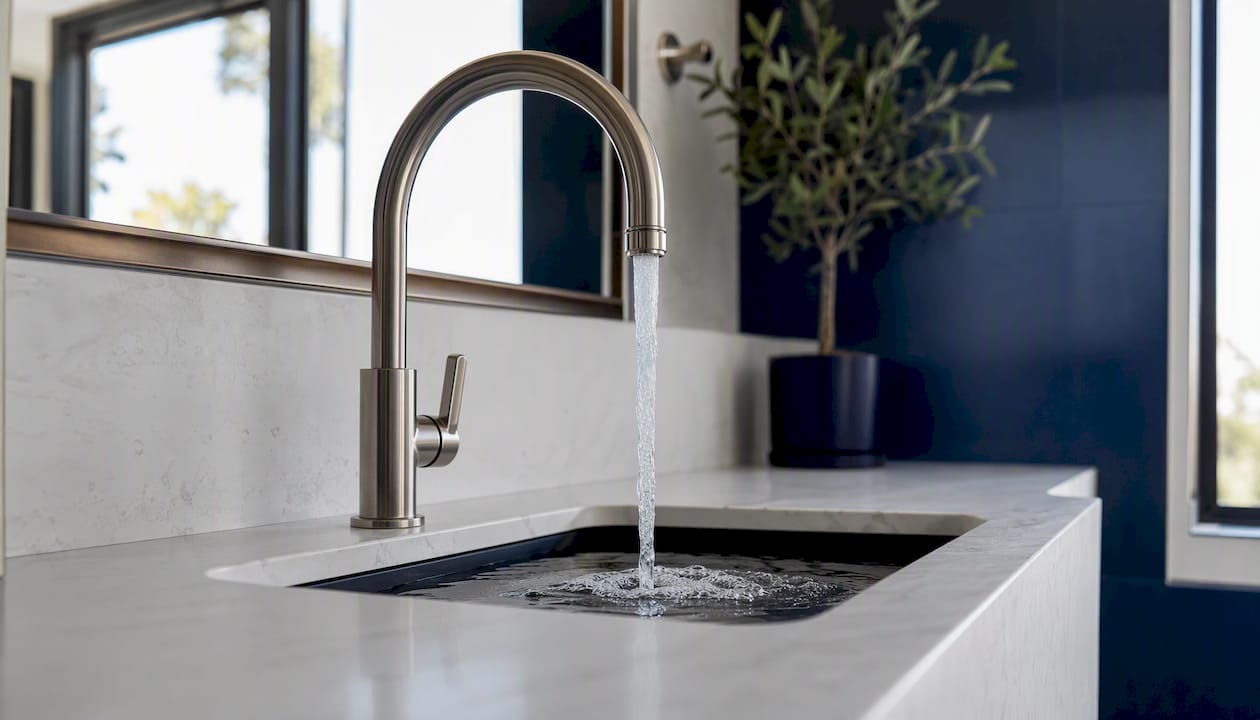
Low and straight spouts suit compact powder rooms where counter space is tight and the sink bowl is deep enough to contain the flow. They’re also the default for traditional two-handle widespread faucets.
Waterfall and open-spout designs deliver water in a wide, flat sheet rather than a stream. Better Homes & Gardens describes these as primarily aesthetic choices and flags that the open channel collects more limescale in hard-water areas compared with enclosed spouts. If your water is hard, plan for more frequent cleaning or choose a closed-spout design instead.
For vessel sinks specifically, the spout height calculation is straightforward: measure from the deck to the top of the vessel rim, then add at least 4–6 inches for comfortable hand clearance. A faucet that clears the rim by less than 3 inches makes hand washing awkward.
- Spout reach should extend far enough to deliver water over the drain, not the rim.
- A reach of 4–6 inches from the faucet body suits most standard sinks.
- Pull-out or pull-down spouts are rare in bathroom faucets but appear in some utility-style vanity designs.
How do finish and base material affect durability and maintenance?
Finish is the most visible choice you’ll make, and it’s also the one most affected by your bathroom’s humidity level and water chemistry. Choosing the wrong finish for a high-humidity, hard-water bathroom means constant cleaning and early wear.
- Chrome is the most durable plated finish and the easiest to clean, but it shows water spots and fingerprints immediately. It suits dry, low-traffic bathrooms or anyone willing to wipe down fixtures regularly.
- Brushed nickel hides water spots and fingerprints better than polished chrome, according to Wayfair’s buying guide, and it’s the most forgiving finish for everyday family bathrooms.
- Oil-rubbed bronze has a dark, warm tone that works well in traditional and transitional designs. The living finish changes slightly over time, which some homeowners appreciate and others find inconsistent.
- Matte black is popular in modern and industrial bathrooms. It hides fingerprints well but can show mineral deposits in hard-water areas, requiring more frequent wiping.
- Polished brass and antique brass are making a comeback in transitional and maximalist designs. Quality brass faucets use a solid brass body, which resists corrosion better than zinc-alloy alternatives with brass plating.
The base material matters as much as the surface finish. Solid brass bodies are the industry standard for longevity because brass resists corrosion and holds up under the temperature cycling that bathroom faucets experience daily. Zinc alloy (zamak) bodies are lighter and cheaper but more prone to pitting and cracking over time, especially in humid environments.
Pro Tip: When coordinating finishes across a bathroom, you don’t need to match every fixture exactly. Mixing brushed nickel hardware with a matte black faucet, for example, is a common designer move. What matters is staying within the same warm or cool tone family. If you’re also updating cabinetry, a vanity refinishing project is a good opportunity to align hardware and cabinet tones at the same time.
Are special features like touchless sensors and WaterSense worth it?
Modern bathroom faucets offer features beyond basic on/off operation. Whether they’re worth the added cost depends on how you use the bathroom and what problems you’re trying to solve.
Touchless and sensor faucets activate when they detect hands beneath the spout. The hygiene benefit is real, particularly in shared or high-traffic bathrooms where multiple people use the sink throughout the day. The trade-offs are practical: touchless faucets require either batteries or a hardwired transformer, and Better Homes & Gardens notes they can be harder to control for precise temperature without supplementary manual controls. Most sensor faucets preset to a fixed temperature, which works for hand washing but limits flexibility.
WaterSense certification is the straightforward water-saving choice. The EPA’s WaterSense program identifies faucets and aerators that reduce sink water use while maintaining adequate performance. A WaterSense-labeled faucet uses no more than 1.5 gallons per minute, compared with the 2.2 GPM standard for older fixtures. Aerators achieve the same result at minimal cost: a $5–$10 aerator swap on an existing faucet can bring flow rates into WaterSense territory without replacing the faucet body.
Flow rate matters for usability. Very low-flow aerators (below 0.5 GPM) can make rinsing and filling tasks noticeably slow. A 1.0–1.5 GPM aerator is the practical sweet spot for most bathroom sinks.
Waterfall spouts are a design feature, not a functional upgrade. They deliver water in a wide, flat sheet that looks striking in a spa-style bathroom but offers no performance advantage over a standard spout. As noted in the spout section, they collect limescale faster in hard-water areas.
Integrated sprayers appear occasionally in bathroom faucets, more commonly in utility or prep-style vanities. They add convenience for rinsing the basin but require an extra hole or a deck plate with a port.
How do you choose the right faucet for your bathroom?
Work through this checklist in order before you finalize any purchase. Skipping the first two steps is the most common cause of returns and retrofit complications.
- Count the holes in your sink or vanity deck. One hole points to single-hole or centerset. Three holes spaced 4 inches apart means centerset or widespread. Three holes spaced 6–16 inches apart means widespread only.
- Measure the spread. Use a ruler or tape measure from the center of the left hole to the center of the right hole.
- Measure spout reach and clearance. The spout tip should clear the drain by at least 1 inch and sit at least 3–4 inches above the rim of the basin.
- Check your water pressure. Sensor faucets and some cartridge designs have minimum pressure requirements, typically 20–80 PSI. Confirm your home’s supply pressure before buying.
- Confirm valve connections. Standard supply lines are 3/8-inch compression or 1/2-inch IPS. Check what’s under your sink before ordering.
- Pick handle style for your household. Lever handles for accessibility, single-handle for speed, two-handle for precise temperature control.
- Choose valve type for your maintenance tolerance. Ceramic disc for low maintenance, cartridge for easy DIY repair, ball or compression for budget installs.
- Select finish for your environment. Brushed nickel or matte black for humid, high-use bathrooms; chrome for dry, low-traffic spaces.
- Verify warranty and parts availability. Ask specifically: What is the valve model? Are replacement cartridges available? What does the warranty cover, and for how long?
Red flags that mean you should hire a licensed plumber:
- The new faucet requires in-wall supply line work (wall-mounted faucets, especially).
- You’re replacing a centerset with a widespread and the holes need to be redrilled.
- The existing supply lines are corroded, kinked, or the wrong size.
- The rough-in valve position doesn’t match the new faucet’s requirements.
For a broader look at fixture selection across the whole bathroom, the homeowner’s plumbing fixtures guide covers sinks, toilets, and shower valves alongside faucets.
How do you maintain a bathroom faucet and fix common problems?
Most faucet problems are preventable with basic routine maintenance. A few quick tasks done twice a year keep the valve clean and the finish intact.
- Clean the aerator every 6 months. Unscrew the aerator from the spout tip, rinse out sediment, and soak it in white vinegar for 30 minutes if mineral deposits are present. Reinstall and check flow.
- Wipe the finish after cleaning. Avoid abrasive cleaners on brushed nickel, matte black, or oil-rubbed bronze. A soft cloth with mild soap is sufficient for most finishes.
- Check supply-line fittings annually. Look under the sink for moisture, corrosion, or slow drips at the compression fittings. Catching a small leak early prevents cabinet damage.
- Flush debris after installation. Run the faucet for 2–3 minutes after any installation or cartridge replacement to clear pipe debris before it reaches the valve seat.
For a dripping faucet: identify the valve type first. Compression faucets drip when the washer wears out. Remove the handle, unscrew the packing nut, and replace the rubber washer. Cartridge faucets drip when the cartridge itself is worn. Pull the cartridge straight out, take it to a hardware store to match the replacement, and press the new one in. The step-by-step leaky faucet guide walks through both repairs in detail.
For low flow: the aerator is almost always the cause. Clean or replace it before assuming a supply line or valve problem.
For a loose handle: tighten the set screw under the decorative cap on top of the handle. Most are Phillips or hex-head screws.
Pro Tip: A persistent drip that returns within weeks of a washer or cartridge replacement usually means the valve seat is damaged. At that point, the repair cost often approaches the cost of a new faucet. A licensed plumber can assess whether a seat repair or full replacement makes more financial sense, particularly for faucet repair on older fixtures with corroded valve bodies.
When does faucet installation require a licensed plumber?
Some faucet swaps are genuinely straightforward. Others involve work inside walls, under floors, or in finished cabinetry that goes well beyond a wrench and a YouTube video.
| Job Type | Typical DIY Time | Estimated Pro Time | Complexity |
|---|---|---|---|
| Like-for-like centerset swap | 45–90 min | 30–60 min | Low |
| Single-hole to widespread (3-hole) | Not recommended | 1–3 hrs | Moderate |
| Deck-mount to wall-mounted | Not recommended | 3–6 hrs + wall work | High |
| Vessel faucet on existing deck | 60–90 min | 45–75 min | Low |
| Floor-mounted freestanding tub faucet | Not recommended | 4–8 hrs | High |
Time and cost estimates are general planning ranges. Actual labor and material costs vary by location, existing conditions, and fixture brand.
Complexity triggers that point to a professional:
- Any job requiring in-wall valve placement (wall-mounted faucets, shower valve integration).
- Replacing a centerset with a widespread when the sink deck needs new holes drilled.
- Routing new supply lines through finished cabinetry or tile.
- Corroded or non-standard rough-in connections that need replumbing.
- Floor-mounted freestanding tub faucets, which require supply lines run through the floor.
When hiring a plumber for faucet work, verify their license number, confirm they carry liability insurance, and ask specifically whether the labor warranty covers both the installation and any valve or supply-line work performed. For bathroom remodeling projects that combine faucet installation with other plumbing changes, the bathroom remodeling plumbing guide covers what to coordinate with your contractor before work begins.
Pro Tip: Ez-plumbing holds a C-36 Plumbing Contractor License (#583868) and is fully insured. For any faucet job that involves wall work, supply-line replacement, or a new valve rough-in, having a licensed plumber handle it protects both the installation and your warranty coverage on the fixture itself.
What most homeowners get wrong when picking a faucet
The most common mistake is buying the faucet before measuring the sink. A homeowner walks into a showroom, falls for a widespread faucet with cross handles, brings it home, and discovers the sink has one hole and 4 inches of clearance. That’s a return, a delay, and sometimes a restocking fee.
The second mistake is underestimating spout height relative to the basin. A gooseneck spout looks proportional on a deep undermount sink and completely wrong over a shallow vessel bowl where the rim sits 5 inches above the deck. Measure from the deck to the top of the rim, add the clearance you need, and then shop.
The third mistake is choosing a valve based on price alone. Compression faucets are cheap upfront and expensive over time. A ceramic-disc valve costs more at purchase but rarely needs service. For any bathroom that sees daily use, the disc valve is the better long-term investment.
My recommendation: measure first, always. Write down hole count, spread, and spout clearance before you look at a single product page. Then filter by valve type, starting with ceramic disc for any bathroom where you want low maintenance. Handle style and finish come last, after compatibility is confirmed.
Ez-plumbing handles faucet installation and valve replacement in Los Angeles
Ez-plumbing’s licensed C-36 plumbers handle faucet installation, valve replacement, and supply-line work across the greater Los Angeles area, with warranty-backed labor on every job. Whether you’re swapping a centerset in a powder room or setting a wall-mounted faucet rough-in for a full vanity remodel, the work is done to LA municipal code with no guesswork on compatibility.
If you’ve worked through this guide and landed on a job that involves wall work, new supply lines, or a valve rough-in you’re not comfortable with, that’s exactly where a licensed plumber earns their fee. Call Ez-plumbing or schedule a service estimate online. The team serves residential and commercial clients throughout Los Angeles, and same-day and emergency appointments are available for urgent repairs.
Sources
These sources provide additional depth on valve types, mounting specs, water-saving standards, and buying guidance:
- Epa
- Types of Faucets
- Types of Faucets: How to Choose the Right One – BHG
- Bathroom Faucet Buying Guide
Before purchasing, check the manufacturer’s product page for the specific valve model number, replacement cartridge availability, and warranty terms. Knowing the cartridge model before you need it saves time on any future repair.