
Automatic Shut Off Valve Guide: Protect Your Home
One automatic shut-off valve can reduce water-damage insurance claims by 96% after homeowners install Flo by Moen devices, and that changes the question from “Do I need a valve?” to “Which valve fits my property?” A smart automatic shut-off valve isn't just a pipe part, it's a damage-control tool that can protect a home when nobody's there to hear a leak start.
In Los Angeles, I see the same mistake over and over. Someone searches for an automatic shut off valve, then ends up comparing a tiny sink valve to a whole-home leak system, and those are not the same job at all. One fixes a fixture, the other protects the whole property, and picking the wrong one wastes money while leaving risk untouched.
Table of Contents
- What Is an Automatic Shut Off Valve and Why It Matters
- How Automatic Shut Off Valves Detect and Stop Leaks
- Types of Automatic Shut Off Valves for Different Applications
- The History and Regulation Behind Automatic Shutoff Standards
- Benefits and Cost Expectations for Los Angeles Properties
- Installation Guidance and When to Hire a Licensed Plumber
What Is an Automatic Shut Off Valve and Why It Matters
A homeowner goes out for the weekend, comes back to a soaked laundry room, and finds a washing-machine hose let go sometime on Saturday night. By then the damage has already spread under cabinets and into drywall, and the repair bill is no longer just about plumbing. That's the kind of call that makes people start searching for an automatic shut off valve.
The confusing part is that “automatic shut off valve” means two different things in the market. One is a small fixture-level angle stop under a sink, toilet, or appliance, usually used for local isolation. The other is a whole-home automatic shutoff system that watches flow or sensors at the main supply and closes the water for the entire property when something looks wrong.
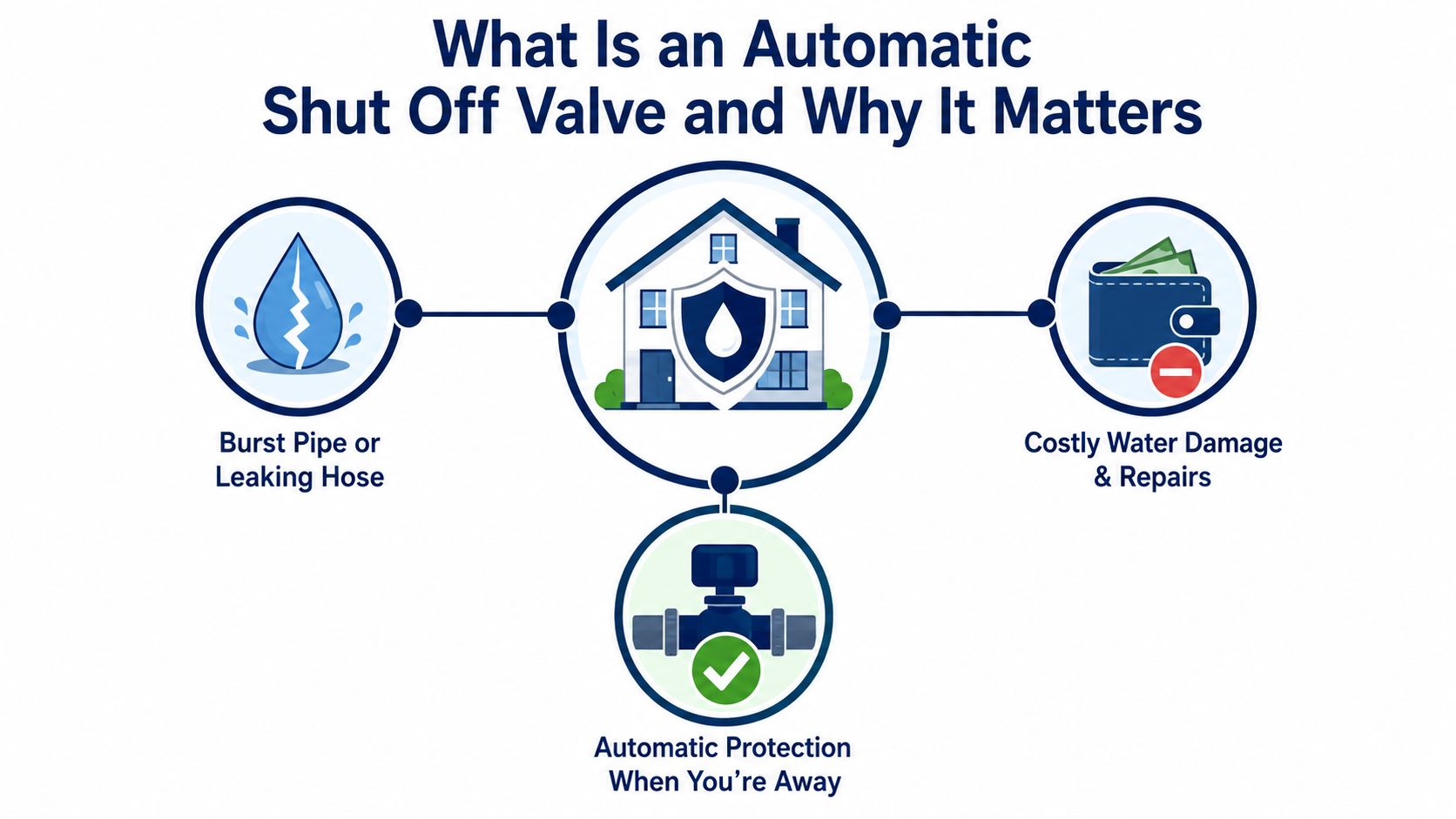
Two meanings, two very different decisions
The distinction matters because the wrong purchase solves the wrong problem. A fixture valve helps you isolate a toilet, faucet, or dishwasher during a repair, while a whole-home system is about stopping a leak before it spreads through a finished room, condo stack, or rental unit. That's why I always tell property owners to start by deciding whether they need local shutoff or whole-property protection.
For Los Angeles homes, that decision often comes down to age and exposure. Older houses with aging supply lines, hillside properties where a leak can run unchecked, and multi-unit buildings with shared liability are very different from a simple under-sink replacement. If you're trying to read the signs of a hidden leak before it turns into a bigger event, this guide on how to read a water meter for leaks is a useful place to start.
Practical rule: If the problem is one fixture, fix the fixture. If the damage risk is the whole building, look at a whole-home system.
A lot of people also use the term when they really mean leak detection. That's why the most useful question isn't “Do I need an automatic shut off valve?” It's “What am I trying to stop, and where would the water do the most damage if I miss it?”
How Automatic Shut Off Valves Detect and Stop Leaks
Most homeowners think the valve itself “detects” a leak. In practice, detection and shutoff are usually two separate jobs. The system watches for an abnormal condition, then the valve closes because the controller tells it to.
What the system is watching for
Three detection patterns show up most often in residential setups. Flow monitoring looks for water moving longer than expected, like a toilet that runs or a supply line that never really stops. Point sensors sit near high-risk spots, such as under sinks or near a water heater, and trigger when water reaches them. Pressure-sensing systems respond when a failure causes a sudden drop that doesn't match normal use.
Each method has trade-offs. Flow-based systems are better at whole-home oversight, but they need good sizing and sensible thresholds so they don't mistake normal household routines for a leak. Sensor-based setups are fast at the exact location where water shows up, but they only protect the places you cover.
For homeowners trying to understand burst-pipe response, the adjuster article on burst pipe claim help from the adjusters is a relevant read because burst events are where shutoff speed matters most.
What happens after detection
Once a controller decides something's wrong, it sends the signal to close the valve on the main line or on the protected branch. Some products use battery-backed AC design, which matters because power outages are part of real-world plumbing, not a rare edge case. Others include an automatic cleaning cycle, which helps keep the actuator from sitting idle for long stretches and getting stubborn.
That's the main lesson homeowners miss. Reliability isn't just about whether the product can close once in a demo. It's about whether the system can keep working after months of normal use, water pressure changes, and the occasional maintenance call.
If you're comparing systems, this is the right time to read a homeowner-focused explanation of what leak detection means in a house. The better you understand the trigger logic, the easier it is to choose a device that won't become a nuisance.
If a system can't tell the difference between everyday use and a true leak, homeowners end up disabling the very protection they paid for.
Types of Automatic Shut Off Valves for Different Applications
The category label on the box matters less than the plumbing job underneath it. A sink valve, a whole-home smart shutoff, and an industrial excess flow valve all close flow automatically in some way, but they're built for completely different environments.
Fixture valves, whole-home systems, and excess flow valves
Fixture-level angle stop valves are the small 90-degree shutoffs under sinks, toilets, and appliances. They're there for isolation and repair, and they're still manual in normal use. In older homes, I often see sediment buildup, stiff handles, or valves that won't fully close when someone finally needs them.
Whole-home automatic shutoff systems sit at the main water supply and use flow monitoring, moisture sensors, or both. These are the systems most homeowners mean when they talk about water-damage prevention. They're the right fit when the concern is broader than one sink or one appliance, especially in properties with expensive finishes or limited vacancy visibility.
Excess flow valves are a different animal entirely. ASTM F1793 defines them as self-contained devices for air or nitrogen that close automatically when a downstream failure creates excess flow, such as a hose rupture. They're sized around a specific operating envelope, not as general-purpose home water devices.
| Automatic Shut Off Valve Types Compared | ||||
|---|---|---|---|---|
| Valve Type | Activation Method | Coverage Area | Typical Cost | Best For |
| Fixture-level angle stop | Manual turn, local isolation | One sink, toilet, or appliance | Varies by job | Local repair and fixture isolation |
| Whole-home automatic shutoff system | Flow monitoring, sensors, or both | Entire property main supply | Varies by system | Water-damage prevention and leak response |
| Excess flow valve | Rapid flow increase from downstream failure | Air or nitrogen service line | Varies by industrial install | Pneumatic protection and process safety |
How to choose without overbuying
If your problem is a worn-out under-sink valve, replacing that valve is usually enough. If your concern is a water heater in a garage, a laundry leak, or a rental unit that sits empty, a whole-home or sensor-based system makes more sense. And if you're dealing with air or nitrogen service in a commercial setting, the industrial EFV belongs in a different conversation altogether.
Buy for the leak path, not the marketing label.
That's especially true in older Los Angeles properties. A fixture valve replacement can be a practical maintenance job, but it won't protect the building from a hidden line failure in the wall.
The History and Regulation Behind Automatic Shutoff Standards
Automatic shutoff didn't start as a smart-home idea. The roots go back to the late eighteenth century with James Watt's fly-ball governor, and even earlier water-control devices like Roman bronze plug cocks show that controlled flow has been around for centuries. In pipeline safety, engineers began developing early valve-closure systems in the 1940s to reduce the impact of ruptures, and the design later evolved into pneumatically operated automated control valves and remote-controlled mainline valves as communications improved. The long history matters because today's devices are the result of incident-driven engineering, not gadget trends. Source material on this technical lineage shows how far the concept has come.
Fire protection and pipeline safety changed the standard
Fire protection pushed the idea forward in a different way. In the late 1800s, automatic sprinkler systems led to shut-off valves between sprinklers and water supplies so systems could be isolated for maintenance or after activation. Insurance-industry experience with closed valves then drove the development of indicating control valves to reduce losses. That history is why the modern market isn't just about convenience, it's about controlling damage when things fail.
Pipeline regulation made the point even clearer. PHMSA issued a final rule on March 31, 2022, requiring all new or replaced onshore pipelines six inches or more in diameter to have automatic shut-off valves, and the rule took effect on September 27, 2022. The rule was shaped in part by the 17-hour Kalamazoo River crude-oil release and the San Bruno rupture that killed 8 people, injured 51, and destroyed or damaged at least 108 homes. Those are the kinds of losses that force standards to change. The regulatory summary lays out that shift clearly.
Why homeowners should care about that history
The commercial lesson is simple. Modern shutoff valves sit at the intersection of industrial safety, fire protection, and utility automation, and residential leak protection borrowed that same mindset. Once you see it that way, the product stops looking like a luxury accessory and starts looking like a risk-control device.
Benefits and Cost Expectations for Los Angeles Properties
Los Angeles properties do not all face the same plumbing risk, but the cost of a missed leak is still the same in the end. Water spreads fast, and in older homes, multi-unit buildings, and hillside properties, the damage depends on how far that water reaches before anyone notices. I treat these systems as a property decision, not just a plumbing upgrade.
What the numbers say and what they mean in practice
A U.S. Department of Energy publication on irrigation control has cited California field results showing that shut-off devices can reduce water use over a full year, with outcomes varying by site and operating conditions. That kind of result does not promise the same savings at every house, but it does show that automatic shutoff changes actual consumption patterns, not just emergency response. For smart-home water protection, the case for early response is stronger. A report tied to Flo by Moen said water-damage insurance claims dropped sharply after homeowners installed its devices, and published research on smart shutoff valves across more than 2,300 homes found leak severity fell significantly.
Those findings match what I see in the field. A system that reacts early can keep a problem in the repair category instead of the reconstruction category. That matters most in finished spaces where cabinets, flooring, drywall, and trim cost more to restore than the plumbing work itself.
Cost, warranty, and maintenance realities
Fixture-level work is usually straightforward if the valve is accessible and the plumbing is in good shape. Whole-home systems are different. They may require main-line access, correct valve sizing, and sensor placement that fits the way the property is used. Warranty terms and maintenance expectations also deserve attention, because a valve that sits untouched for years is no help if it sticks when it is needed.
For Los Angeles owners, the practical checklist is simple, test the system regularly, check batteries where the device uses them, and move sensors after any remodel or appliance change. Building managers need to take that even more seriously, because tenants rarely report a slow drip at the first sign of trouble. For a broader real-estate look at smart features, this article on smart houses for sale fits the same conversation, because automatic shutoff is now part of how buyers and owners compare property-tech upgrades.
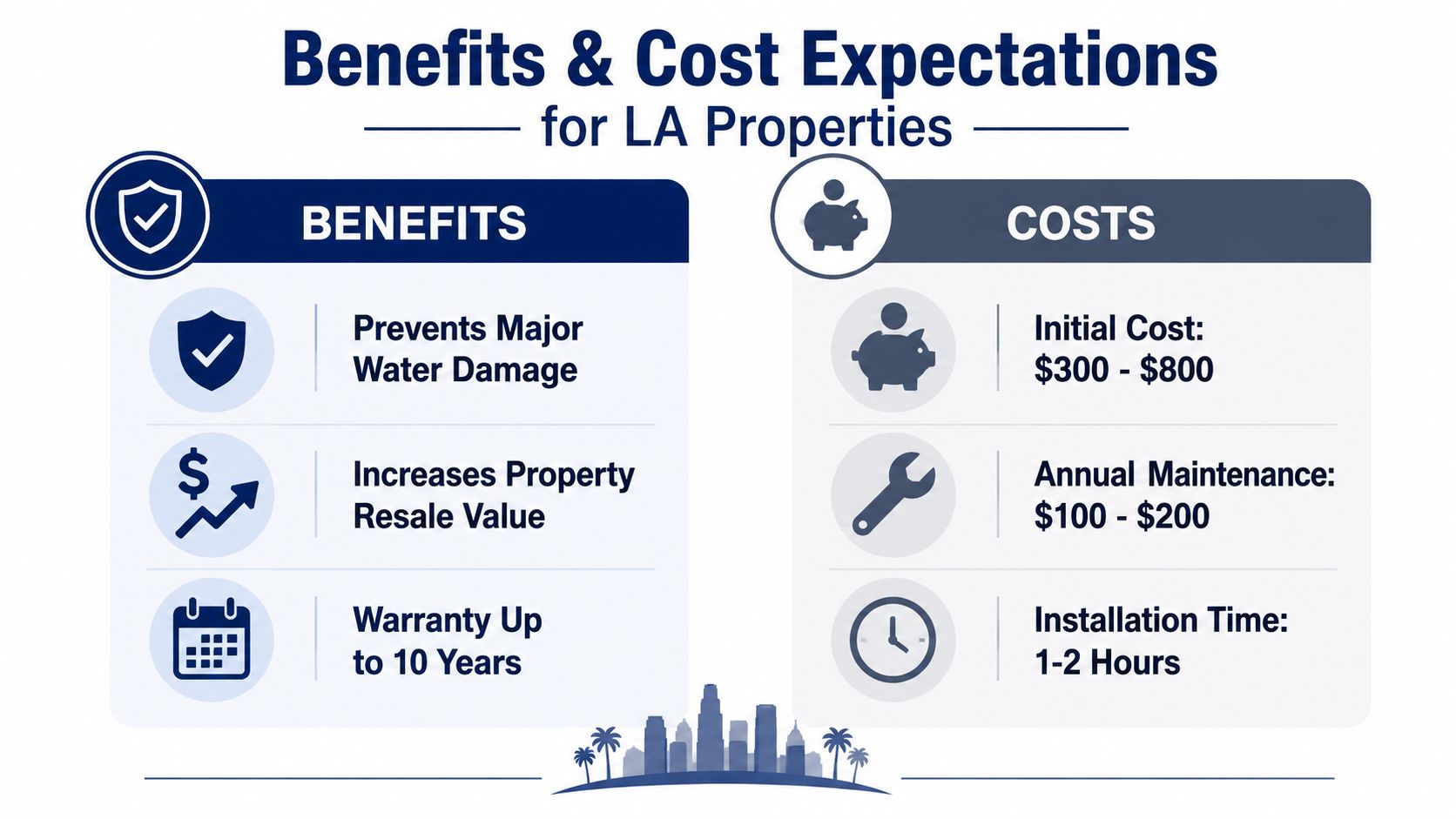
Maintenance matters: A protection device that nobody tests is just a piece of hardware on the pipe.
For homeowners and managers, that means the purchase decision has to include service, not just installation. In the field, I have seen stuck handles, sediment buildup, and old valves that looked fine until someone tried to close them in an emergency.
Installation Guidance and When to Hire a Licensed Plumber
A fixture valve replacement can be a decent DIY project for someone who already knows how to shut water down, work cleanly, and deal with a little corrosion. Whole-home automatic shutoff installation is a different level of work because it often means cutting into the main line, setting the actuator correctly, and confirming the valve sizing won't cause nuisance closures or incomplete shutoff. If the valve is buried in a tight meter box or an awkward utility closet, professional installation usually saves time and trouble.
Signs you should stop and call a plumber
- Main-line work: If the installation requires cutting into the building supply, hire a licensed plumber.
- Hard-plumbed connections: Soldering, push-fit rework, or older pipe repairs need proper tools and experience.
- Multi-unit systems: Shared shutoffs and building-wide isolation create liability if they're handled wrong.
- Gas-line proximity: Work near gas equipment isn't a place for trial and error.
- Bad existing valves: If the manual shutoff is frozen, corroded, or doesn't fully close, it should be addressed before adding automation.
The hiring part matters just as much as the hardware. In California, verify licensing, insurance, and direct experience with automatic shutoff installations, not just general plumbing. If you need a reference point for contractor screening, this licensed plumbing contractor guide is a useful checklist.
Common mistakes that create false confidence
The biggest DIY errors are predictable. Homeowners choose the wrong valve size, place sensors where splashes trigger them, or install a system that can't handle the actual pressure and usage pattern of the house. I also see setups where the owner never tests manual override, which is a problem because every automatic system still needs a human fallback.
EZ Plumbing installs and repairs automatic water shutoff valve systems for homes, offices, commercial spaces, schools, and hospitals, so the right choice isn't always the fastest one off the shelf. For Los Angeles owners, the safest path is often to have a licensed plumber size the valve, confirm clearances, and test it under real operating conditions before relying on it.
If you're in Los Angeles and you're not sure whether your property needs a fixture shutoff, a whole-home leak system, or both, reach out to EZ Plumbing for a professional look at the plumbing and the risk. We handle automatic shutoff valve installation, repair, and emergency response for homes, HOAs, landlords, and commercial properties, and you can schedule service through EZ Plumbing or call (818) 908-2710 for direct help.