
How to Detect Underground Leaks: A Homeowner’s Guide
Underground leak detection is the process of locating water loss in buried pipes before it causes structural damage, mold growth, or a water bill that doubles without warning. Knowing how to detect underground leaks is the first step every homeowner and property manager should take when water use climbs unexpectedly or the yard develops soft, soggy patches. The process combines simple visual checks and water meter tests with specialized tools like acoustic detectors and ground penetrating radar (GPR). Getting it right early saves thousands in excavation and repair costs. Ez-plumbing serves the greater Los Angeles area and sees this problem regularly across residential and commercial properties.
How can you confirm an underground leak exists?
Confirming a leak before calling anyone is the smartest first move. Start with your water meter. Locate the meter at the street, write down the reading, and do not use any water in the home for at least one to two hours. A slow underground leak may not move the meter dial immediately, which is why a timed test of one to two hours is far more reliable than a quick glance.
After the waiting period, check the meter again. If the reading changed and no water was used, a leak is present somewhere in the system. The next step is isolating whether that leak is inside the home or in the buried service line running from the meter to the house.
Turn off the main water shut-off valve inside your home. Then watch the meter again. If the meter stops moving after closing the valve, the leak is inside the house. If it keeps moving, the leak is in the underground service line between the meter and the building. This single test prevents unnecessary and costly digging outside.
Visual signs also guide the search zone. Greener grass in one patch of the yard, sunken paving, or unexplained wet soil are all early indicators. These visual features are useful starting points but must always be confirmed with objective tests before any excavation.

Pro Tip: Run the timed meter test at night when household water use is zero. Even a dishwasher running on a delayed cycle will invalidate your reading.
High water bills are not always a definitive sign of an underground leak. Silent interior leaks from a running toilet or a dripping fixture can mimic the same symptoms. Always complete the isolation test before assuming the problem is underground.
- Record the meter reading with no water in use.
- Wait one to two hours without using any water.
- Check the meter again for any change.
- Close the main interior shut-off valve and repeat the observation.
- If the meter still moves, the leak is in the buried service line.
What tools and technologies locate underground leaks?
Once you confirm a buried leak, the next question is where exactly it sits. Several technologies answer that question with varying degrees of accuracy, cost, and invasiveness.
Acoustic leak detection is the most widely used method in residential settings. A technician places sensors along the pipe route above ground. The sensors pick up the sound frequency that pressurized water makes as it escapes through a crack or joint. Professional acoustic detection achieves 85–95% success rates with accuracy to within ±0.5 meters. That level of precision means a plumber can dig one small, targeted hole rather than tearing up a yard.
Ground penetrating radar (GPR) sends electromagnetic pulses into the ground and reads the reflected signals to map subsurface features. GPR works well for locating pipe routes and voids caused by water erosion. However, GPR and AI-enhanced imaging depend heavily on soil composition and saturation levels, so a technician needs to understand local geology before deploying the equipment.
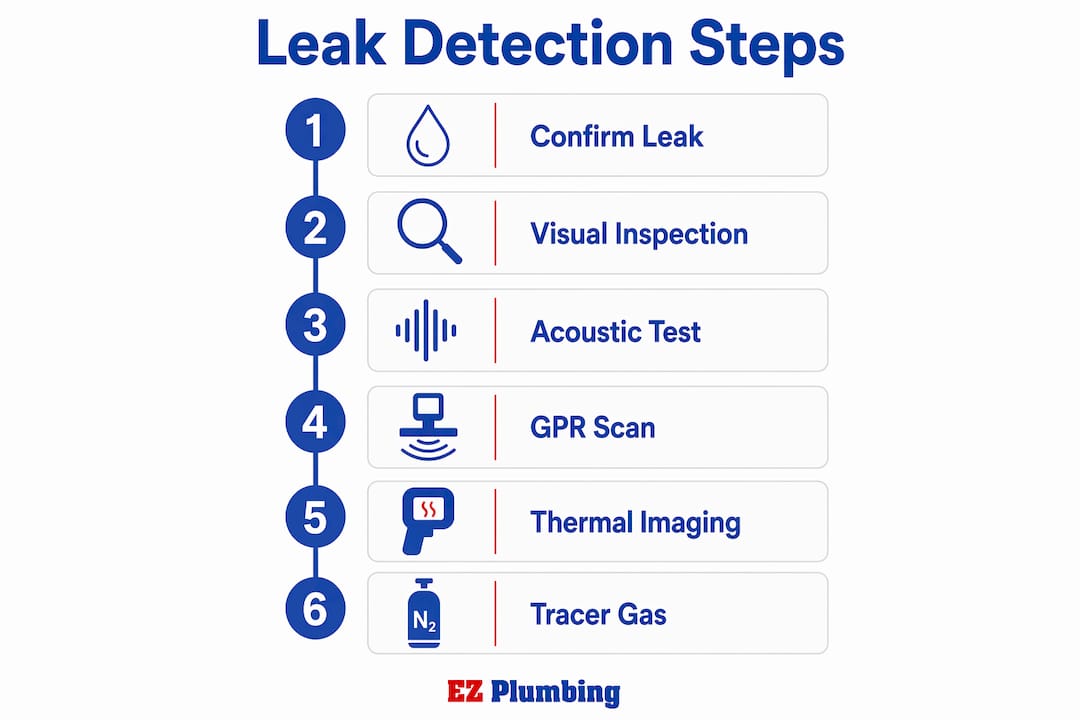
Thermal imaging uses an infrared camera to detect temperature differences at the surface. A buried leak creates a cooler or warmer zone depending on the water temperature, and the camera maps that anomaly. Thermal imaging works best on hard surfaces like concrete driveways or slabs.
Tracer gas detection involves injecting a safe, non-toxic gas mixture into the pipe. The gas escapes at the leak point and rises through the soil. A sensor at the surface detects the gas concentration and pinpoints the exit location. This method is particularly useful in deep or complex pipe systems where acoustic signals are weak.
| Method | Accuracy | Invasiveness | Best Use Case |
|---|---|---|---|
| Acoustic detection | ±0.5 meters | Non-invasive | Pressurized water lines |
| Ground penetrating radar | Moderate | Non-invasive | Mapping pipe routes and voids |
| Thermal imaging | Surface level | Non-invasive | Slab leaks, concrete surfaces |
| Tracer gas | Very high | Minimal | Deep or complex pipe systems |
Pro Tip: For Los Angeles properties with clay soil, GPR accuracy drops significantly after rain. Schedule GPR surveys during dry periods for the clearest subsurface readings.
DIY acoustic listening devices are available at hardware stores, but consumer-grade equipment lacks the sensitivity of professional correlators. For a confirmed underground leak, professional leak detection services deliver the accuracy needed to avoid repeat excavations.
How do professionals perform underground leak detection?
A professional detection visit follows a structured sequence that minimizes guesswork and protects your property. Understanding the process helps you prepare the site and get better results.
The technician begins with a site walk. They review the property layout, note the location of visible pipe access points, and identify any recent landscaping or construction that may have shifted pipe routes. This context shapes where sensors are placed.
Next, the technician sets up acoustic sensors at multiple points along the suspected pipe route. Leak noise correlation (LNC) with multiple sensors measures the time lag between acoustic signals at each sensor. The system calculates the leak position based on those time differences, triangulating the location with high precision.
Acoustic detection sensitivity requires low ambient noise. Technicians prefer working at night or in the early morning when traffic is minimal. Direct contact with the pipe using grounding rods improves signal clarity and reduces background interference from soil vibration.
The professional process typically follows this sequence:
- Review utility maps and mark known pipe routes above ground.
- Place acoustic sensors at hydrants, valves, or exposed pipe sections.
- Run the correlation software to identify the signal time lag between sensors.
- Triangulate the leak location and mark it on the surface.
- Verify the finding with a secondary method such as thermal imaging or tracer gas.
- Mark the confirmed location clearly before any excavation begins.
Verification before digging is non-negotiable. A single misread sensor can send a crew to the wrong spot. Cross-checking with a second method adds confidence and protects you from unnecessary property disruption. Ez-plumbing uses this multi-step approach on every underground detection job in Los Angeles.
What are common mistakes when detecting underground leaks?
The most frequent error homeowners make is treating the wettest surface spot as the leak location. Leak noises and water travel along the path of least resistance underground, meaning visible wet patches can sit several feet away from the actual pipe rupture. Digging at the wet spot without further testing almost always misses the source.
A second common mistake is abandoning the meter test too quickly. A slow leak may not register in five minutes. Professionals recommend waiting up to two hours for an accurate reading. Patience at this stage prevents a false negative that delays the real repair.
Failing to isolate interior plumbing before assuming an underground problem is another costly error. A running toilet or a leaking supply line under a sink can produce the same meter behavior as a buried pipe failure. Complete the shut-off valve isolation test every time before moving to outdoor detection.
Noise interference is a technical pitfall that affects acoustic detection accuracy. Traffic, HVAC systems, and even wind across sensor cables introduce false signals. Working during low-traffic hours and using grounding rods for direct pipe contact reduces this interference significantly.
Pro Tip: If your first acoustic test produces inconsistent results, repeat it at a different time of day. A single noisy reading is not a diagnosis. Two consistent readings from separate sessions are.
When to stop the DIY approach and call a professional is a judgment call, but the threshold is clear. If the meter test confirms a leak and the isolation test points to the buried service line, the detection work from that point forward requires professional equipment. Basement waterproofing services may also be needed if water has already reached the foundation, since underground leaks near the structure can compromise the building envelope over time.
Key Takeaways
Detecting underground leaks accurately requires combining a timed water meter test, proper isolation of interior plumbing, and professional acoustic or imaging technology to pinpoint the buried source before any excavation begins.
| Point | Details |
|---|---|
| Start with the meter test | Run a timed one to two hour test with zero water use to confirm a leak exists. |
| Isolate before you excavate | Use the main shut-off valve to determine if the leak is inside or in the buried service line. |
| Match the tool to the situation | Acoustic detection suits pressurized lines; GPR and thermal imaging work best on slabs and complex routes. |
| Wet spots mislead | Water travels underground, so the dampest surface area is rarely directly above the pipe rupture. |
| Professionals add precision | Acoustic leak detection achieves 85–95% success rates with ±0.5 meter accuracy in residential settings. |
What I’ve learned after years of underground leak calls in Los Angeles
The homeowners who handle underground leaks best are the ones who do the meter test first and resist the urge to start digging. I’ve seen properties where a crew excavated three separate spots based on wet grass alone, and the actual leak was under the driveway the whole time. That’s an expensive lesson in skipping the confirmation step.
One thing I’d push back on is the idea that professional detection is always overkill for a residential property. The cost of a professional acoustic survey is a fraction of what you pay to repair a yard that got dug up in the wrong place. The technology has also improved considerably. Leak noise correlation software now triangulates locations with a level of accuracy that was only available to municipal water utilities a decade ago.
For Los Angeles properties specifically, the combination of aging galvanized pipes, expansive clay soils, and seasonal ground movement creates conditions where leaks develop gradually and travel far from their origin point before showing any surface sign. That’s not a reason to panic. It is a reason to take the meter test seriously and not wait for the water bill to spike before acting.
The future of this field is moving toward continuous monitoring. Smart water meters and in-line pressure sensors are already available for residential installation, and they flag anomalies in real time. That kind of early warning system changes the equation entirely. You catch a slow leak in days rather than months, and the repair stays small.
— EZ
Ez-plumbing’s professional leak detection services in Los Angeles
Ez-plumbing provides licensed underground leak detection across the greater Los Angeles area, using acoustic correlation, thermal imaging, and GPR to locate buried pipe failures without unnecessary excavation.

When a confirmed underground leak needs professional attention, Ez-plumbing’s leak detection team handles the full diagnostic process from meter confirmation through precise location marking. For properties where the leak has affected sewer infrastructure, Ez-plumbing also provides sewer line repair to address damage before it compounds. After any major plumbing repair, homeowners often take the opportunity to upgrade aging water heaters. Ez-plumbing’s water heater installation services cover both traditional and tankless systems throughout Los Angeles. Call Ez-plumbing at C-36 License #583868 to schedule a diagnostic visit.
FAQ
How do I check for an underground water leak at home?
Turn off all water in the home, record the meter reading, and wait one to two hours without using any water. If the meter reading changes, a leak is present somewhere in the system.
What are the signs of an underground water leak?
Common signs include unexplained increases in your water bill, patches of greener or softer grass, sunken paving, and damp soil in dry weather. These signs guide the search zone but require objective meter testing to confirm.
How accurate is professional underground leak detection?
Professional acoustic leak detection achieves 85–95% success rates with accuracy to within ±0.5 meters in residential settings. That precision allows targeted excavation rather than broad trenching.
Can I use DIY tools to locate an underground leak?
Consumer-grade acoustic listening devices can detect the presence of leak noise but lack the sensitivity to pinpoint location accurately. For a confirmed buried service line leak, professional correlating equipment produces far more reliable results.
How much does underground leak detection cost?
Professional diagnostic services for underground leak detection are not publicly listed at a flat rate, but professional ground-based surveys typically run in the range of several hundred dollars depending on property size and method used. Getting a precise diagnosis upfront costs far less than repairing excavation damage from guesswork.