
How to Check if Sump Pump Is Working: 2026 Guide
Rain is in the forecast, the pit sits quiet in a corner, and you're wondering the same thing a lot of homeowners wonder right before a storm: if water starts rising, will the sump pump save the day?
That's the right question. A sump pump can sit unnoticed for months, then suddenly become the most important piece of equipment in the house. Knowing how to check if sump pump is working isn't about hearing the motor buzz for a second. It's about confirming the whole system can sense water, move it out, and shut down correctly before your basement or lower level takes a hit.
Table of Contents
- Your Sump Pump The Unsung Hero of Your Home
- First Things First Safety and Visual Checks
- The Manual Sump Pump Test A Step-by-Step Guide
- Is It Really Working Signs of a Weak or Failing Pump
- Testing Your Backup Sump Pump System
- When to Call a Los Angeles Plumber for Your Sump Pump
Your Sump Pump The Unsung Hero of Your Home
It's common not to think about a sump pump until the weather turns ugly. In Los Angeles, that usually means the first serious winter rain, a lot of runoff, and a sudden trip to the garage, basement, or crawlspace to see if that old pump is ready.
That little pump does a big job. It stands between groundwater and a flooded space full of drywall, flooring, stored boxes, and electrical risks. According to the National Association of Home Builders, sump pumps should be tested biannually, before spring and fall, to help prevent flooding events that can cost homeowners an average of $10,000 to $30,000 in water damage repairs and structural remediation. If you're planning an upgrade rather than a test, it helps to understand your sump pump installation options.
Practical rule: Don't wait for the storm to tell you whether your sump pump works.
A lot of homeowners treat sump pump testing like a chore. In the field, it's closer to a seatbelt check. It takes a few minutes, it doesn't require fancy tools, and it can spare you a brutal cleanup.
Why timing matters
Before the rainy season is when you want to find problems like a jammed float, a dead outlet, or a restricted discharge line. Those are manageable on a dry day. They're expensive and stressful when water is already rising.
What a good test should prove
A real check answers more than one question:
- Power: Is the pump getting electricity?
- Activation: Does the float trigger the motor when water rises?
- Discharge: Is water leaving the pit and getting outside?
- Shutoff: Does the pump stop when the level drops?
That full sequence is what protects the house. Not just the sound of a motor turning on.
First Things First Safety and Visual Checks
Before you touch the float or pour in any water, start with safety. Water and electricity are a bad combination, and a rushed test creates problems that weren't there before.
If the area around the pit is wet, treat the electrical side carefully. Don't stand in water while reaching for cords or outlets. If you see damaged wiring, burn marks, or anything that looks unsafe, stop there.
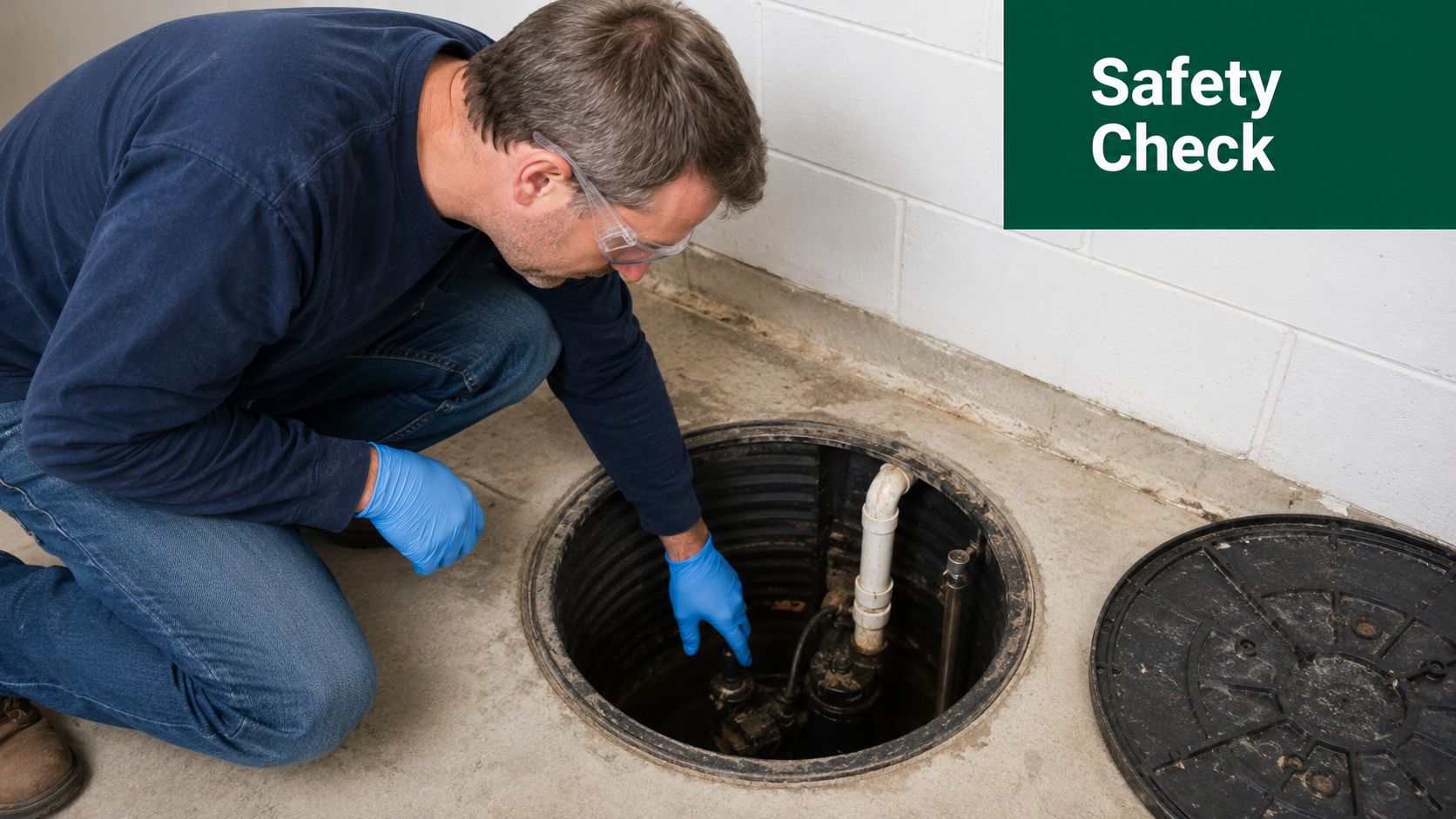
Check the power before the pump
This is the first thing I look at on service calls because it solves a surprising number of “dead pump” complaints. The American Society of Home Inspectors reports that 60% of inactive sump pumps during flood events are caused by a tripped GFCI outlet or a disconnected power cord, as noted by the American Society of Home Inspectors guidance.
A simple way to check the outlet is to plug in a lamp or another small device you know works. If it doesn't power on, the problem may be upstream of the pump. If the outlet is GFCI-protected, inspect the reset status and confirm it's supplying power.
Look inside the pit like a plumber would
Don't overcomplicate the visual inspection. You're looking for obvious reasons the system might fail under load.
Use this quick checklist:
- Pump position: Make sure the pump is sitting upright and stable.
- Float movement: The float should move freely and not rub the pit wall or catch on the cord.
- Debris in the basin: Remove loose dirt, stones, toys, or sludge that could block the intake or jam the float.
- Cord condition: Check for cuts, pinches, or a plug that's worked loose.
- Discharge connection: Make sure the discharge pipe is attached securely and doesn't show visible cracks or separation.
A sump pump can be mechanically fine and still fail because the float can't rise.
Don't skip the discharge path
A lot of homeowners focus only on the unit in the pit. The discharge line matters just as much. If that line is damaged, blocked, or disconnected, the pump may run and still leave you with water at your foundation.
Walk the visible portion of the line if you can. Look for sagging sections, impact damage, or signs that water has been leaking back near the home instead of moving away from it.
The Manual Sump Pump Test A Step-by-Step Guide
The most useful hands-on test is simple. Verify power, add water, and watch the complete cycle. That's how you check if sump pump is working in a way that mirrors real conditions.
Start with the visual checks already covered. Once those look good, move to a manual test.
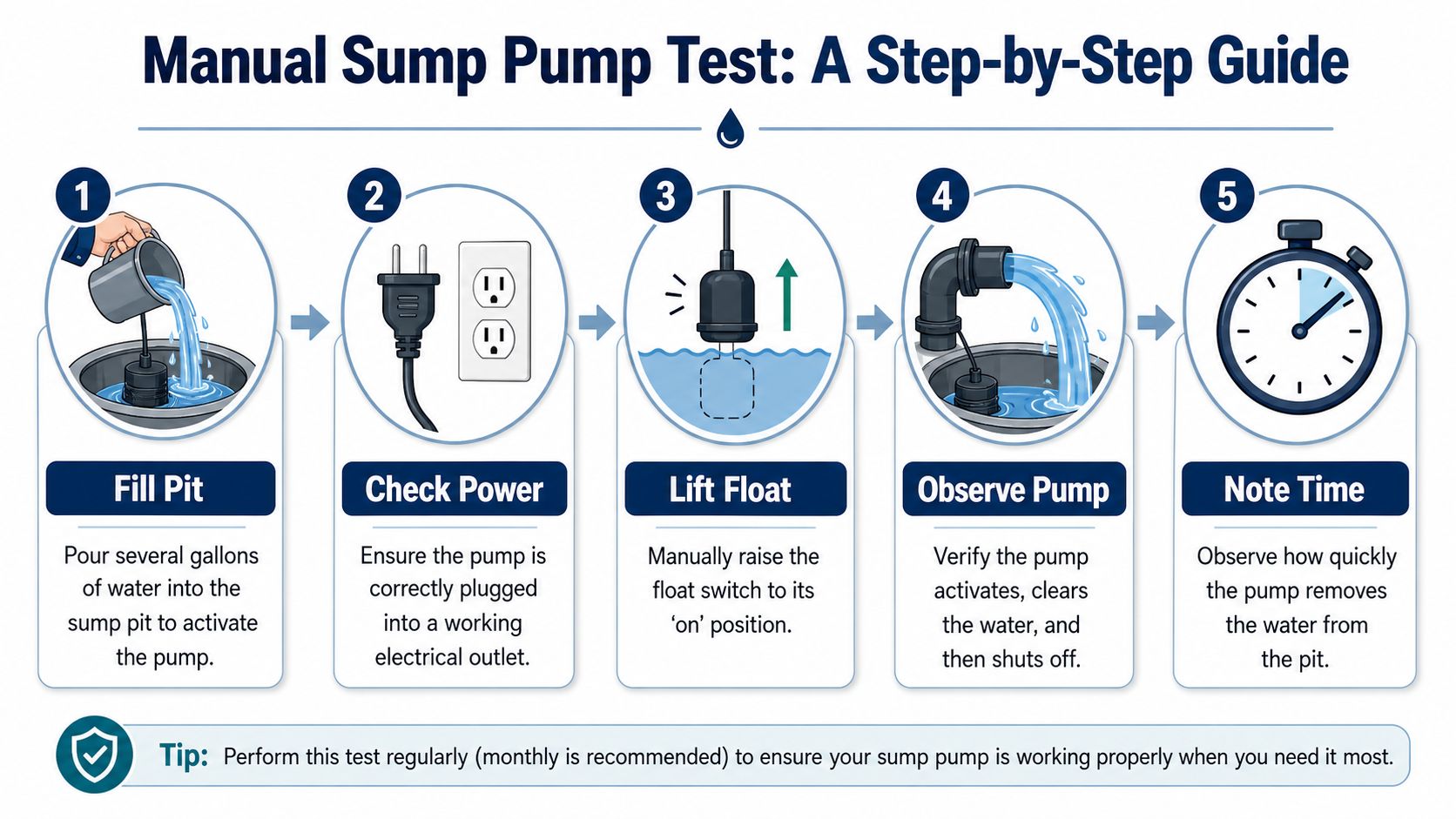
Method one Manual float lift
If your pump has an accessible float arm or switch, you can do a quick activation test by lifting it carefully. This is the fast check, not the best check.
When you raise the float, the motor should respond right away. If nothing happens, don't keep forcing it. That points to a power issue, a stuck switch, or a failed pump.
What this test tells you:
- The switch can trigger the motor.
- The motor is at least capable of turning on.
What it doesn't tell you:
- Whether the pump can move water properly.
- Whether the discharge line is clear.
- Whether the system shuts off correctly after draining.
Method two The bucket test
This is the better homeowner test because it checks the full sequence. Zoeller's homeowner guidance recommends a practical field test that starts with confirming power and the discharge path, then pouring about 3 to 5 gallons of water into the sump basin and watching for the float to rise, the pump to start, and water to discharge outside, as described in Zoeller's sump pump testing guide.
Here's the clean way to do it:
- Confirm the pump is plugged in and the outlet is live.
- Inspect the discharge pipe for visible clogs or damage.
- Pour water into the pit slowly, not all at once.
- Watch the float rise as the water level comes up.
- Listen for pump startup and look for water moving through the system.
- Check the outside discharge point if possible, to make sure water is leaving.
- Watch for shutoff after the water level drops.
A short video can help if you've never seen the sequence before.
What you should observe
A successful test has a clear rhythm. Water rises, the float trips, the pump starts, water exits, the pit drains down, and the pump shuts off. If any one of those steps is missing, the pump isn't ready.
Use this simple read on the results:
| Observation | What it usually means |
|---|---|
| Pump doesn't start | Power issue, switch issue, or failed motor |
| Pump starts but no water leaves | Discharge blockage, air lock, or impeller problem |
| Water leaves slowly | Weak pump, partial clog, or restriction in the line |
| Pump won't shut off | Float, switch, or control problem |
If the motor turns on but the water level barely drops, don't call that a pass.
Is It Really Working Signs of a Weak or Failing Pump
A sump pump can pass a basic test and still fail when the inflow gets serious. That's the difference between activation and performance. Homeowners miss this all the time. They hear the motor kick on and assume the system is healthy.
It isn't enough for the pump to run. It has to move water fast enough to protect the space.
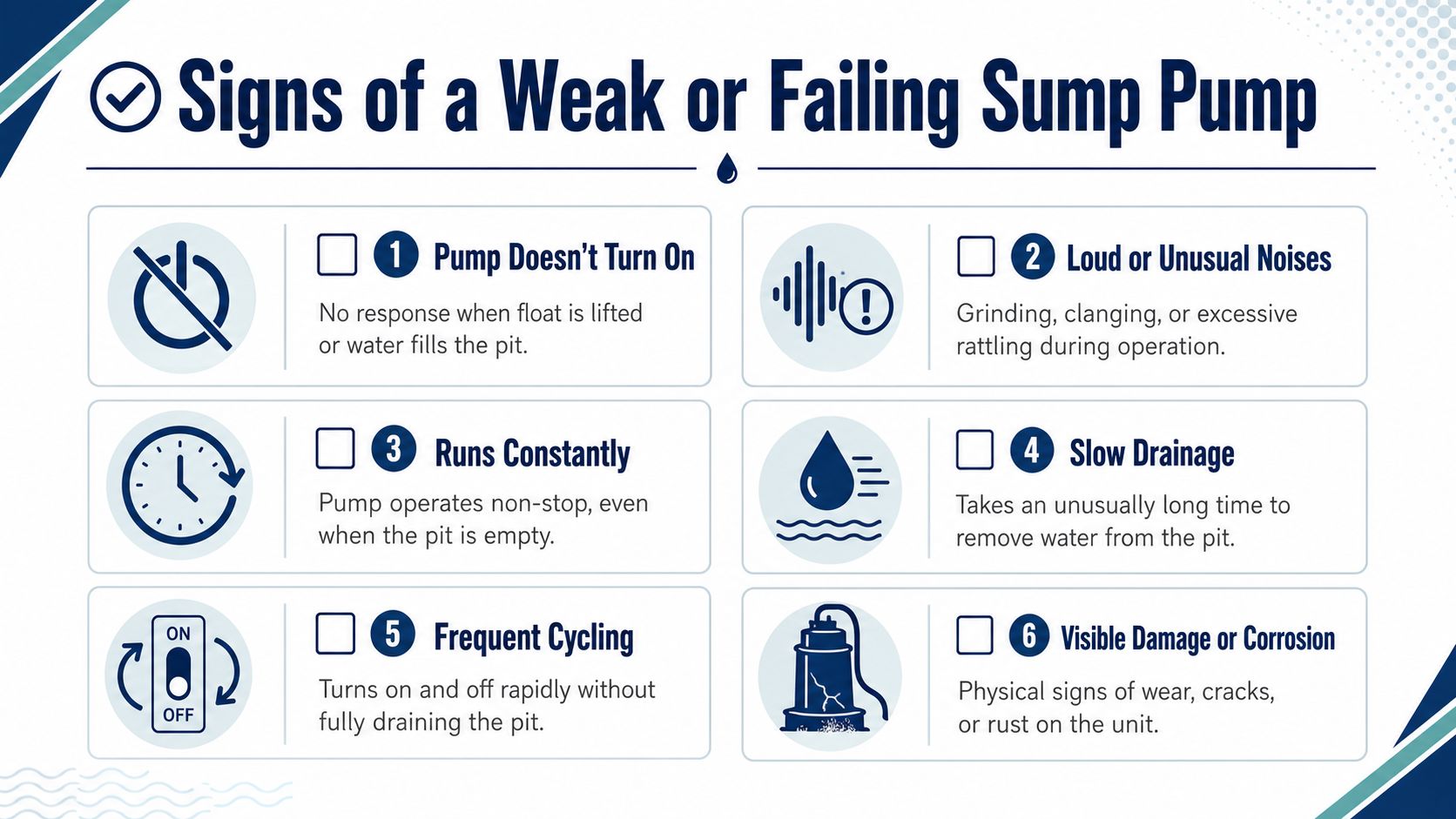
Performance matters more than noise alone
According to the American Society of Home Inspectors, a properly functioning sump pump must activate within 30 seconds of the float rising and drain water at at least 10 gallons per minute, and grinding, rattling, or clicking noises indicate a 90% probability of motor or impeller failure. That benchmark gives you a practical way to judge whether the pump is doing real work, not just making sound.
If you run the water test and the basin empties sluggishly, that's a warning sign even if the pump technically turned on. In real storms, partial failure is what gets people in trouble. Restricted discharge lines, intake debris, and worn impellers often show up as weak pumping before total failure.
Red flags I take seriously
Some symptoms deserve more attention than others. These are the ones that usually point to a pump that's on borrowed time:
- Slow water drop in the basin: The pump may be running, but it isn't keeping pace.
- Grinding or rattling: Internal wear or debris around the impeller is likely.
- Clicking with poor discharge: The switch may be cycling, but the hydraulic side isn't doing the job.
- Rapid on-off behavior: That often points to a float or valve problem.
- Excess heat from the housing: A struggling motor may be overworking.
If your lower level has already shown signs of moisture, that bigger context matters too. A visible damp area, staining, or persistent musty smell may call for a broader moisture assessment. For that side of the problem, Survey Merchant's report guide gives a useful overview of how damp conditions are evaluated beyond the pump itself.
What counts as a failing result
You don't need to diagnose every internal component to know something's off. If the pump leaves water behind, sounds rough, or cycles in an odd pattern, treat it as unreliable.
If you've already had water where it shouldn't be, a practical next read is what to do when your basement floods. The goal is to react fast and limit damage while the root cause gets handled.
“It runs” and “it protects the basement” are not the same answer.
Testing Your Backup Sump Pump System
The backup system is the part homeowners forget until the power goes out. That's also the exact moment the main pump may be useless.
Testing the primary pump without checking the backup leaves a blind spot. Backup capability matters more now, and homeowner guidance still doesn't do a great job of explaining how to prove the whole system is dependable through outage and heavy inflow conditions, as discussed in this backup testing overview from Reddi Plumbing.
Battery backup checks
If your system has a battery backup pump, test it on purpose. Don't just glance at the charger light and assume you're covered.
A practical routine looks like this:
- Inspect the battery terminals for corrosion or loose connections.
- Confirm the charger is operating and the battery is being maintained.
- Simulate loss of house power according to the manufacturer's instructions, then repeat a controlled water test.
- Listen for transfer to backup mode and verify that water still leaves the basin.
The key is testing the backup under water load, not just looking at status lights. A backup that appears ready but can't move water isn't giving you protection.
Water-powered backup systems
These are less common, but they need attention too. Check that the water supply serving the backup is active and unobstructed. If there's a shutoff valve on that line, make sure it's open. Then verify the unit engages according to its design when the primary system is unavailable.
What homeowners often miss
The most common mistake is separating the tests too much. People will check the float manually one day, glance at the battery another day, and never verify the full backup sequence.
Run the system the way a storm will. Water in the pit. Primary unavailable. Backup engaged. Water discharged. That's the standard worth trusting.
When to Call a Los Angeles Plumber for Your Sump Pump
Some sump pump checks are homeowner work. Some aren't. Knowing where that line is can save you from burning out a motor, missing an electrical fault, or trusting a system that's already failing.
If the pump hums but doesn't move water, runs continuously, or fails to shut off automatically, those symptoms point to float-switch, valve, or electrical faults that need professional diagnosis, as explained in Ken's Plumbing troubleshooting guidance.
Stop troubleshooting and make the call if you notice these
- The pump hums but doesn't discharge water
- The unit runs nonstop after the basin is empty
- You smell burning or see any sign of electrical damage
- The float sticks, tangles, or behaves inconsistently
- The discharge setup looks damaged or poorly connected
- The pump passes a dry test but fails under a water test

When repair beats guessing
Once you're into valve problems, intermittent electrical faults, or a pump that sounds rough under load, guesswork stops helping. A proper service visit can confirm whether the issue is a switch, blockage, discharge problem, failing motor, or a pump that's at the end of its life.
If the system needs hands-on diagnosis or repair, schedule a professional sump pump repair service rather than waiting for the next storm to test it for you.
If you want a licensed local team to inspect, diagnose, or repair your sump pump before the next heavy rain, EZ Plumbing serves Los Angeles homeowners, HOAs, and property managers with fast, reliable plumbing service. Call (818) 908-2710 or schedule online for help protecting your property before a small sump pump issue turns into a major flood.