
Sewer cleanouts in LA homes: what every owner should know
Most homeowners in Los Angeles assume that when a sewer problem happens, the city will send someone out to handle it. That assumption is costly. Property owners are responsible for maintaining the entire private sewer lateral, which runs from the house all the way to the main line in the street, including any cleanouts along the way. A sewer cleanout is one of the most important and most overlooked components of your plumbing system, and understanding it can save you serious time, money, and stress the next time something backs up.
Table of Contents
- What is a sewer cleanout?
- Why are sewer cleanouts critical in Los Angeles?
- How sewer cleanouts are installed and maintained
- Common problems with sewer cleanouts in LA homes
- Expert perspective: what most LA homeowners miss about sewer cleanouts
- Get help with sewer cleanouts and plumbing in LA
- Frequently asked questions
Key Takeaways
| Point | Details |
|---|---|
| Owner responsibility | Homeowners must maintain the private sewer lateral and cleanouts in Los Angeles. |
| Critical access | Cleanouts make sewer inspections and repairs faster, cleaner, and cheaper. |
| Compliance matters | LA law and home sales often require visible, working sewer cleanouts. |
| Old pipes need caution | Use a camera inspection before powerful cleaning methods on older piping. |
| Professional help pays off | Licensed installation and routine checks can prevent costly emergencies. |
What is a sewer cleanout?
A sewer cleanout is a capped pipe, typically made of ABS plastic, PVC, or cast iron, that gives plumbers direct access to your private sewer lateral. Think of it as a service hatch for your underground drainage system. When a blockage occurs, a plumber inserts a snake, hydro-jet, or camera into the cleanout opening rather than digging up your yard or pulling apart your interior plumbing.
On most Los Angeles properties, you’ll find the cleanout located in the front yard near the foundation, along the side of the house, or occasionally inside a garage or basement, depending on the home’s layout and age. The cap is usually flush with the ground or slightly above it, often round or square shaped, and marked with a threaded plug. If you’ve never noticed it, you’re not alone, but locating it before you have an emergency is one of the smartest things you can do as a homeowner.
Cleanouts serve several important purposes. They allow plumbers to clear blockages without invasive methods. They provide an access point for sewer camera inspection to locate breaks, root intrusion, or pipe deterioration. They also support compliance with local plumbing codes and make routine preventive maintenance practical and cost effective.
There are two main types of cleanouts commonly found in LA properties:
| Type | Direction of access | Best use |
|---|---|---|
| One-way cleanout | Single direction only | Clearing blockages toward the street |
| Two-way cleanout | Both directions | Full lateral access, easier maintenance |
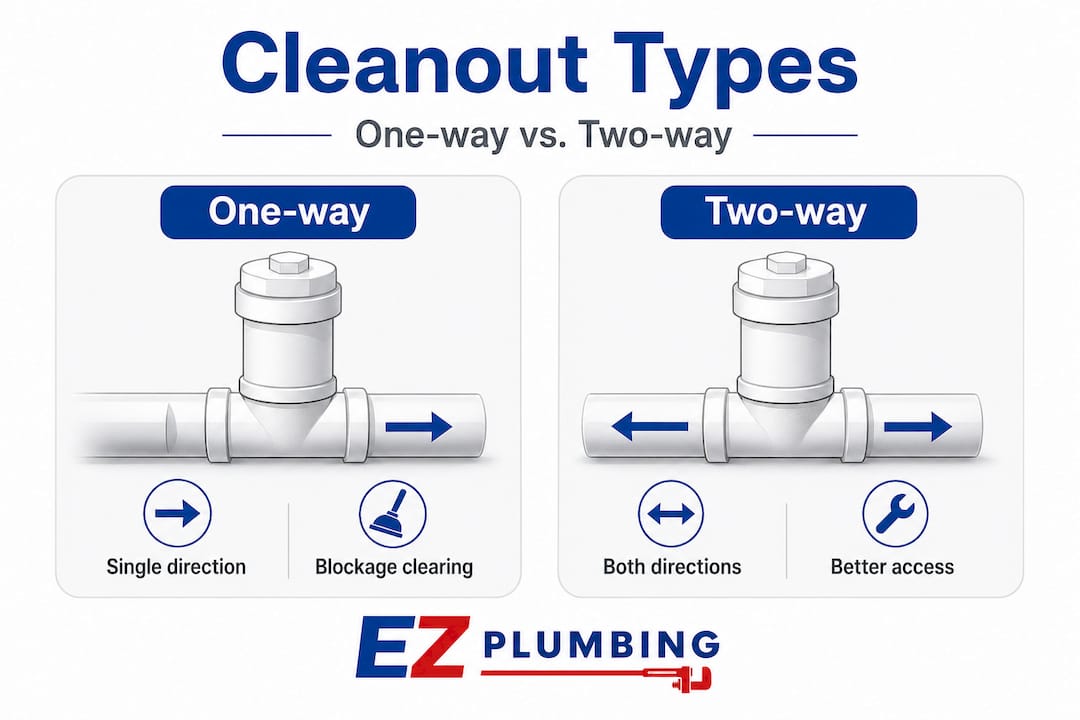
Per California Plumbing Code requirements, cleanouts must be installed every 100 feet horizontally, at bends greater than 135 degrees, at upper terminals, and the pipe must maintain a minimum slope of 1/4 inch per foot to allow proper drainage flow. Homes built after 1960 generally have at least one cleanout already installed. Older homes, particularly those built before World War II in neighborhoods like Boyle Heights, Echo Park, or Highland Park, may have no cleanout at all, or worse, one that has been buried under concrete or overgrown landscaping over the decades.
Why are sewer cleanouts critical in Los Angeles?
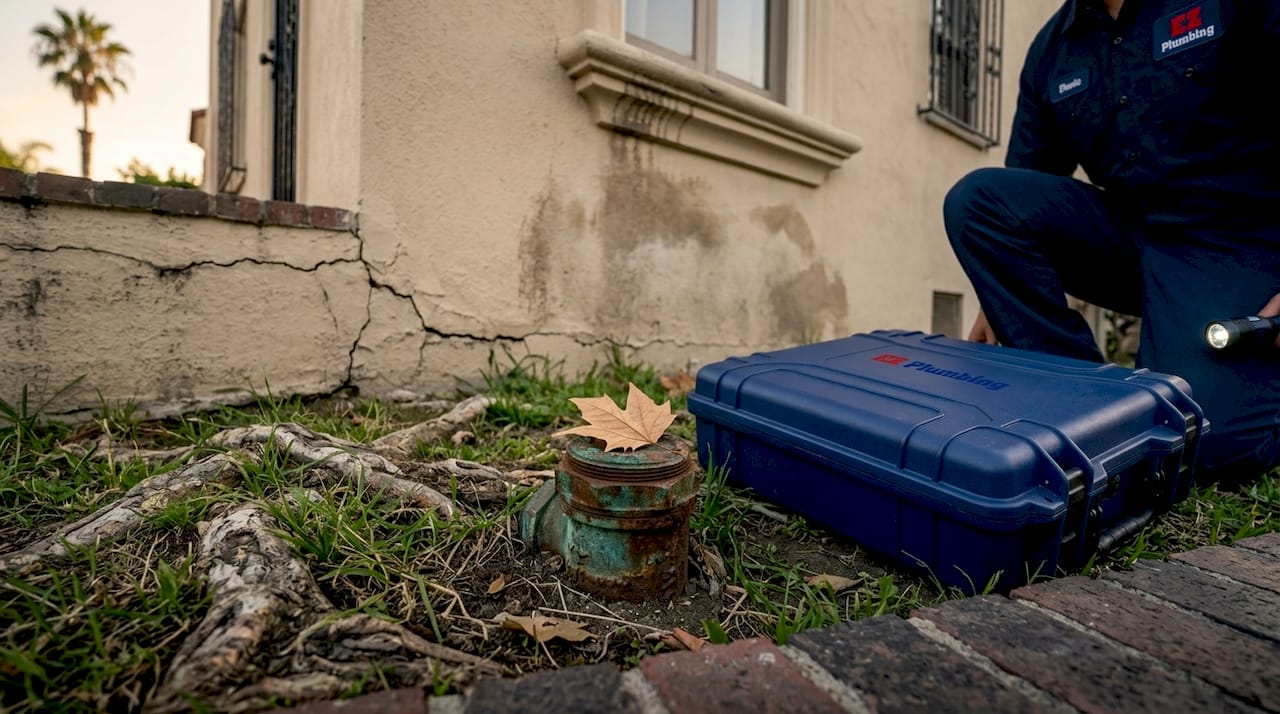
Los Angeles is a city where plumbing conditions are genuinely different from most of the country. The combination of aging housing stock, hillside terrain, expansive clay soil, mature tree canopies, and a dense urban infrastructure creates a set of sewer challenges that make cleanout access more important here than almost anywhere else.
Under LA County Code 20.24.080, property owners must maintain sewer laterals in safe and sanitary condition, with cleanouts installed according to the Uniform Plumbing Code. That’s not a suggestion. It’s a legal requirement that can affect your ability to sell your property.
If your home doesn’t have an accessible, code-compliant cleanout, you may run into delays during a real estate transaction. LA County enforces point-of-sale inspections in many jurisdictions, which means a buyer’s inspector or the county can flag missing or buried cleanouts as a deficiency. That finding can stall escrow, require emergency installation, or force a renegotiation of the sale price.
“When a cleanout is buried, obstructed, or missing entirely, a routine drain clearing job can turn into a half-day excavation project. The homeowner ends up paying emergency rates for work that preventive access could have avoided altogether.”
Without a working cleanout, plumbers must find another way in. That typically means removing a toilet, which requires turning off water, pulling the fixture, clearing the blockage through the toilet flange, and then resetting the toilet with a new wax ring. In some cases, it means breaking through concrete to reach a pipe. Both options add hours to the job and significantly increase the cost.
Pro Tip: Walk your property now and locate your cleanout. If you can’t find it, ask a licensed plumber to trace your lateral and mark it. Keep the area clear of mulch, decorative rock, or shrubs, and make sure the cap is hand-removable, not corroded shut.
The cost comparison between having and not having an accessible cleanout is significant. A standard drain cleaning through an existing cleanout typically runs $150 to $400. The same job requiring toilet removal or concrete breaking can run $800 to $2,000 or more, and that’s before any repair work on the pipe itself.
| Situation | Approximate cost range |
|---|---|
| Standard drain clearing via cleanout | $150 to $400 |
| Clearing via toilet removal | $600 to $1,200 |
| Emergency clearing via concrete breaking | $1,000 to $2,500+ |
| Cleanout installation (proactive) | $500 to $2,000+ |
How sewer cleanouts are installed and maintained
If your home doesn’t have a cleanout, or if an existing one is buried, cracked, or non-code-compliant, installation is a straightforward process for an experienced plumber, though it does require a permit and a licensed contractor.
Here is how a typical cleanout installation works in Los Angeles:
- Locate the sewer lateral. A plumber uses a camera or pipe locator to trace the path of your sewer line from the house to the main city line.
- Excavate the access point. A trench is dug to the appropriate depth, which can range from 18 inches to several feet depending on the pipe’s depth in the ground.
- Cut the existing pipe. The main sewer line is cut at the best access point, usually near the property line or within 5 feet of the house foundation.
- Install the fitting. A wye or tee fitting is connected to the cut ends of the pipe, with a riser pipe and a threaded cap extending to the surface.
- Inspect and test. The new connection is inspected by a city or county inspector to confirm it meets code.
- Backfill and restore. The trench is filled, compacted, and the surface is restored.
Per LA County permit requirements, this work must be performed by a CSLB-licensed contractor. For sewer work specifically, a C-42 sanitation license is the relevant specialty. EZ Plumbing holds a C-36 general plumbing license (#583868), which covers this type of work within the scope of residential and commercial plumbing services. Costs for installation typically range from $500 to over $2,000, with hillside properties, deep pipe runs, and homes with challenging access pushing toward the higher end of that range.
Once a cleanout is in place, maintenance is relatively simple. Keep the cap in place and hand-tight. Don’t let landscapers bury it under mulch or pavers. Know its location so you can direct a plumber to it immediately when a backup occurs. For older properties, schedule a sewer camera inspection every few years to catch root intrusion, pipe cracking, or joint separation before it becomes a full blockage.
Pro Tip: Before scheduling hydro-jetting (high-pressure water cleaning) on a home built before 1970, always run a camera inspection first. Clay and Orangeburg pipes common in older LA homes can be fragile, and high-pressure water can cause collapse in pipes that are already cracked or root-compromised.
Common problems with sewer cleanouts in LA homes
Older Los Angeles homes carry a specific set of plumbing vulnerabilities that don’t apply the same way in newer construction. Understanding these common problems helps you stay ahead of failures rather than reacting to them.
Older homes built before 1960 are frequently plumbed with clay tile, Orangeburg (a tar-and-paper composite), or cast iron, all of which degrade over time in ways that PVC does not. Clay pipes are susceptible to tree root intrusion because roots actively seek moisture and can enter through the smallest joint gaps. Orangeburg softens and collapses under soil pressure. Cast iron corrodes from the inside out, reducing flow capacity and eventually crumbling at the joints.
Common cleanout-related problems in LA properties include:
- Buried cleanouts: Decades of landscaping, concrete patios, and additions can cover a cleanout entirely. Many owners don’t know their cleanout exists until a plumber goes looking for it.
- Corroded or seized caps: Caps that haven’t been opened in years often fuse to the fitting from corrosion or root pressure, requiring tools or a new fitting entirely.
- Cracked risers: The vertical pipe that brings the cleanout to the surface can crack from hillside soil movement, a significant issue in areas like Silver Lake, Los Feliz, Mount Washington, and the Santa Monica Mountains.
- Root intrusion at the cleanout collar: Tree roots can enter at the junction between the fitting and the riser, creating a secondary blockage point right at the access location.
- Missing cleanouts altogether: Some properties were never brought up to code, or cleanouts were removed during renovation work without replacement.
“When there is no cleanout, a plumber’s only real option is to pull a toilet or break concrete. Both create additional work, additional cost, and additional time that could have been avoided with a simple access point.”
The danger of skipping a camera inspection before hydro-jetting cannot be overstated for older properties. High-pressure water at 3,000 to 4,000 PSI directed into a clay pipe that’s already cracked from root pressure can turn a manageable blockage into a full pipe collapse requiring major excavation and replacement. A camera inspection first is not an upsell, it’s protection for your infrastructure.
Expert perspective: what most LA homeowners miss about sewer cleanouts
Here is something we see repeatedly on service calls across Los Angeles: homeowners who have owned their property for ten or twenty years and have never once looked for their cleanout. They know where the circuit breaker panel is. They know where the water shutoff valve is. But the sewer cleanout? It’s invisible until something goes wrong.
By the time they call us, they’re dealing with sewage backing up into a shower or a toilet that won’t flush. At that point, the cleanout search is happening under pressure, which is the worst possible time. Finding out the cleanout is buried under a brick patio, or that it was never installed in the first place, turns a two-hour job into an all-day project.
The broader issue is that most homeowners treat sewer maintenance the same way they treat car maintenance until the check engine light comes on. Hydro-jetting is far superior to snaking for long-term pipe health, as it clears the full pipe diameter and removes grease, mineral buildup, and root remnants rather than just punching a hole through a clog. But hydro-jetting into an uninspected older pipe can cause real damage. The correct sequence is always camera first, then treatment based on what you actually find.
Two-way cleanouts are worth the upfront investment if you’re having one installed or replaced. They give a plumber access in both directions along the lateral, which matters when a blockage is close to the house versus close to the main, or when you need to confirm a pipe section is fully cleared. Upgrading to a two-way cleanout during a service call is a reasonable and cost-effective decision.
If you’re selling a property, get your sewer lateral inspected and your cleanout verified before listing. LA’s point-of-sale inspection requirements exist precisely to protect buyers, and a flagged cleanout during escrow is a negotiating problem that’s entirely avoidable. Use our drain maintenance guide for a broader look at keeping your full drainage system in good shape year-round.
Get help with sewer cleanouts and plumbing in LA
If this article made you realize you’ve never located your cleanout, or that it might be buried, missing, or non-compliant, you don’t have to figure it out alone. EZ Plumbing serves homeowners and property managers throughout the greater Los Angeles area, from single-family residences in the Valley to multi-unit buildings in Koreatown and Culver City.
We provide professional sewer camera inspection to locate, assess, and document your lateral’s condition, as well as cleanout installation, cap replacement, and full sewer line repair when something more serious is found. Our drain cleaning services include hydro-jetting for appropriate pipes and mechanical snaking for older, fragile lines, always preceded by a camera inspection when the pipe’s condition is unknown. We’re fully licensed, insured, and familiar with LA County permit requirements so your work is code-compliant from day one. Call us before the backup, not after.
Frequently asked questions
Where is a sewer cleanout usually located on my property?
Most cleanouts are found near the base of an exterior wall, in the front yard, side yard, or garage, and may be partially hidden by soil, mulch, or landscaping that has built up over the years.
What happens if my home has no sewer cleanout?
Without a cleanout, plumbers must remove a toilet or break through concrete to access the main sewer line, making the repair slower, significantly messier, and far more expensive than it would otherwise be.
Do I need a permit for sewer cleanout installation in LA?
Yes, Los Angeles requires a permit and a licensed C-42 plumbing contractor to legally install or replace a sewer cleanout.
How much does it cost to install a sewer cleanout in Los Angeles?
Typical costs range from $500 to over $2,000, with deeper excavation, hillside terrain, and complex access situations driving the price toward the higher end.
How do I maintain my sewer cleanout?
Keep the cap secure, accessible, and free from landscaping overgrowth, and schedule periodic camera inspections, particularly if your home has older clay or cast iron pipes, to catch developing problems before they become emergencies.
Recommended
- Drain maintenance guide: prevent costly plumbing issues at home
- Sewer Camera Inspection Los Angeles | EZ Plumbing
- Solve common plumbing problems: practical tips for LA homes
- Manage plumbing repairs in Los Angeles: step-by-step guide
- Main Sewer Line Inspection: Protect Your Home from Plumbing Disasters