
How to Snake a Kitchen Sink: A Step-by-Step DIY Guide
You’re usually reading this with a sink full of gray water, coffee grounds, or last night’s dishwater that won’t go down. Maybe one bowl of a double sink drains slowly while the other backs up. Maybe the garbage disposal hums, but the water just sits there. That’s the moment when most homeowners either dump in chemicals or start taking pipes apart too fast.
A kitchen sink clog is common, and it’s usually mechanical. Grease cools inside the line, food catches on it, and sludge builds layer by layer until water has nowhere to go. A snake can clear many of these blockages if you use it correctly and stop before you turn a simple clog into a damaged pipe or a mess under the cabinet.
Table of Contents
- Why Your Kitchen Sink Keeps Clogging
- Gather Your Tools and Prepare the Workspace
- The Step-by-Step Snaking Process
- Troubleshooting Common Snaking Problems
- How to Prevent Future Kitchen Sink Clogs
- When to Call EZ Plumbing for Your Drain Clog
Why Your Kitchen Sink Keeps Clogging
The usual pattern is simple. The sink starts draining a little slower each week. Then one evening, you rinse a pan, run the faucet, and dirty water rises instead of dropping. That doesn’t mean you did anything unusual. It means the drain line has been collecting buildup for a while.
In a study by NSF International, kitchen sink drains were found to harbor over 50,000 colony-forming units of bacteria per square inch, making them a prime location for the grease and food debris buildup that causes stubborn clogs, as noted in Mr. Rooter’s discussion of kitchen sink drain buildup.
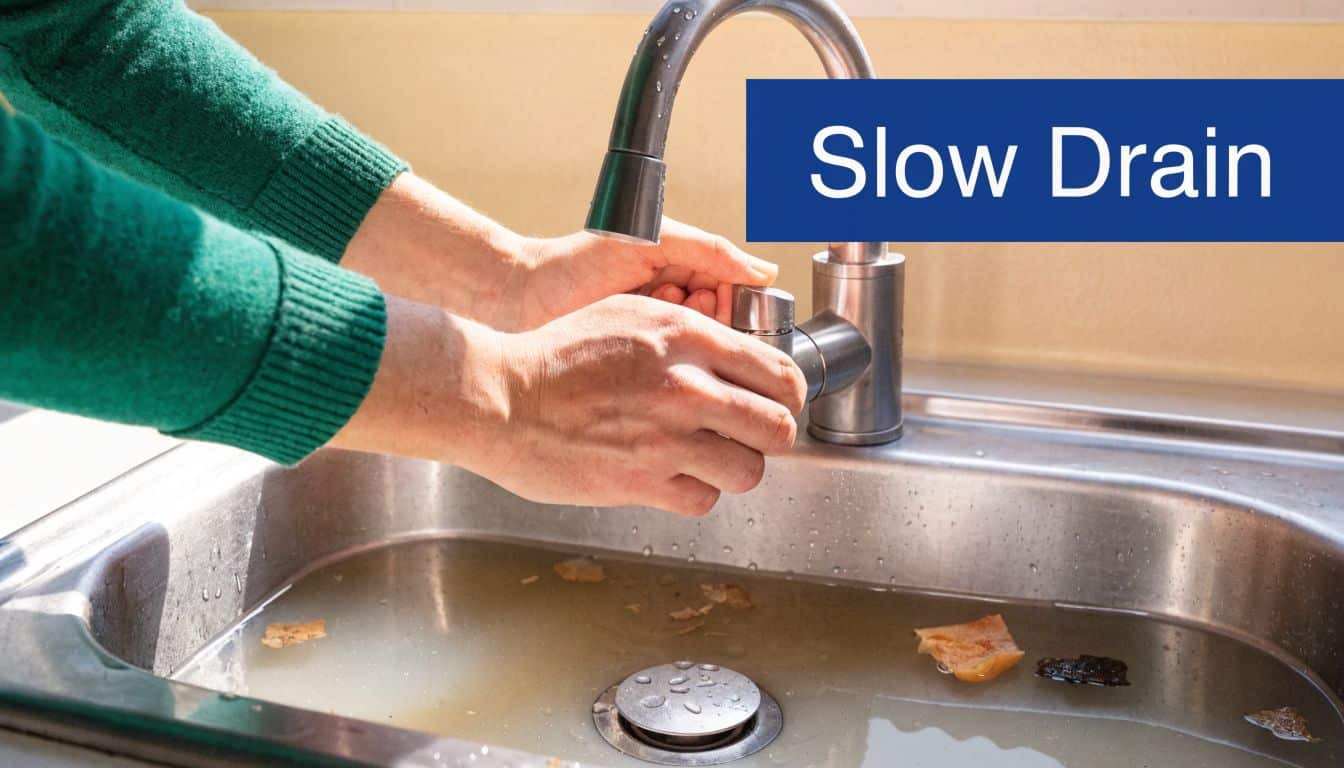
That mix matters. A kitchen clog usually isn’t one clean obstruction you can poke once and forget. It’s often a sticky mass of grease, softened food, soap residue, and biofilm stuck to the pipe wall. That’s why plunging helps sometimes, but often doesn’t finish the job.
What a snake actually does
A drain snake or auger reaches past the trap and into the branch line. Instead of dissolving the clog, it breaks through it, hooks it, or opens enough flow for flushing to carry the loosened debris away.
Practical rule: If the clog is in the pipe, use a mechanical tool. If the problem involves multiple fixtures, stop and diagnose before forcing a cable deeper.
For many homeowners, learning how to snake a kitchen sink is the right middle ground. It’s more effective than guessing. It’s also safer than pouring one chemical after another into a drain you may need to open by hand a few minutes later.
Gather Your Tools and Prepare the Workspace
Good prep makes this job cleaner, faster, and less frustrating. Most kitchen sink snaking jobs go wrong before the cable even enters the pipe. People skip the bucket, leave cleaning supplies packed under the sink, or try to loosen plastic nuts with the wrong pliers and crack the trap.
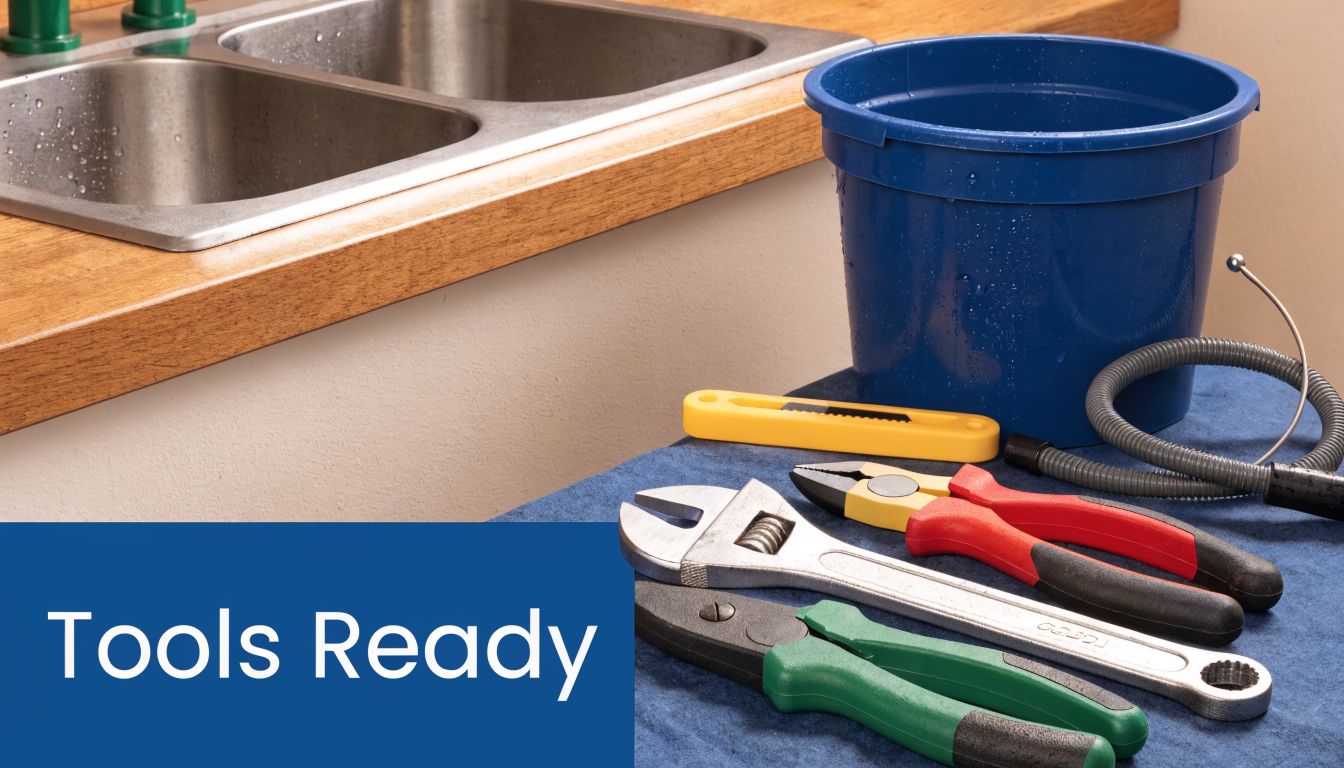
For a typical kitchen sink clog, set aside enough uninterrupted time to work carefully. This isn’t a rush job. You’ll need room to kneel, enough light to see the fittings, and a clear path to remove the trap without dumping foul water into the cabinet.
Required tools and materials checklist
| Item | Purpose |
|---|---|
| Manual drum auger | Reaches into the drain line and breaks up or retrieves the clog |
| Power auger or drill-attached snake | Helps with tougher blockages when manual effort isn’t enough |
| 8-inch channel locks | Loosens slip nuts and fittings without slipping as easily as generic pliers |
| 5-gallon bucket | Catches trap water and debris when you remove the P-trap |
| Old towels or rags | Protects the cabinet floor and wipes down fittings |
| Nitrile gloves | Keeps sludge, bacteria, and residue off your hands |
| Flashlight | Lets you inspect the stub-out and confirm where you’re feeding the cable |
| Bent wire hanger | Removes visible debris near the opening before you snake |
| Screwdriver | Useful if you need to loosen clamps or remove nearby panels |
| Sink or drain caps | Helps isolate one side of a double sink during testing |
| Teflon tape | Helps with reassembly if threaded connections need a better seal |
Prep the area before you touch the plumbing
Start by removing everything from under the sink. Cleaners, trash bags, and storage bins always seem to be exactly where the bucket needs to sit. Lay towels down first, then put the bucket directly below the trap.
Wear gloves from the start. Kitchen trap water is dirty, and if someone already poured chemical cleaner down the drain, you don’t want that on your skin or in your eyes. If a disposal is installed, make sure power to the unit is off before your hands go anywhere near that assembly.
Use a flashlight and look at the layout before you take anything apart. In Los Angeles homes, especially condos and older multifamily properties, under-sink setups can include a double bowl, dishwasher tie-in, disposal discharge, and awkward branch angles. Knowing where each line goes helps you avoid feeding a snake into the wrong path later.
Clear the cabinet completely. A crowded workspace turns a simple trap removal into a spill, and a spill turns into rushed decisions.
The Step-by-Step Snaking Process
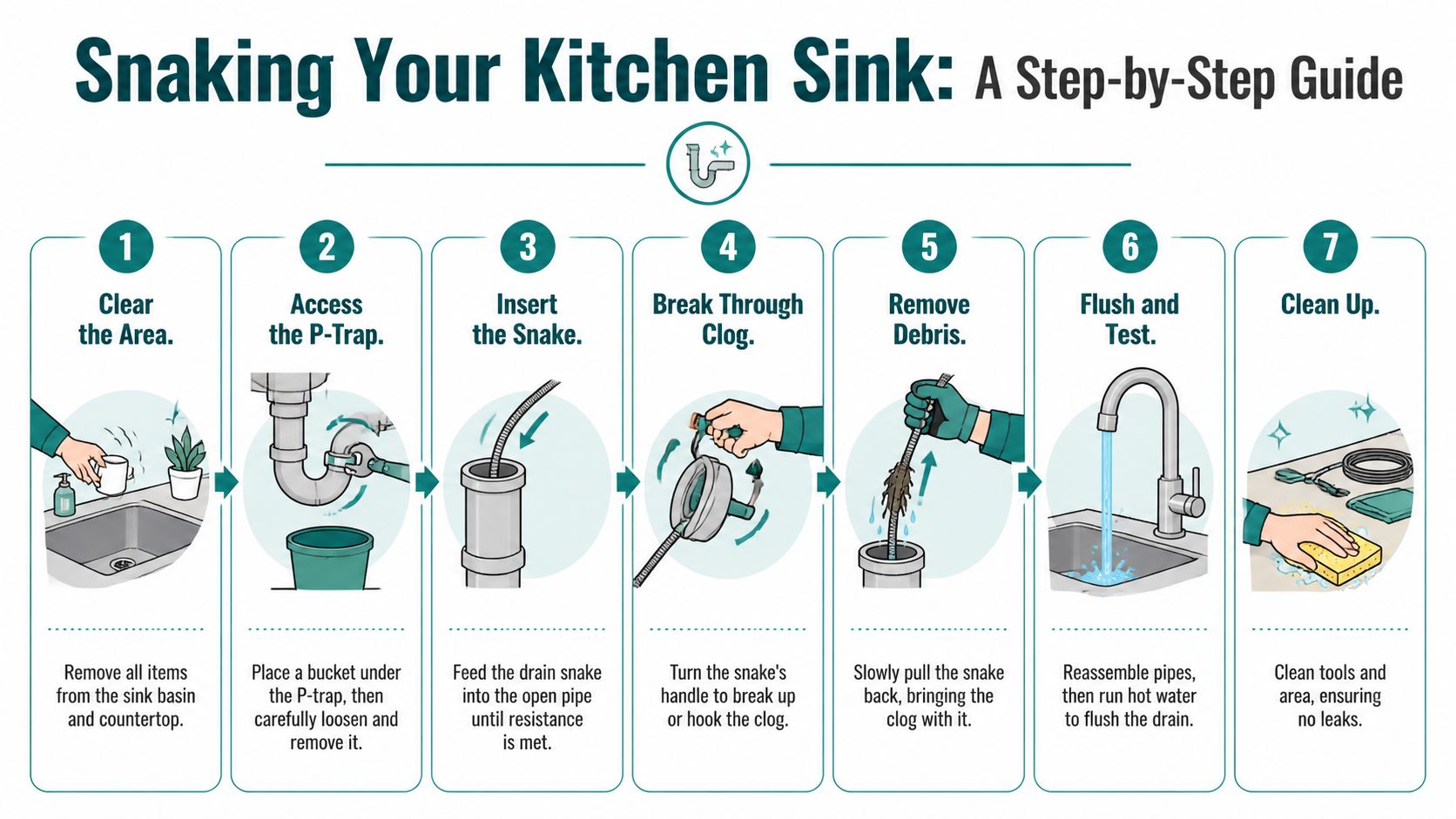
The right sequence matters. Open the line, confirm your access point, then snake the pipe with controlled pressure. Most damage happens when someone forces the cable blindly or spins it too fast.
A visual guide can help before you start handling tools.
Accessing the drain through the P-trap
Put the bucket under the trap and loosen the slip nuts carefully. Support the trap as you remove it so the assembly doesn’t twist against another fitting. Once it drops free, empty the contents into the bucket and inspect what came out.
If the trap is packed with grease or food sludge, clean it fully before reinstalling. If it’s mostly clear, the clog is probably farther down the wall pipe. That’s the opening you want. Feed the snake into the stub-out, not back through a sink strainer unless you have no better access.
A bent wire hanger can help remove debris you can see near the opening. That only helps with shallow obstruction, but it’s worth doing before the cable goes in. Keep your flashlight on the opening and check that the snake enters the wall line smoothly rather than curling back at you.
Using a manual hand auger
A manual drum auger is the best starting tool for most homeowners. It gives you control, and that matters more than brute force in kitchen drain work.
When using a manual drum auger, advance the cable in 1-2 foot increments while cranking clockwise at 60-90 RPM. When you feel resistance, retract the cable six inches and advance again to bore through the clog without damaging the pipe. That technique has a 70-85% success rate for clogs within 10 feet, according to Roto-Rooter’s kitchen sink snaking guidance.
Here’s what that feels like in practice:
- Feed the tip first: Insert the snake head into the wall pipe several inches before tightening the feed control.
- Crank with steady pressure: Turn clockwise and let the cable work. Don’t jab.
- Read resistance correctly: A soft, mushy resistance often means grease or packed debris. A hard stop may be a bend, fitting, or branch.
- Back off and re-approach: Pull back slightly, then advance again while rotating.
- Retract and inspect: Pull the cable out slowly and check for grease, food matter, or stringy debris on the head.
If the cable comes back coated with dark sludge, wipe it clean and run it again. It often takes multiple passes to open a greasy kitchen line well enough for water to carry everything out.
This is the point where patience pays off. A homeowner who rushes usually kinks the cable or jams it into a fitting. A homeowner who works in short controlled passes usually gets the line open.
Before the flush test, it helps to watch the process once.
After a pass or two, loosely reassemble enough of the drain to test with a controlled flow of water. Don’t blast full volume immediately. Start with a modest stream and watch for smooth drainage and leaks under the sink.
If the cable binds hard, stop turning. Forcing a hand auger is how homeowners kink cables and scar pipe walls.
When to use a power auger
A power auger makes sense when the clog is stubborn and still appears to be in a relatively short run. It’s not automatically the better choice. It’s the stronger choice, and that comes with more risk.
Use one only if you can access the line cleanly through the trap opening and control the speed. Low speed is critical. High speed can score pipe walls and create a bigger repair than the original clog.
A drill-attached snake is useful for grease-heavy kitchen clogs because it keeps the head rotating with less hand fatigue. Feed the cable manually at first, get through the first bend, then use controlled low-speed rotation. Short pulses work better than long aggressive runs.
If your property uses cable service regularly, one mechanical option available in Los Angeles is EZ Plumbing’s cable drain service, which is designed for mechanical clog removal in drain lines.
Power tools are not the answer for every sink. They’re a tool for a specific problem. If the cable keeps catching, the line branches unexpectedly, or the clog returns immediately, more force usually isn’t the fix.
Troubleshooting Common Snaking Problems
A lot of DIY guides assume every sink has one straight, simple drain path. That’s not how many Los Angeles kitchens are built. Double-bowl sinks, garbage disposals, dishwasher connections, and shared laterals change the job.
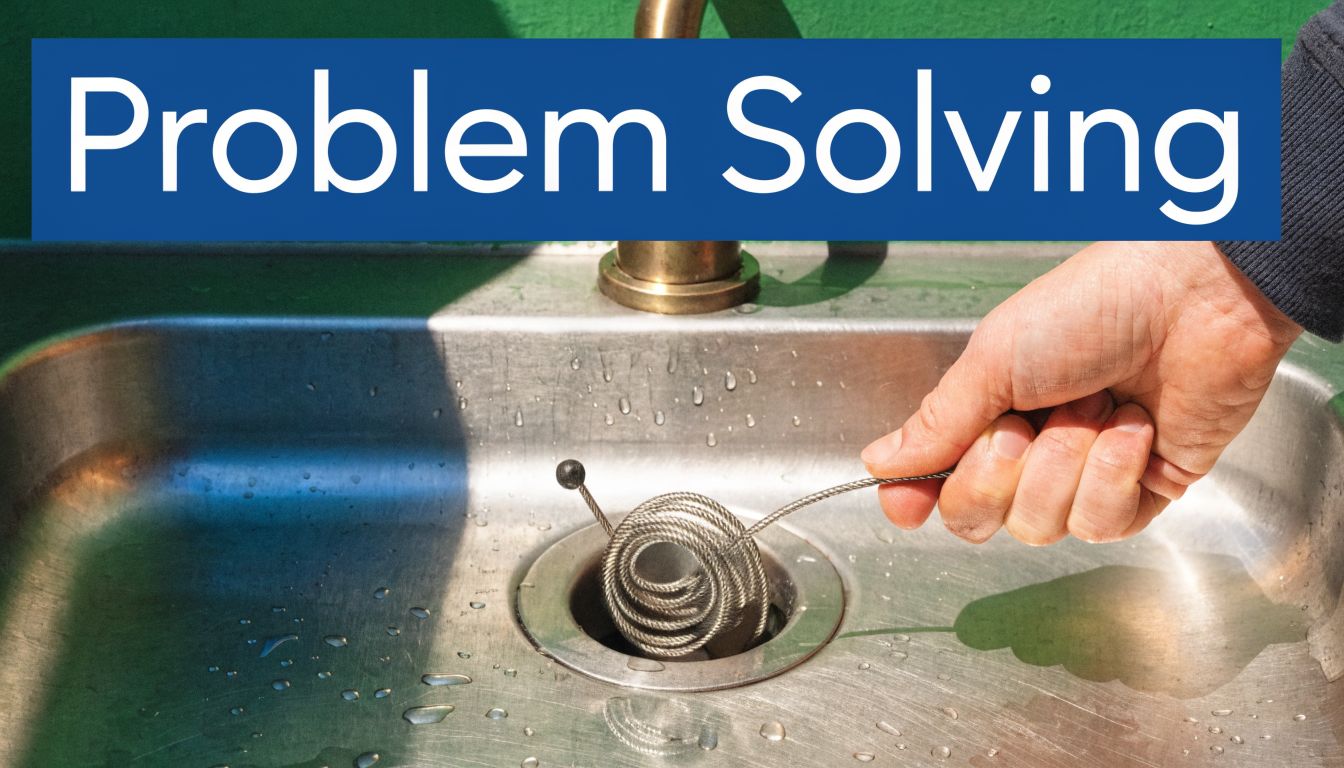
In dense multi-unit buildings common in Los Angeles, an estimated 40% of drain calls involve shared lateral lines. A DIY snaking attempt can inadvertently push a clog into a neighbor's line or fail because the snake takes a wrong turn at a shared junction, a problem rarely addressed in standard guides, as described in this multi-unit drain line overview from Home Depot.
The snake keeps missing the clog
This happens often in double sinks. One side may connect through a disposal, while the other joins at a baffle tee before heading into the trap arm. If you feed a snake from the wrong opening, it can loop into the opposite bowl instead of entering the branch line.
Try isolating the second sink opening with a cap or firm stopper while you work from the side with the clearest path. Watch under the sink as you feed the cable. If it pushes back into a connected branch, stop and change entry strategy.
The cable gets stuck or won’t advance
Don’t yank immediately. Rotate gently while pulling back. A stuck cable may be caught in a tee, wrapped in fibrous debris, or twisted from overfeeding.
If the cable repeatedly stops at the same point, the issue may not be a simple clog. In condo buildings and HOA properties, that’s where a camera becomes useful. A sewer camera inspection for shared or uncertain drain paths can show whether the cable is hitting a branch, a buildup pocket, or a deeper line problem.
The sink drains, then backs up again
That usually means one of three things:
- Partial clearing: You punched a small hole through grease, but left most of the buildup attached to the pipe wall.
- Wrong line: The cable entered a branch and never reached the actual obstruction.
- Shared drain issue: Your sink is reacting to a clog farther downstream that affects more than one unit or fixture.
In multi-sink and multi-unit plumbing, a failed snake attempt doesn’t always mean poor technique. Sometimes the layout is the problem.
If another sink, a dishwasher standpipe, or a nearby drain also acts up, stop treating it like a single-fixture clog.
How to Prevent Future Kitchen Sink Clogs
Clearing the sink is only half the job. If you go back to pouring grease, rinsing food scraps, and ignoring slow drainage, the line will build up again.
According to industry data, 40% of drain clogs recur if proper maintenance isn't performed after the initial clearing. The same data notes 2.1 million annual plumbing service calls for sink clogs in the U.S., which is why regular upkeep matters. That recurrence data appears in this video reference on sink clog maintenance and repeat blockages.
Habits that actually help
- Keep grease out entirely: Don’t send oil, pan drippings, or buttery residue down the drain, even with hot water running. Let grease cool and throw it away.
- Use a real sink strainer: A good basket strainer catches the food particles that create the base of many kitchen clogs.
- Flush with hot water after messy sink use: After washing dishes with heavy residue, run hot water long enough to move loosened material through the line.
- Clean the disposal properly: If you have one, avoid treating it like a trash can. Fibrous foods and starchy scraps create stubborn buildup fast.
- Stay ahead of slow draining: A sink that’s draining slower than normal is giving you warning.
Property owners who want a broader upkeep routine can use a drain maintenance guide for preventing costly plumbing issues to build a more consistent schedule.
What doesn’t help
Chemical drain cleaners often create a false sense of progress. They may soften some material, but they don’t remove the cause the way mechanical cleaning does. They also make later hands-on work nastier and less safe.
A little prevention is cheaper than repeating the same emergency every few months.
When to Call EZ Plumbing for Your Drain Clog
DIY works best when the clog is local, accessible, and limited to one sink. The smart cutoff point is sooner than most homeowners think. If water backs up into other fixtures, sewer odor is present, or the snake repeatedly hits something you can’t identify, stop pushing.
A DIY power auger has a 90% success rate for simple clogs under 8 feet, while professional hydro jetting has an 85% long-term success rate for clearing entire lines of grease and debris, making it the better choice for stubborn or recurring blockages, according to this power auger versus hydro jetting comparison video.
That trade-off matters in real properties. A simple short clog can respond well to a cable. A line with heavy grease coating, repeated backups, or shared drainage usually needs deeper cleaning and better diagnostics. For those cases, professional hydro jetting for grease and recurring drain blockages is often the right next step.
Call when the sink clog affects more than the sink. That’s not giving up. That’s protecting the pipe, the cabinet, and in HOA or multi-unit settings, your neighbors too.
If your kitchen sink still won’t clear, or you’re dealing with a double-sink, disposal, or shared drain line in Los Angeles, contact EZ Plumbing. They serve homes, HOAs, property managers, and multi-unit properties across Los Angeles with 24/7 emergency response and same-day scheduling. Call (818) 908-2710 when the clog needs professional drain cleaning, camera diagnostics, or full-line clearing.