
Water Heater Mixing Valve: How It Works and When to Replace It
A water heater mixing valve blends hot water from your tank with cold water so the temperature reaching your taps stays at a safe, steady level. It is what allows a heater to store water hot enough to discourage bacteria while keeping the shower from scalding anyone. If your water swings between too hot and too cold, runs lukewarm, or comes out of the wrong tap, the mixing valve is one of the first parts a licensed plumber checks. Below we explain how the valve works, how to recognize failure, how to adjust it safely, and when to call us.
TL;DR
- A thermostatic (anti-scald) mixing valve blends hot and cold water downstream of the heater to hold a preset outlet temperature.
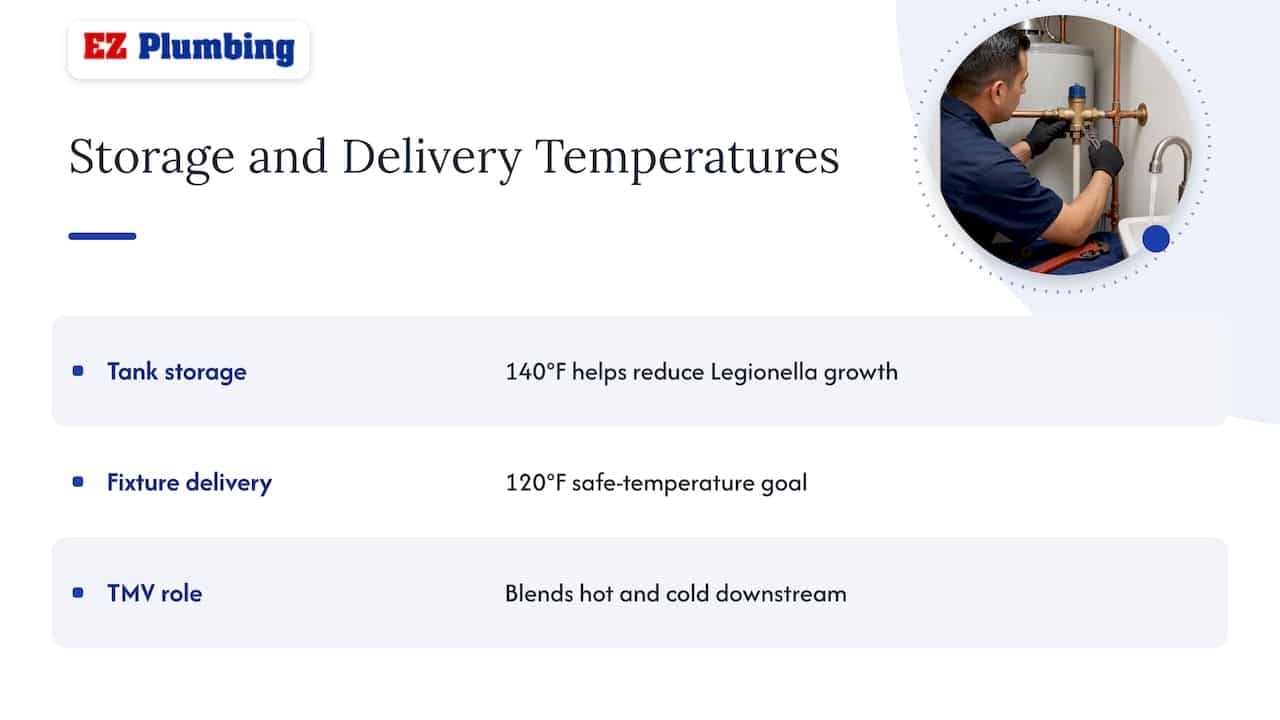
- It lets you store water at 140°F to limit Legionella growth while delivering around 120°F to fixtures.
- Warning signs: trouble setting the temperature, noisy operation, temperatures that drift, or hot water at a cold tap.
- A mixing valve is not a shower diverter. One controls temperature, the other redirects flow between outlets.
- Adjust it only with a thermometer and the manufacturer’s instructions, and have it inspected yearly by a licensed plumber.
Table of Contents
- What a water heater mixing valve does
- How a thermostatic anti-scald valve works inside
- Symptoms of a failing mixing valve
- Mixing valve vs. diverter valve: which one is failing?
- How to adjust a mixing valve safely
- Repair or replace: what usually decides it
- Our perspective: why we install and test these valves ourselves
- Need a mixing valve checked or replaced in Los Angeles?
- Frequently asked questions
- Sources
What a water heater mixing valve does
A thermostatic mixing valve (TMV) sits on the hot outlet of the water heater, with a cold line teed into it. Hot water leaves the tank, meets cold water inside the valve, and the blend goes out to the house at the temperature you set. According to a manufacturer’s technical page, this arrangement lets heaters store water at higher temperatures such as 140°F, which helps reduce Legionella growth, without risking scalding at the fixtures.
That is the practical reason these valves exist. Cooler storage is more comfortable for the tank and safer at the tap, but it favors bacteria. Hotter storage protects against bacteria but is dangerous at a shower or bathtub, particularly for children and older adults. The same source describes delivery at a safe 120°F as the goal, so the valve resolves the conflict instead of making you pick one risk.
A second benefit is stability. Trade reporting in PHCP Pros explains that a thermostatic mixing valve combines hot and cold water downstream of the heater to stabilize delivery temperature and buffer spikes. The same article notes that instantaneous heaters and heat exchangers can produce fluctuating outlet temperatures, which is why temperature-actuated mixing valves are recommended downstream of them to meet code temperature limits. If you are weighing a tankless unit, our tankless water heater page covers what to expect.
Extra capacity from the same tank
Because the valve adds cold water to the blend, a tank set higher can stretch further. Some installers turn the heater up to 140°F and set the valve to roughly 120°F, so a given volume of stored hot water supplies more showers. It is a real benefit in a household with several bathrooms, though it only makes sense when the valve is working and has been verified with a thermometer.
How a thermostatic anti-scald valve works inside
Inside the valve is a temperature-sensitive element, usually a wax or metal element, that sits in the mixed stream. A manufacturer’s technical sheet describes how the element expands and contracts as incoming hot and cold temperatures and pressures change, moving a slide valve that proportions the two supplies to hold the preset outlet temperature.
The failsafe is the part that matters for scalding. The same document explains that if the cold supply fails completely, the element expands fully and moves the slide valve to close the hot seat, shutting off the hot supply instead of sending boiling-hot water to the outlet. That behavior is why a properly working anti-scald valve is a safety device and not just a convenience. The document is from a UK manufacturer, but the thermostatic principle is the same in valves sold in the United States.
Two practical consequences follow. First, the valve needs both supplies to be present and reasonably balanced. Second, the small internal parts (the element, the check valves, the screens) can foul with mineral deposits over time, which is where most problems begin. Los Angeles has hard water in many neighborhoods, so scale is a common reason a valve drifts out of calibration.
Symptoms of a failing mixing valve
The maintenance guide from a commercial valve manufacturer lists the typical signs: difficulty reaching or setting the required temperature, noisy operation, temperature changes over time, or hot water coming from a cold tap because of fouled check valves. In a home, that translates to a handful of situations we see regularly:
The temperature will not hold. You set the shower where you like it and ten minutes later it has crept hotter or colder. Scale on the element or worn internal parts are the usual cause.
Water is never quite hot enough. If the valve is stuck partly open to cold, it dilutes the hot supply constantly. Before blaming the valve, rule out the basics, because a heater problem looks the same. Our guides on what to check when you have no hot water and water heater troubleshooting for no hot water walk through the heater side first.
Hot water at a cold tap. This points to a fouled check valve letting hot water cross into the cold line. It is more than an annoyance, because it also means the valve is no longer protecting you reliably.
Banging, chattering or whistling. Noise at the valve itself, particularly when a tap opens or closes, can signal worn parts or restricted passages.
Scalding bursts when someone flushes a toilet or runs the dishwasher. That is pressure imbalance, and a valve that cannot compensate is failing at its core job. Treat this as urgent, because the risk is a burn, not just discomfort.
Rule out the heater before replacing the valve
A mixing valve gets blamed for things the heater does. A pilot that will not stay lit, a failed thermostat, a worn burner or a sediment-packed tank can all produce weak or inconsistent hot water. If you have a gas unit, start with our guides on troubleshooting a gas water heater and the gas water heater control valve, which is a different component from the mixing valve despite the similar name. The gas control valve manages the burner. The mixing valve manages the temperature of the water leaving the heater.
Mixing valve vs. diverter valve: which one is failing?
Searches about diverter valve issues often get tangled up with mixing valve problems, and the confusion is understandable because both sit behind the wall or beside the heater and both affect your shower. They do different jobs.
A mixing valve controls temperature. A diverter sends water to one outlet or another, such as a tub spout versus a showerhead, without changing how hot it is. One shower brand explains that a shower valve controls the hot/cold balance and on/off, while a diverter directs water between outlets like a showerhead, hand shower or tub spout. Installation guidance from another manufacturer adds that thermostatic shower valves mix hot and cold but do not provide volume or shut-off control, and a diverter is used when a system has multiple fittings. The two often live in the same fitting, which is why they get mistaken for each other.
A quick way to separate them comes from Moen’s support guidance: a transfer (diverter) valve is identified by the devices it selects, while the mixing valve supplies the whole shower system. According to that guidance, losing one device or pressure at one branch points toward the transfer valve, while no water anywhere, or losing only hot or only cold, points toward the mixing valve.
| What you notice | Likely culprit |
|---|---|
| Water keeps coming from the tub spout when the showerhead is selected | Diverter |
| Weak flow at the showerhead but the tub spout is fine | Diverter |
| Water is only hot or only cold everywhere | Mixing valve (or the heater) |
| Temperature drifts or cannot be set | Mixing valve |
| Hot water at a cold tap | Mixing valve check valves |
If the diverter is the problem, our diverter valve replacement guide explains the repair, and the shower valve installation guide covers the case where the whole valve behind the wall needs to be replaced.
How to adjust a mixing valve safely
Adjustment is the one task here that a careful homeowner can sometimes do, but only with a thermometer and the manufacturer’s instructions for your specific model. The following steps summarize a commercial manufacturer’s maintenance guide and apply to typical cap-style valves. Yours may differ, so read the label first.
- Run the water at the fixture for at least two minutes so the valve reaches steady state.
- Measure the temperature of the mixed stream with a reliable thermometer, not by hand.
- Loosen the cap screw. Per the manufacturer’s guide, turning the cap counterclockwise makes the water hotter and clockwise makes it colder.
- Tighten the screw and measure again. Repeat in small steps.
The same guide says that for valves covered by ASSE 1016, 1069 or 1070 applications, the outlet should be set to a safe temperature not exceeding 110°F. That is a manufacturer’s maintenance instruction for those valve classes, and it is lower than the 120°F figure commonly cited for household delivery, so follow the paperwork that came with your valve and your local code.
The guide also says periodic inspection and yearly maintenance by a licensed contractor are required, with regular checking and cleaning of the internal components and check valves. If the valve will not hold a setting after you have adjusted it, stop adjusting. A valve that cannot hold a setting is worn or fouled, and further turning only masks the problem.
Cautions before you touch anything
Do not raise the heater thermostat to compensate for lukewarm water without a working mixing valve in place. Water at 140°F can cause a serious burn in seconds. If you have young children or older adults at home, consider anti-scald protection at the point of use as well, and if you are planning a bathroom modification for safety, accessible bathing systems are worth looking at alongside the valve work. If you smell gas, leave the home and call your gas utility and 911 before anything else.
Repair or replace: what usually decides it
Most mixing valves can be cleaned and rebuilt when the problem is scale on the element or a stuck check valve. Replacement makes sense when the element is worn, the body is corroded, the valve is a poor match for the heater, or the cost of parts and labor approaches the price of a new valve. In older Los Angeles homes with galvanized or mixed-metal plumbing, we also look at the connected piping, because corroded fittings around the valve cause leaks that have nothing to do with the valve itself.
What drives the final bill is the same set of things on nearly every job: the valve type and quality, how accessible the heater is, whether piping has to change, whether the tank needs to be drained, and the time needed to calibrate the outlet temperature. We publish our hourly rates on our rate calculator: $150 to $280 per hour for residential work and $120 to $240 per hour for commercial work. We give you up-front written pricing before work begins, so you know the number before the valve comes off.
A replacement is also a chance to fix related problems in one visit. If the tank is old, if the pressure relief valve is dripping, or if the heater is due for replacement anyway, it is cheaper to address everything together. Our pressure relief valve guide explains why a dripping relief valve should never be ignored or capped.
Our perspective: why we install and test these valves ourselves
We have worked on Los Angeles water heaters since 1989, and the pattern is consistent. Homes built in different eras have very different plumbing: older bungalows with galvanized lines, mid-century homes with copper, and newer builds with PEX. A mixing valve that works well in one can struggle in another because of scale, pressure swings and old piping. That is why we do not treat the valve as a standalone part.
When we replace or service one, we measure the delivered temperature at a fixture, check for cross-flow between hot and cold lines, inspect the heater’s relief valve and connections, and document the job for code compliance. We are licensed (C-36 License #583868) and insured, and the people who answer your call are local staff, not a remote call center.
Our honest advice: if your valve is more than a few years old and you have never had it serviced, have it inspected. Scald protection is a safety device, and the cheapest time to find out it has failed is before someone is standing in the shower.
— EZ
Need a mixing valve checked or replaced in Los Angeles?
If your water temperature is unstable, or you simply want to know whether your valve is still protecting you, we can inspect it, rebuild or replace it, and verify the outlet temperature before we leave. Our technicians handle the valve, the heater and the connected piping in one visit.
See our water heater repair service for repairs, or our water heater installation page if the heater itself is at the end of its life. If you have hot water spraying, a gas smell or flooding, use our 24/7 emergency plumbing line and a local dispatcher will respond.
Frequently asked questions
Where is the mixing valve on a water heater?
It is on the hot outlet at the top of the heater, usually a brass fitting with a cold line teed into it and a cap or dial for adjustment. Not every heater has one, because many older units rely on the tank thermostat alone. If you cannot find one, a plumber can confirm in a minute.
How do you tell if you have a bad mixing valve?
Look for temperatures that drift or cannot be set, noisy operation, or hot water coming out of a cold tap. Any of these suggests fouled or worn parts. Since heater faults look similar, a plumber should confirm which component is at fault before you buy parts.
Is a mixing valve the same as a diverter valve?
No. A mixing valve blends hot and cold water to control temperature. A diverter sends the water to a different outlet, such as the tub spout or showerhead, without changing the temperature. They often sit in the same shower fitting, which is why people confuse them.
How much does it cost to replace a water heater mixing valve?
The price depends on the valve type, access, any piping changes, draining the tank and calibration time. Our hourly rates are published on our calculator page, and we provide a written price before starting work.
Should I adjust the mixing valve myself?
You can make small adjustments if you follow the manufacturer’s instructions and measure with a thermometer. Do not raise the water heater thermostat to compensate. If the valve will not hold a setting, call a licensed plumber.
Sources
- Thermostatic Mixing Valves, Cash Acme
- How Does a Thermostatic Mixing Valve Work?, Horne
- Water Heater Vs. Heat Exchanger and Control Valve, Part 2, PHCP Pros
- Maintenance Guide, Bradley
- Difference Between Diverter and Shower Valve, Kingston Brass
- Installation Guidelines, Waterworks
- Shower Faucet: Low Flow, Independent Transfer Valves, Moen