
Tankless Cold Water Sandwich: Causes and Fixes for LA Homes
A cold water sandwich is the short blast of cold water you get in the middle of a hot shower or between two hot-water uses when a tankless water heater is involved. You get hot water, then a few seconds of cold, then hot again. It happens because the heater shuts off when flow stops and has to go through a start-up sequence when flow resumes. In most homes it is a design trait, not a defect, and it can be reduced with the right settings, a buffer tank, or a recirculation setup.
Below we explain what is happening inside the unit, how to tell normal behavior from a real problem, which fixes work, what each one costs you in energy or delivery time, and when to call a licensed plumber.
TL;DR
- The cold water sandwich is a brief drop in hot-water temperature caused by the heater shutting down and restarting. Manufacturers say it cannot be fully eliminated in a standard plumbing system.
- Short on/off cycles and very low flow make it worse, so check aerators, filters, and flow first.
- Real fixes are a heater with a hot-start or buffer feature, a small mixing or buffer tank, or a recirculation system, each with trade-offs.
- Persistent or severe cold bursts, error codes, or anything involving gas, venting, or electrical work belongs with a licensed plumber.
Table of Contents
- What the cold water sandwich feels like
- Why a tankless heater does this
- Is it normal, or is something wrong?
- Checks you can do before calling anyone
- Ways to reduce the cold water sandwich
- How to check whether a heater has a buffer feature
- When to call a licensed plumber
- Our perspective at EZ Plumbing
- Get a tankless heater that works for your house
- Frequently asked questions
- Sources
What the cold water sandwich feels like
Picture a typical morning. You rinse your hands, turn the water off to lather, and turn it back on. For a few seconds the water is lukewarm or cold, then it returns to hot. Or you shower, pause the water to shave, and restart it to find a cold stretch before the heat comes back. That is the “sandwich”: hot water, a slice of cold, then hot again.
Technically, it is a momentary drop in hot-water temperature at the outlet while the heater recovers. Rinnai describes it as the result of frequent on/off operation in which brief stops and restarts repeat the ignition sequence and let a small amount of cold water through.
It is most noticeable in bathrooms, where people pause the water, and in kitchens, where dishes and hand washing mean many short draws. It is least noticeable in a long, continuous shower.
Why a tankless heater does this
A tank heater keeps a reservoir of hot water ready. A tankless unit keeps nothing in reserve. It heats water only while water is moving through it, which is the source of its efficiency and also of this quirk.
The sequence works like this:
- You open a faucet, and a flow sensor detects demand. Rheem explains that opening a faucet activates the flow sensor and burner.
- Ignition begins. During this delay, cold water keeps moving through the heater. According to Rinnai, the flow-sensing and ignition sequence can take up to 10 seconds on restart, and a small amount of cold water flows through during that time.
- You close the faucet. The sensor sees no flow and the unit shuts down.
- Hot water already sitting in the pipe between the heater and your fixture starts to cool.
- You reopen the faucet quickly. The pipe may still hold some hot water, but the heater is cold and restarting. When that hot slug passes, the cold water that came through the heater during ignition arrives at your fixture.
The cold “filling” of the sandwich is therefore a combination of that restart delay and the cooled water in the line. The longer the pipe run from heater to tap, the more noticeable the effect, because there is more water in the line to deliver before the fresh hot water arrives.
Is it normal, or is something wrong?
For most households a short cold interval after a pause is normal. Rinnai states that the effect is inherent to how tankless heaters operate and cannot be completely eliminated from a standard plumbing system. So the goal is to reduce it to something you barely notice, not to expect it to vanish.
Flow rate is a big factor. Tankless units need a minimum flow before they fire. The U.S. Department of Energy’s Building America program notes that low-flow activation thresholds have historically contributed to delivery problems, with some units reporting thresholds as low as 0.4 gallons per minute. If you run a trickle at a sink, the heater may fire, shut off, and fire again. Rinnai’s troubleshooting guidance also identifies low flow below the unit’s minimum activation requirement as a cause of cycling and cold-water sandwiches.
Signs that point to something more than normal behavior include:
- Cold bursts during steady, continuous flow, not just after a pause
- Water that never gets fully hot, or temperature that swings repeatedly
- An error code on the heater’s display
- Cold water appearing at a fixture only when you run a second fixture, which can suggest a crossover between hot and cold lines
- Noticeably worse performance than when the unit was new
If you see any of those, the cause may be a clogged inlet filter, scale, a faulty sensor, a plumbing crossover, or an installation issue. Our guide to tankless water heater repair covers the common failures, and the pros and cons guide for LA homeowners puts this quirk in context against the rest of the trade-offs.
Checks you can do before calling anyone
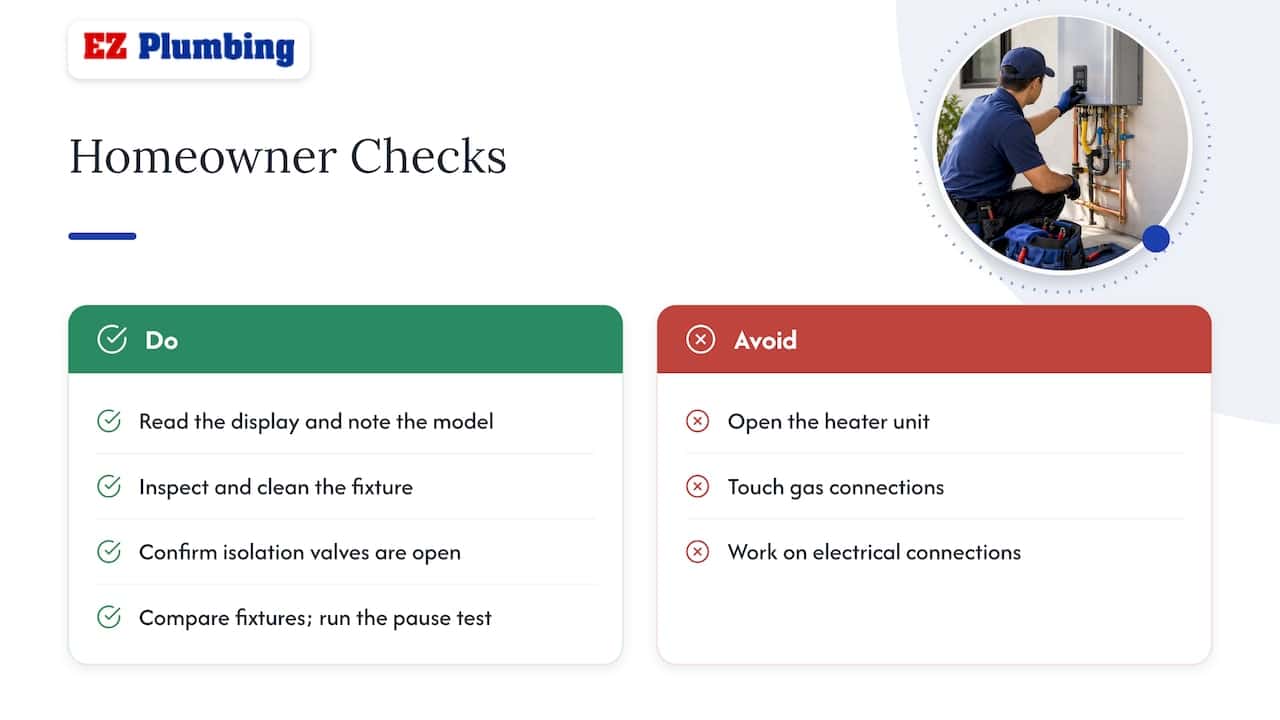
A few low-risk checks are reasonable for any homeowner. None of them involves opening the unit, touching gas, or working on electrical connections.
Read the display. Most modern tankless heaters show an error code. Write it down with the model number. It saves diagnostic time later.
Check the fixture. Unscrew the faucet aerator or look at the showerhead’s flow restrictor. Mineral buildup can cut flow below the heater’s activation threshold, which causes cycling. Soak the aerator in vinegar and rinse it.
Check the isolation valves. Make sure the valves on the heater’s water lines are fully open. A half-closed valve restricts flow.
Test with one fixture. Run only the problem fixture at a moderate flow. Then repeat with a different fixture. If the problem follows one fixture, the issue is local to it. If it appears everywhere, look at the heater or the piping.
Pause test. Run hot water for a minute, turn it off for ten seconds, and turn it back on. If you get a brief cold interval and then steady hot water, that is the classic sandwich. If the water stays cold or lukewarm, something else is wrong.
For a broader no-hot-water checklist, see our guide on what to check before you call a plumber.
Ways to reduce the cold water sandwich
There is no single cure. Each option addresses part of the problem, and each carries a cost in money, energy, or space.
Change how you use the water
The cheapest fix is behavioral. Avoid very short pauses, since a heater that has barely shut down may still be in the middle of its cycle. Use a moderate flow rather than a trickle, so the heater stays above its minimum activation flow. In a shower, adjust the temperature with the handle instead of shutting the water off and back on.
Use a heater with a hot-start feature
Some heaters keep themselves ready for a short time after a draw ends. Rheem’s Hot Start Programming, for example, keeps supported units ready for five minutes after demand ends, which reduces cold bursts during back-to-back use. A Ruud/Rheem product manual says the same thing: the feature is intended to minimize cold-water bursts between back-to-back uses.
This helps with the “quick pause” pattern, such as dishes or a shave. It does less for a long gap, such as walking away for twenty minutes, because the feature has a time window.
Add a small buffer or mixing tank
The underlying cause is that nothing stores hot water. Adding a little storage fixes that directly. The Building America report notes that Bosch and Rinnai recognized hot/cold plug-flow and trickle-flow problems and recommended additional stored water volume to overcome them.
Rinnai describes a small electric storage heater, or a 2-to-6-gallon storage tank, as a mixing tank in circulating systems. The tank version requires full 3/4-inch hot-water supply and return lines, so it is not a drop-in add-on for every house.
The same DOE report describes powered and unpowered buffer options. The powered option is more robust but uses more energy. The unpowered tank can increase delivery time after long idle periods. In other words, you trade away a bit of the tankless efficiency advantage for steadier temperature.
Install a recirculation system
A recirculation loop keeps hot water moving through the pipes, so hot water is waiting at the fixture. Rinnai’s installation manual says recirculation reduces the time required for hot water to reach fixtures. It also notes that Economy mode uses less energy, while Comfort mode cycles more often and uses more energy.
The control method matters a great deal. Los Angeles County’s 2025 plumbing code ordinance defines hot-water recirculation as a supply-and-return system with shutoff and balancing valves, a pump, and a control method, and it describes timer-, temperature-, occupancy-, smart-, and demand-initiated versions. Demand-initiated systems run only when you ask for hot water, which keeps energy use down.
Rinnai’s Circ-Logic guide says on-demand recirculation can run for five minutes or until loop temperature is reached, and that insulated lines improve results. Insulating exposed hot-water pipes is a modest step that helps with any of the approaches above.
We compare control types in more detail in our piece on which recirculation pump control saves energy.
Consider a hybrid design
A hybrid pairs a tankless burner with a small storage volume. A DOE-backed retrofit study found that hybrid systems can mitigate cold-water sandwiches by combining tankless efficiency with the delivery advantages of a storage heater. The modeling supports this approach when delivery consistency matters as much as efficiency, including in warm climates such as Sacramento and Phoenix, which is relevant for Southern California.
Quick comparison
| Option | What it does | Trade-off |
|---|---|---|
| Usage changes | Keeps flow above minimum, avoids short pauses | Free, but relies on habit |
| Hot-start feature | Keeps unit ready for about five minutes | Helps short pauses, not long gaps |
| Small buffer or mixing tank | Adds stored hot water | Needs space and correct piping; powered versions use more energy |
| Recirculation | Brings hot water to the fixture faster | Pump energy depends on control type |
| Hybrid system | Combines storage with tankless heating | Gives up some pure tankless efficiency |
How to check whether a heater has a buffer feature
If you are buying or replacing, do not rely on a marketing page. Look at the installation manual and the specification sheet for the exact model, which manufacturers post on their sites as PDFs. Search the document for terms such as “buffer tank,” “mini-tank,” “hot start,” “recirculation,” and “cold water sandwich.” Check whether the feature is built into the unit or sold as an accessory, whether it needs a separate power connection, and whether the manual lists minimum activation flow in gallons per minute. A lower activation flow generally helps with low-flow draws. If the manual does not mention a feature, ask your installer to confirm it in writing before you buy.
When to call a licensed plumber
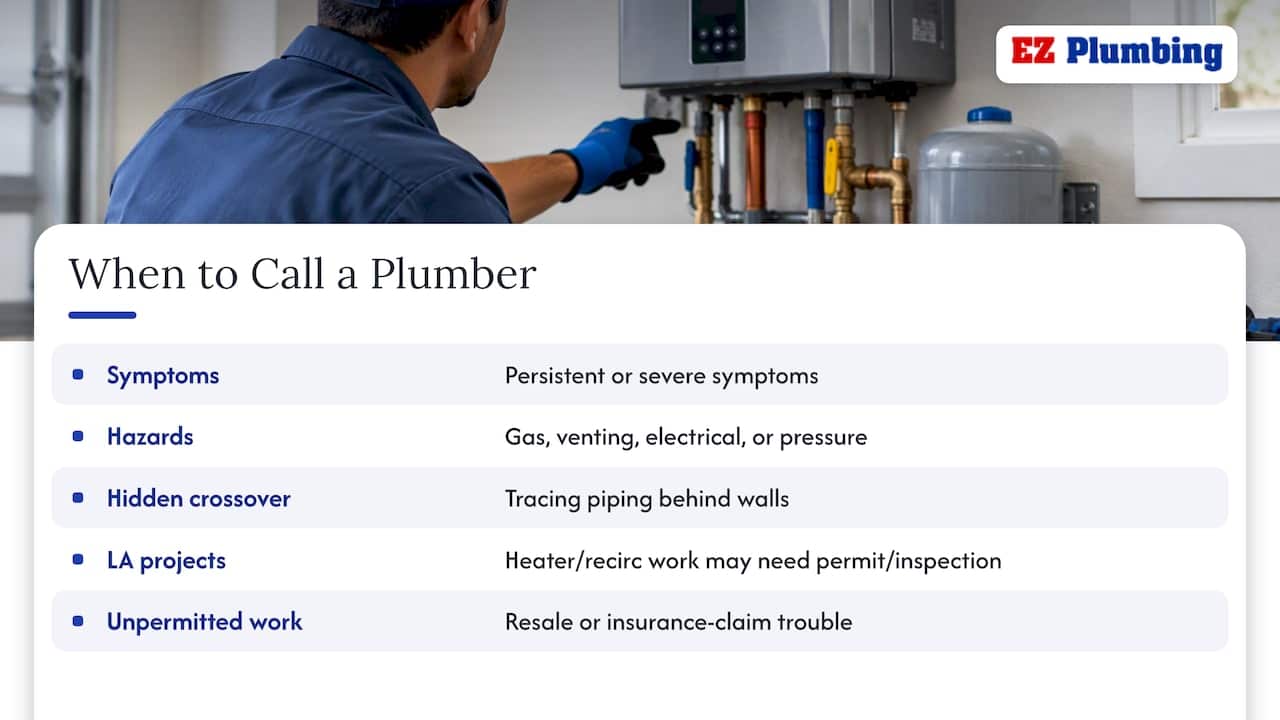
Call a professional for persistent or severe symptoms, and for anything touching gas supply, venting, combustion air, electrical connections, or water pressure. A hidden crossover between hot and cold lines is also a plumber’s job, since it means tracing piping behind walls. Rinnai’s troubleshooting guidance treats the error display, inlet filter, aerators, minimum flow, isolation valves, and recirculation pump or check valve as the first checks, and anything beyond those as work for a qualified technician.
In Los Angeles, replacing or relocating a water heater, or adding recirculation piping, may require a permit and inspection. The Los Angeles Department of Building and Safety publishes a tankless water heater resource that is worth reading before you plan a project. Unpermitted work can cause trouble at resale or after an insurance claim, so it pays to have a licensed contractor handle it.
Older LA homes add their own complications. Houses from different building eras have different piping, long runs between the water heater location and distant bathrooms, and sometimes galvanized lines with corrosion that restricts flow. Those conditions can make a normal cold water sandwich feel much worse.
Our perspective at EZ Plumbing
We have been a family-owned Los Angeles plumbing company since 1989, and the cold water sandwich is a complaint we hear after almost every tankless conversion. Our view is simple: it is a known characteristic of the technology, and it should be planned for before the heater goes in, not discovered afterward.
In practice that means looking at the house before recommending a unit. How far is the heater from the master bath? What are the pipe size and condition? Is there room for a small buffer tank or a recirculation return line? Does the family take long showers or lots of short draws? A heater that suits a one-bathroom bungalow may disappoint in a two-story house with a long run to the far bedroom.
We also think homeowners should hear the honest trade-offs. A buffer tank or recirculation pump improves comfort and costs some energy. A hybrid setup gives up a bit of pure tankless efficiency for steadier delivery. If a customer values a few seconds of cold water less than the lowest possible energy use, a simple usage change may be the right answer, and we will say so.
Our work is documented for code compliance, our technicians know LA’s building codes and housing eras, and we give up-front written pricing so you know the scope before we start.
— EZ
Get a tankless heater that works for your house
If your tankless heater gives you a cold burst you cannot live with, our team can inspect the unit, check flow and piping, and recommend a fix that fits your home. We handle water heater repair and water heater installation across the greater Los Angeles area, and you can review our hourly rate ranges (residential $150–$280 per hour, commercial $120–$240 per hour) on the rate calculator page. Our tankless water heater page explains what we install and service. If there is no hot water at all, our 24/7 emergency plumbing line is staffed by real local people, not a remote call center.
Frequently asked questions
Does every tankless water heater have a cold water sandwich?
Most do to some degree. Rinnai says the effect is inherent to tankless operation and cannot be completely eliminated from a standard plumbing system. Hot-start features, buffer tanks, and recirculation reduce how often you notice it and how long it lasts.
Will a recirculation pump fix it?
It can help a lot, because hot water is already near the fixture when you turn the tap. It does not change the heater’s start-up sequence, so you may still notice a short interval in some setups. A demand-initiated control keeps energy use lower than a continuously running timer or temperature-based system.
Why avoid a tankless water heater?
Some homeowners skip tankless because of higher upfront cost, venting or gas line upgrades, and the cold water sandwich. Whether it is the right choice depends on your household’s usage, pipe layout, and budget. Our pros and cons guide walks through the decision for LA homes.
Is a cold burst during a long, steady shower a sign of trouble?
It can be. The normal sandwich appears after a pause, not during continuous flow. Steady-flow temperature swings can point to a clogged inlet filter, scale buildup, a sensor fault, or a hot and cold crossover, and a licensed plumber should diagnose them.
Sources
- Tankless Water Heaters and the “Cold Water Sandwich Effect” (Rinnai)
- Everything You Want to Know About Tankless Water Heaters (Rheem)
- Expert Meeting Report: Recommendations for Applying Water Heating Systems (U.S. DOE Building America)
- Assessment of a Hybrid Retrofit Gas Water Heater (U.S. DOE Building America)
- Tankless water heater troubleshooting guide (Rinnai diagnostic manual)
- Ruud/Rheem product manual, Hot Start Programming
- Rinnai Tankless Water Heater Installation and Operation Manual
- Rinnai Recirculation with On-Demand Accessories User Guide
- Los Angeles County Title 28 Plumbing Code Ordinance
- Tankless Water Heater (LADBS)