
Water Heater Sizing: What Size You Need for Your Home or Business
Most families of four do well with a 50-gallon tank, but household size is only the starting point. The right water heater is the one that covers your busiest hour of hot-water use without running constantly or heating water nobody needs. Below, we walk through how to size a tank by first-hour rating, how to size a tankless unit by flow and temperature rise, and when a small business needs to think in commercial terms.
TL;DR
- For a family of four, published guidance points to roughly 40 to 50 gallons for regular use and 50 to 75 gallons when demand is high, such as overlapping showers.
- Tank gallons alone do not tell you what you will get. The first-hour rating (FHR) combines stored water with recovery, and it is the number to match to your peak hour.
- Tankless units are sized by flow rate (gallons per minute) and temperature rise, so colder incoming water means a bigger unit.
- Undersized heaters run constantly and wear out early. Oversized tanks lose heat while they sit.
- Restaurants, salons, and other businesses with constant hot-water demand need sustained output, which usually means a commercial system.
Table of Contents
- Quick answers by household size
- Why household size is not the whole answer
- Sizing a tank water heater by first-hour rating
- Sizing a tankless water heater by flow and temperature rise
- What happens when the size is wrong
- Sizing for a small business
- How we help you choose and install the right size
- Frequently asked questions
- Sources
Quick answers by household size
If you want a number before the detail, start with a utility’s published ranges. CenterPoint Energy’s sizing guide separates regular or low demand from high demand, and the spread between the two columns matters as much as the household count.
| People in the home | Regular or low demand | High demand |
|---|---|---|
| 1 to 2 | 30 gallons | 40 to 50 gallons |
| 2 to 3 | not listed separately | 40 to 50 gallons |
| 3 to 4 | 40 gallons (family of four) | 50 to 75 gallons |
| 5 or more | not listed separately | 75 gallons |
Manufacturer guidance lands in the same neighborhood. One major manufacturer says a 40 to 50-gallon electric heater is usually suitable for two to four occupants, while households of five or more often benefit from 55 gallons or more. Another says a 50-gallon tank is a comfortable fit for many families of four when showers and appliances are staggered, and that overlapping use may call for more capacity.
So what size water heater do you need for a family of four? A 40-gallon tank can work if your family showers one after another and runs the dishwasher at off-peak times. A 50-gallon tank is the safer default. Go to 60 or 75 gallons, or to a unit with a high recovery rate, if you have teenagers on the same morning schedule, a soaking tub, or a laundry routine that overlaps with showers.
That last point is why the table is only a starting point. Two homes with four people can have very different peak hours.
Why household size is not the whole answer
Manufacturer guidance treats a lifestyle audit as the first step. Rheem recommends checking shower timing, tub volume, appliance overlap, and peak demand in gallons per hour before you size either a tank or a tankless unit. Concurrency, meaning how many things draw hot water at once, can matter more than headcount.
Here is what we ask homeowners to think through before we recommend anything:
- How many showers happen back to back on a typical weekday morning, and how long are they?
- Do you fill a large tub, and how often?
- Does the dishwasher or washing machine run while someone is showering?
- Has anything changed since the current heater was installed: a new baby, an adult child moving back in, a remodel that added a bathroom?
The last question deserves attention. ENERGY STAR notes that if your existing heater meets your needs, the same size is a reasonable starting point, while increased household demand may justify a larger tank. If you never ran out of hot water with the old unit, matching it is often the right call. If you did run out, the old size is the wrong place to start.
It also helps to lower demand before choosing capacity. ENERGY STAR recommends reducing demand with low-flow fixtures and efficient appliances first, then sizing for the resulting simultaneous peak. If you are updating a bathroom anyway, our notes on bathroom remodeling plumbing cover how fixture choices change the load on your water heater.
Sizing a tank water heater by first-hour rating
The gallon number on the front of a tank is storage volume. It is not how much hot water you can use in a busy hour. The U.S. Department of Energy’s Building America guidance says to list the fixtures and appliances you use during the busiest one-hour period, total their hot-water demand, and select a storage heater whose first-hour rating meets that total, ideally within about 2 gallons.
The first-hour rating is defined in DOE’s test-procedure work as the total gallons a storage heater delivers during one hour, and it depends on both storage volume and recovery rate. Two 50-gallon tanks can have different ratings if one heats water faster than the other. The rating is printed on the yellow EnergyGuide label, so you can compare models directly.
A worked example
The numbers below are illustrative, not measured. Your own fixtures and habits will differ.
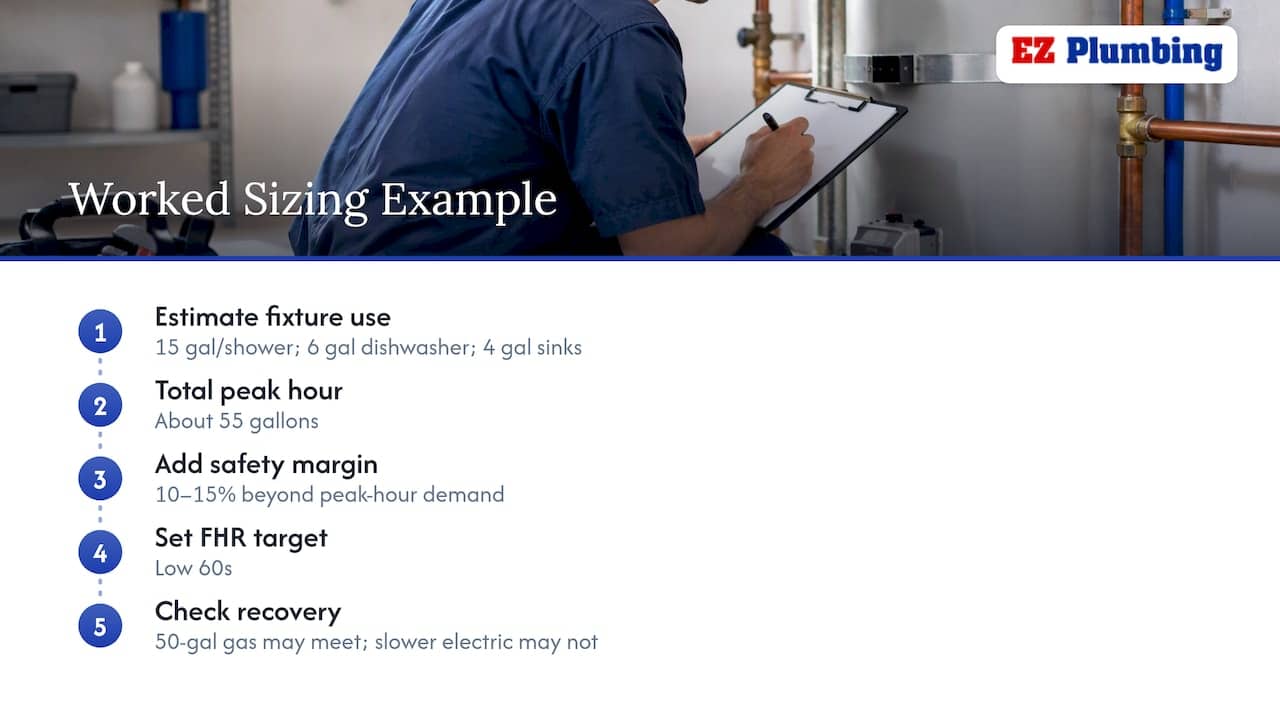
Imagine a family of four on a weekday morning. Over one hour, three people take showers, the dishwasher runs once, and someone washes their hands and a few dishes by hand. If you estimate the hot water each of those uses at roughly 15 gallons per shower, 6 gallons for the dishwasher, and 4 gallons for sinks, the peak hour totals about 55 gallons. You would look for a tank with an FHR at or just above 55 gallons, and you would not stop at asking for a “50-gallon tank.”
Then add a margin. CenterPoint recommends meeting peak-hour demand with roughly 10 to 15 percent capacity to spare. In this example, that points to an FHR in the low 60s. A 50-gallon gas tank with a strong recovery rate may meet it. A 50-gallon electric tank with slower recovery may not, which is why fuel type belongs in the sizing conversation.
Fuel type changes what a gallon means
DOE notes that storage water heaters commonly range from 20 to 80 gallons and may run on natural gas, electricity, propane, or fuel oil, and that selection should weigh fuel availability, cost, capability, longevity, and safety. Gas units generally recover faster than standard electric units of the same size, so a gas tank can often deliver a higher FHR from the same storage volume. If you are comparing fuels, our page on residential gas water heaters explains what we install and what to expect.
Heat-pump water heaters are a different case. ENERGY STAR says they commonly come in 50-, 65-, and 80-gallon options, so the smallest practical size is often larger than a conventional tank you might replace. Plan for the physical footprint as well as the capacity.
Sizing a tankless water heater by flow and temperature rise
Tankless units do not store water, so gallons do not apply. ENERGY STAR explains that tankless capacity is rated in gallons per minute, and it recommends calculating peak demand when all the relevant fixtures and appliances are running together. The manufacturer approach is the same: add the flow rates of the fixtures and appliances likely to operate simultaneously.
The second input is temperature rise. DOE’s tankless guideline says sizing requires the maximum simultaneous hot-water flow and the required temperature rise, calculated as the desired outlet temperature minus the incoming-water temperature. The Building America Solution Center lists the inputs as temperature rise, peak design flow, and required heat-input rate.
The calculation in plain terms
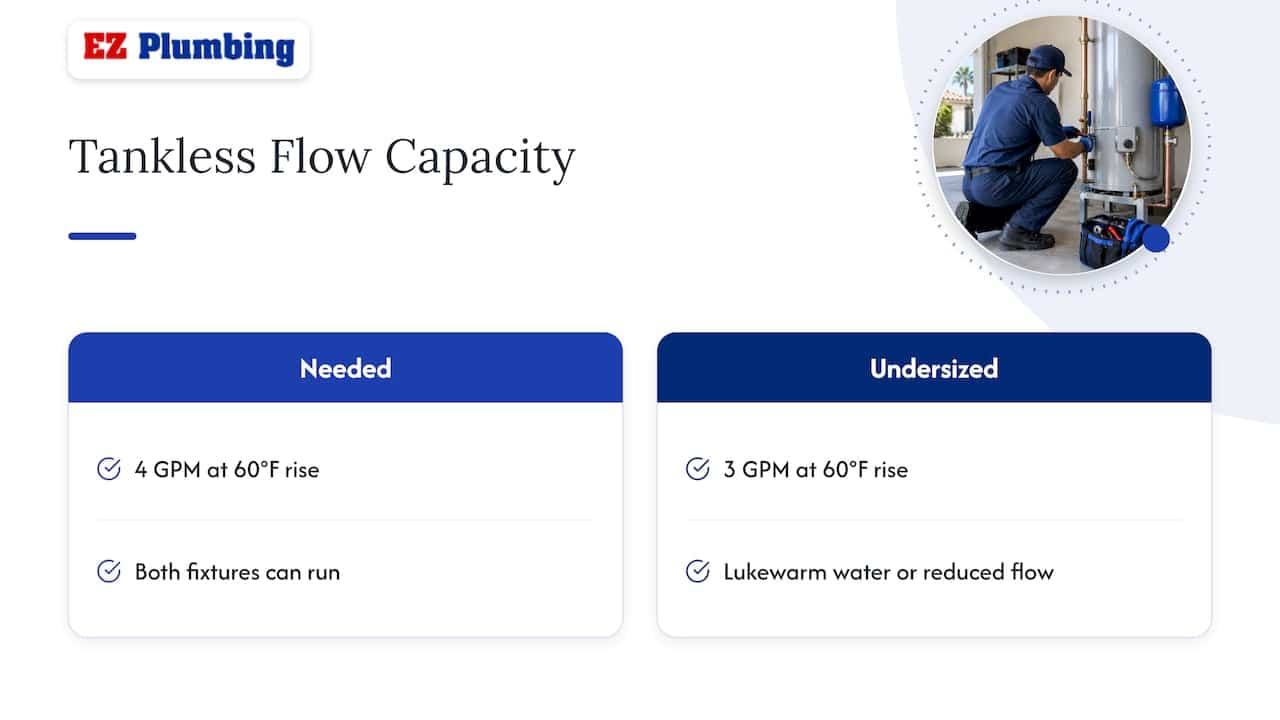
Again, these numbers are for illustration. Suppose a shower and a kitchen faucet could run at the same time, with a combined flow of 4 gallons per minute. You want hot water at 120°F, and the incoming water is 60°F. The temperature rise is 60°F. A tankless heater that can raise water by 60°F at 4 gallons per minute is what you need. A unit that can only manage a 60°F rise at 3 gallons per minute will deliver lukewarm water when both fixtures are open, or it will cut the flow.
For the heat input a gas unit must supply, the standard rule of thumb is flow in gallons per minute times temperature rise times 500 (which comes from 8.34 pounds per gallon times 60 minutes). In our example, that is 4 x 60 x 500 = 120,000 BTU per hour of useful heat, before accounting for the unit’s efficiency.
What this means in Los Angeles
Colder incoming water raises the temperature rise, and that raises the capacity you need. ENERGY STAR says colder groundwater generally requires a higher-capacity tankless heater. DOE’s tankless guidance explains why: the colder the incoming water, the greater the heat input required at a given flow.
Los Angeles winters are milder than most of the country, so the rise is smaller than it would be in a cold-climate city. But size for the coldest time of the year, not for August, because that is when you will notice an undersized unit. We confirm the incoming temperature and your real fixture flows on site rather than relying on a national chart.
Retrofit details that affect size
Swapping a tank for a tankless unit is not always a like-for-like job. Federal research on retrofits found that gas-tankless conversions can require larger gas lines, different venting, added electrical service, and condensate handling. In older Los Angeles homes, where the existing gas line was run for a 40-gallon tank, the gas line may be the deciding factor. If you are weighing the two options, read our comparison of tank and tankless water heaters and our page on tankless water heaters.
What happens when the size is wrong
Both directions cost you money, but in different ways.
An undersized heater runs more often and for longer. CenterPoint warns that it may work constantly and fail prematurely. You notice it as hot water that fades partway through a shower or a long wait between back-to-back uses.
An oversized storage heater has its own cost. DOE warns that oversized units cost more to buy and to operate because a larger stored volume increases standby heat loss. You pay to keep 75 gallons hot all day for a household that uses 40.
The practical goal is a modest reserve, not the biggest tank that fits in the closet. If your hot water fades but the heater is not old, the problem may not be size at all. Sediment, a failing element or burner, or a plumbing issue can mimic an undersized tank, and our guide to what causes low hot water pressure helps you tell the difference.
Sizing for a small business
A café, salon, restaurant, or laundromat does not use hot water the way a family does. Demand is concentrated and often continuous. A manufacturer’s explanation of commercial versus residential equipment says to size a small business around simultaneous demand and sustained output, and that businesses with constant demand need commercial systems. Those installations may involve specialized venting, heavier gas lines, and dedicated electrical service. The same source contrasts residential FHR-based peak delivery with commercial sizing, which focuses on recovery hour after hour.
For a property manager or business owner, that changes the questions to ask:
- What is the busiest continuous period, and how long does it last? A dinner rush is a different load than a morning peak.
- Which fixtures and equipment draw hot water at the same time: prep sinks, dishwashers, mop sinks, hand sinks?
- Is there a health-department or code requirement for water temperature at specific fixtures?
- Can the gas supply, venting, and electrical service support the unit you need?
We treat commercial sizing as a short site assessment rather than a chart lookup. Our commercial plumbing team also sets up maintenance contracts so heaters serving a busy kitchen are flushed and inspected on a schedule, and our commercial plumbing insights cover recurring issues we see in Los Angeles properties.
Our perspective on sizing
Most sizing mistakes we see start with a rule of thumb. Someone replaces a 40-gallon tank with another 40-gallon tank because that is what was there, even though the household has grown. Or someone is sold a larger unit than they need because bigger feels safer.
We approach it the other way around. We start with how your household or business uses hot water, then look at the physical constraints: gas line size, venting, electrical capacity, and where the unit will sit. Los Angeles has a wide mix of housing from different eras, and older homes and small commercial spaces often have tight utility closets or gas lines sized for equipment that no longer matches how people live. Knowing those local conditions is what lets us recommend a size that works in your building, not only on paper.
We are family-owned, and our licensed plumbers install to Los Angeles code and document the job. You get up-front written pricing, and you talk to real local staff, not a remote call center. If you have an old heater that no longer keeps up, a quick on-site look at your fixtures and fuel supply usually answers the sizing question better than any calculator.
EZ
How we help you choose and install the right size
We are a licensed plumbing company (C-36 License #583868) serving the greater Los Angeles area, with residential and commercial water heater installation and repair. For sizing, a visit usually covers your peak-hour demand, the fuel and venting you have, and whether a tank, a larger tank, a heat-pump unit, or a tankless system fits your building. Installation pricing starts from your specific setup, and you can see how we present it on our water heater installation page.
Our published labor rates are $150 to $280 per hour for residential work and $120 to $240 per hour for commercial work, and you can estimate a job with our plumber rate calculator. If your current heater is struggling, our water heater repair team can check whether the problem is size or something fixable. For a first look at what installation involves, see our water heater installation guide for homeowners. To book a sizing assessment, start at ez-plumbing.com.
Frequently asked questions
Is a 50-gallon water heater enough for four people?
For many families of four, yes. Manufacturer guidance calls a 50-gallon tank a comfortable fit when showers and appliances are staggered. If your household regularly showers at the same time or runs laundry during peak use, check the first-hour rating and consider a larger tank or a faster-recovery model.
Is a 40-gallon water heater enough for a family of five?
Usually not. Published ranges put five or more people at roughly 55 gallons and up, and one utility lists 75 gallons for high-demand households of five or more. A 40-gallon tank may work for a family that uses very little hot water at once, but it is more likely to run out.
Is a 30-gallon water heater enough for three people?
It is tight. A utility’s table lists 30 gallons for one or two people under regular demand, and 40 to 50 gallons for two to three people under high demand. For three people, 40 gallons is the more common starting point, and your peak hour decides whether it holds up.
Can I size a water heater by the number of bathrooms?
Bathroom count is a rough clue, not a method. What matters is how many fixtures draw hot water at once and for how long. A two-bathroom home with a soaking tub and teenagers can need more than a three-bathroom home with two occupants. Use your busiest hour as the guide.
Should I go up a size when I switch to tankless?
You do not choose a tankless size in gallons. You choose a flow rate and temperature rise that cover your simultaneous peak, and the colder your incoming water, the more capacity you need. Check your gas line and venting too, since retrofits can require upgrades.
Sources
- CenterPoint Energy: Water Heater Sizing Guide
- Rheem: What size water heater is best for my home
- A. O. Smith: What size water heater do you need for your home
- Rheem: How to size a water heater
- ENERGY STAR: Heat Pump Water Heater Marketing Toolkit
- ENERGY STAR: Technical Bulletin on Demand Water Heaters
- U.S. DOE Building America: Water Heating
- U.S. DOE: Water Heater Test Procedure Rulemaking development testing
- U.S. DOE: Measure Guideline, Transitioning to a Tankless Water Heater
- Building America Solution Center: DHW Instantaneous Sizing
- U.S. DOE: Assessment of a Hybrid Retrofit Gas Water Heater
- A. O. Smith: Commercial vs. residential water heaters