
Tankless Water Heater Sizing: A Los Angeles Guide
To size a tankless water heater, add up the hot water you will run at the same moment, in gallons per minute (GPM), then work out how many degrees the unit must raise your coldest incoming water. Those two numbers, flow and temperature rise, point you to a model whose output chart covers them. Household size and the old tank’s gallons are only starting points. Below is the method we use, with worked examples and the gas and electrical checks that decide whether a unit you like will actually fit your Los Angeles home.
TL;DR
- Tankless units are sized by flow (GPM) at a given temperature rise, not by stored gallons, so a 40 or 50 gallon tank does not convert directly to a tankless size.
- Add up the fixtures that realistically run together at peak, then subtract your coldest inlet water temperature from your target temperature to get the rise.
- A rough screening range for a family of four is 8 to 10 GPM, but your simultaneous use and winter inlet temperature decide the final unit.
- Gas units need a gas line that can carry the Btu input. Electric units need panel and circuit capacity, often more than older homes have.
- A licensed plumber should confirm the numbers and pull the permit before you buy.
Table of Contents
- Why tankless sizing works differently from tank sizing
- Step 1: Find your peak simultaneous flow
- Step 2: Calculate the temperature rise
- Step 3: Match the numbers to a model
- Rough sizes by household
- Replacing a 40 or 50 gallon tank
- Gas or electric: what your home has to support
- What we see in Los Angeles homes
- Our perspective on sizing
- Get your numbers checked
- Common sizing mistakes to avoid
- Frequently Asked Questions
- Sources
Why tankless sizing works differently from tank sizing
A tank heater is sized by how much hot water it stores. That is why you hear 40, 50 and 75 gallons. A tankless heater stores almost nothing. It heats water as it flows, so what matters is how much water per minute it can heat and by how many degrees. Navien’s sizing guide makes the same point: tank units are rated by stored gallons, while tankless units are rated by flow rate.
That has a practical consequence. Two things set the size of the unit you need:
- Maximum simultaneous flow, the most hot water you will draw at once, in GPM.
- Maximum temperature rise, the gap between your incoming water and the temperature you want at the tap.
The U.S. Department of Energy’s Building America guide says sizing must use both the maximum simultaneous hot water flow and the maximum required temperature rise, and that manufacturers publish selection charts for that combination. Every model has a limit. As the rise goes up, the flow it can deliver goes down.
Step 1: Find your peak simultaneous flow
Start by writing down which hot water fixtures could run together on your busiest morning or evening. Be honest rather than optimistic. If two people shower while the dishwasher runs, count all three.
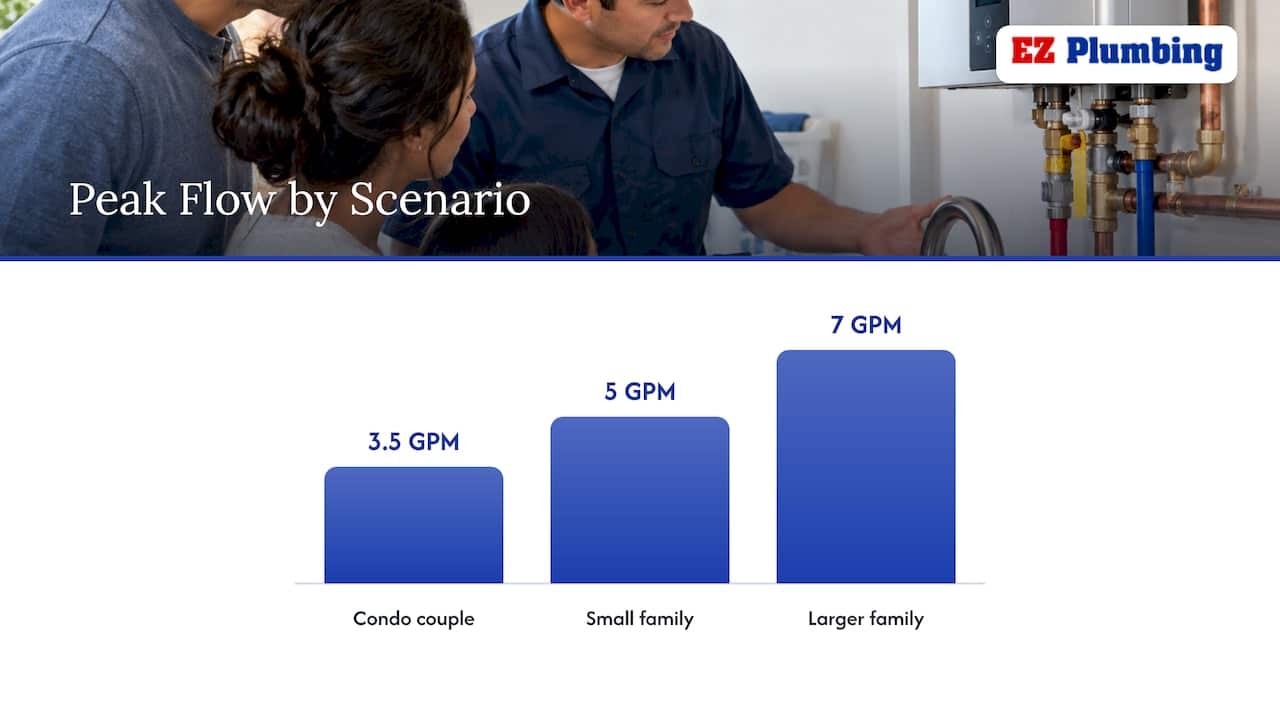
For fixture flow rates, read the rating on the fixture or the manufacturer’s spec sheet. Showerheads are the biggest draw, and a WaterSense-labeled showerhead is rated at no more than 2.0 GPM. Older showerheads, which are common in pre-1990s Los Angeles homes that have never been updated, can run noticeably higher. Faucets, dishwashers and washing machines vary by model, so check the labels.
Here is an illustrative example. These flow figures are assumptions for the exercise, not measurements of your home:
| Scenario | Fixtures running together | Approximate peak flow |
|---|---|---|
| Couple in a condo | One shower (2.0 GPM) and one kitchen faucet (1.5 GPM) | 3.5 GPM |
| Small family, one busy morning | Two showers (4.0 GPM) and a bathroom faucet (1.0 GPM) | 5.0 GPM |
| Larger family | Two showers (4.0 GPM), dishwasher (1.5 GPM), kitchen faucet (1.5 GPM) | 7.0 GPM |
The low-flow fixture detail matters. Stiebel Eltron’s Tempra sizing guide notes that actual maximum flow should be used to refine household recommendations, and gives the example that 3 GPM can supply two 1.5 GPM low-flow showers. Swapping in efficient fixtures can let you buy a smaller unit.
Step 2: Calculate the temperature rise
Temperature rise is simple subtraction: the temperature you want at the fixture minus the temperature of the water coming into the heater. EcoSmart’s FAQ explains that temperature rise is outlet temperature minus inlet temperature, and a greater rise reduces the flow a given electric model can heat.
Two details trip people up:
- Use the coldest inlet water, not an annual average. Navien recommends calculating from the coldest expected inlet-water temperature. A unit sized for July will disappoint you in January.
- Use a realistic setpoint. Navien notes residential settings are typically 120°F or 125°F. Its worked example uses a 120°F setpoint and 55°F inlet water, which requires a 65°F rise.
So if you want 120°F and your winter inlet water is 55°F, you need a 65°F rise. If your cold water is 15 degrees colder, you need an 80°F rise, and the same heater delivers less flow. We do not quote a single inlet temperature for all of Los Angeles, because it varies with season, your water supplier and how the line runs to your house. Measure it with a thermometer on the cold line on a cool morning, or ask your installer to.
A worked example
Say your peak is 5 GPM (two showers and a bathroom sink) and your coldest inlet water is 55°F with a 120°F setpoint, a 65°F rise. You then look at a candidate model’s performance chart and ask one question: at a 65°F rise, can it deliver at least 5 GPM? If the chart says 4.5 GPM at that rise, it is too small for your peak, even if its box says a bigger number. If it says 6 GPM, you have headroom.
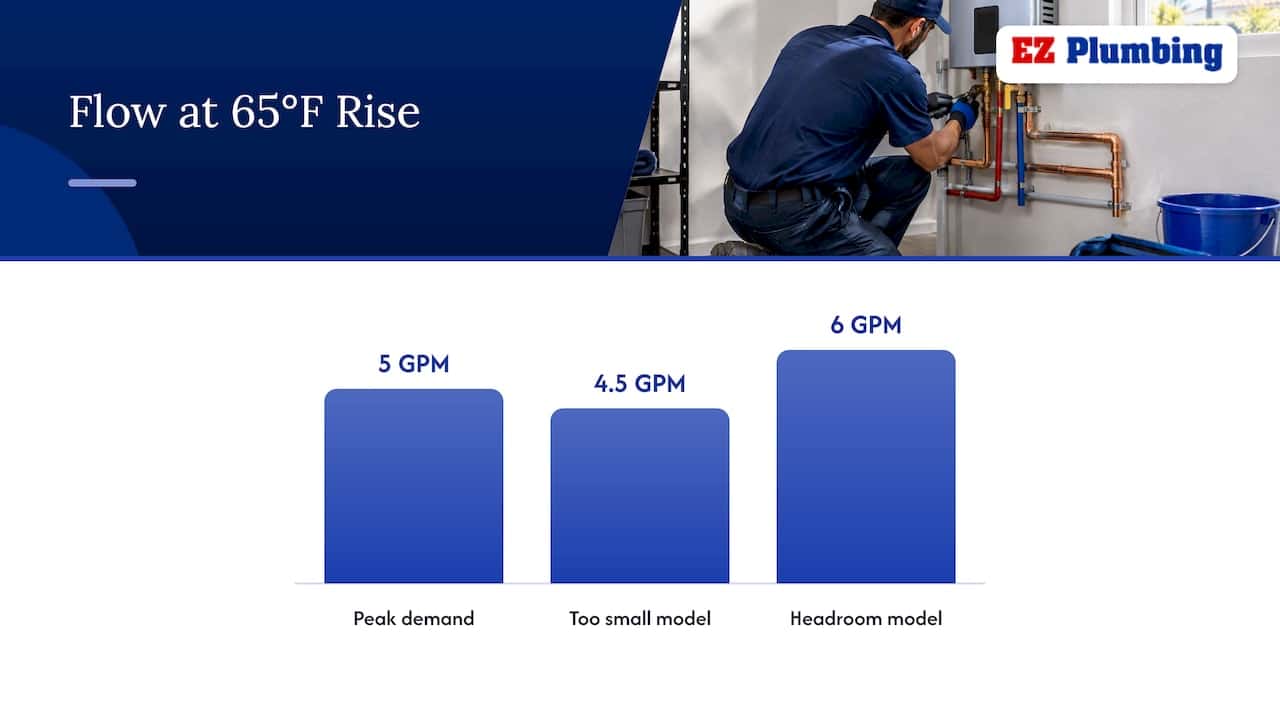
The headline GPM on a box is usually the maximum flow at a modest rise. It is not what the unit delivers at the rise you actually need. This is why the chart matters more than the label.
Step 3: Match the numbers to a model
Once you have flow and rise, the output chart does the matching. The DOE’s Building America Solution Center has an instantaneous water heating sizing tool that takes temperature rise and peak design flow and returns the required heat input, which you use to select the unit. It also flags that some instantaneous heaters have a fixed output while others modulate their firing rate with flow, so you need to know how your chosen appliance behaves before relying on a number.
In practice, a good installer does this with the manufacturer’s data for the specific model. If you are shopping on your own, compare charts at your rise, not the headline.
Rough sizes by household
People often want a starting number before running the full calculation. As a screening range, Home Depot’s buying guide suggests 6 to 8 GPM for two residents and 8 to 10 GPM for a family of four. Treat those as a first filter only. Actual selection still depends on simultaneous fixtures and your coldest inlet temperature.
That is also why bedroom and bathroom counts mislead. Stiebel Eltron’s view is that two homes with the same number of bathrooms can need different equipment, because what counts is how many outlets run at the same time. A three-bedroom, two-bath house where the family showers one after another needs less than the same house with teenagers who all leave at 7:30.
Replacing a 40 or 50 gallon tank
This is one of the most common questions we hear, and the honest answer is that there is no direct equivalent. A 40 gallon tank and a 50 gallon tank both get replaced by tankless units of very different sizes depending on the household. Navien advises not to convert tank gallons into a tankless size, and offers a rough guide of 5 GPM for two to three simultaneous fixtures and 7 GPM for three to four.
A better approach is to ask how you use the tank today. If you regularly run out of hot water, you may want more capacity than your old tank offered. If you never come close, a smaller tankless unit could work. Our guide on the difference between tank and tankless water heaters covers that comparison, and our types of water heaters guide explains the other options.
Gas or electric: what your home has to support
Sizing is only half the job. The best-sized unit is useless if your home cannot feed it. Check these before you buy.
Gas units
A gas tankless heater has a much higher Btu input than a tank heater, so the gas line has to carry it. The DOE guide says gas units require checking gas-line capacity against the heater’s Btu input, following the manufacturer’s instructions and plumbing code, and that retrofit homes may need a larger gas line. Older Los Angeles houses and bungalows, where the original line was sized for a tank heater and a stove, are exactly where this comes up. Venting is the other check, since a tankless unit has different venting requirements than the tank it replaces.
Electric units
Electric tankless heaters draw a lot of power. The same DOE guide says they commonly require 208 or 240 volts and 50 to 200 amps depending on size, so you must confirm your available electrical capacity before choosing. EcoSmart’s position is that selection depends on incoming water temperature, maximum desired flow and available electrical service. A flow answer without panel capacity is incomplete.
In many older LA homes with 100 amp panels, a whole-home electric unit would require a panel upgrade, and that cost can change the math. If you are weighing electric hot water in general, this overview of water heater electricity consumption explains how power use drives running costs. For point-of-use electric units serving a single sink, the electrical demand is far smaller.
What we see in Los Angeles homes
We have worked on Los Angeles homes since 1989, and the same patterns repeat. Homes from different building eras present different challenges: older houses may have undersized gas lines, galvanized supply piping that restricts flow, or tight utility closets and garages with limited venting options. Galvanized corrosion in particular can reduce the flow reaching a new heater, so a unit sized correctly on paper can underperform if the supply piping is restricting it. Where that is the case, repiping the supply and installing the heater together is often the cleaner job.
Tankless installs in the city also need a permit and inspection, and we document our jobs for code compliance. You can see examples of our water heater work in our recent Los Angeles Raypak system job.
Our perspective on sizing
Most sizing mistakes we are called to fix come from one of three shortcuts: buying by the household headcount, using the box’s headline GPM, or ignoring the gas line and the panel until the installer shows up.
We start with a conversation about how your household actually uses hot water, then check the coldest inlet temperature, the fixtures, the gas or electrical capacity, and the venting path. Only then do we pick a model, using its output chart at your temperature rise.
That is what a family-owned, fully licensed and insured plumbing company can offer that a web calculator cannot: someone who has seen your kind of house, in your neighborhood, and who will put the price in writing before work starts. Tankless done right is a strong upgrade for the right home, and sizing is where it is won or lost.
EZ
Get your numbers checked
If you would rather not do the arithmetic yourself, we will do it with you. We size and install tankless units across Los Angeles as part of our water heater installation service, covering the flow calculation, gas line or electrical check, venting and permit. Our published residential labor rate is $150 to $280 per hour, and you can estimate a job on our pricing calculator. We give up-front written pricing before work begins.
If your current heater is failing and you need a fast answer, our water heater repair team can assess it, and our 24/7 emergency line is there if you have no hot water or a leak. For a fuller look at what the benefits and trade-offs mean for your house, read our tankless water heater guide for LA homeowners, and see our tankless water heater page for the services we provide. If you want to know how long the job takes, we explain water heater installation time too.
Common sizing mistakes to avoid
A few errors account for most of the unhappy tankless owners we meet.
Sizing for the average day. Peak demand is the number that counts. If the unit can handle two showers at once in the winter, it will handle everything else.
Using summer water temperature. Inlet water is coldest in winter, and that is when the heater works hardest. Size for that day.
Forgetting future fixtures. If you plan to add a bathroom or a second shower in a remodel or an ADU, size for the house you will have, not the one you have today.
Skipping the gas line or panel check. Both can add cost, and both are far easier to find before you buy than after the unit is on your garage floor.
Ignoring the supply piping. Old galvanized or partially blocked pipes limit flow regardless of what the heater can produce.
Frequently Asked Questions
What size tankless water heater do I need for a 3 bedroom, 2 bath house?
It depends on how many fixtures run at once, not on the room count. A household that rarely runs two showers together may be well served by roughly 5 GPM at its winter temperature rise, while a busier household may need more. Add up your peak simultaneous flow and check the model’s chart at your rise.
What size tankless water heater replaces a 40 or 50 gallon tank?
There is no direct equivalent, because tanks are rated in gallons and tankless units in GPM. Navien suggests about 5 GPM for two to three fixtures and 7 GPM for three to four as a rough guide. Your coldest inlet temperature and actual peak use determine the final size.
How many GPM do I need for a family of four?
As a rough screening range, 8 to 10 GPM is commonly suggested for a family of four. Whether you need that much depends on how many showers and appliances run at once. If you have low-flow fixtures, a smaller unit may be enough.
Does a bigger tankless water heater always work better?
Not necessarily. A larger unit costs more, and a gas model needs a bigger gas line while an electric one needs more amperage. Sizing to your real peak at your real temperature rise gives you steady hot water without paying for capacity you will never use.
Sources
- Measure Guideline: Transitioning to a Tankless Water Heater (U.S. Department of Energy)
- WaterSense Specification for Showerheads, Version 1.1 (U.S. EPA)
- Tankless Water Heater Sizing Guide (Navien)
- EcoSmart FAQ
- Tempra and Tempra Plus Sizing Guide and Technical Data (Stiebel Eltron)
- DHW Instantaneous Sizing (Building America Solution Center)
- Tankless Water Heater Buying Guide (The Home Depot)
- What Size Electric Tankless Water Heater Do I Need (Stiebel Eltron)
- Water heater electricity consumption