
5 Step Commercial Plumbing Maintenance Plan for Facility Managers
A commercial plumbing maintenance plan is a scheduled, risk-based inspection and service program that catches failures before they become emergencies and documents every visit for budgeting and compliance. The first move is not picking a vendor. It’s scheduling a baseline plumbing survey and building an asset map of every shutoff, backflow device, and interceptor on your property. From there, the plan layers in routine inspections, drain and water heater service, and backflow testing on a cadence that matches your building’s risk.
TL;DR:
- Routine inspections should be tailored to building risk, with high-usage kitchens needing monthly checks, while offices may only require quarterly visits.
- Asset maps created during walk-throughs are critical for rapid response and should include all shutoffs, backflow devices, interceptors, and critical system locations.
- Water quality influences maintenance frequency, with hard water demanding semiannual flushes and softening systems to prevent costly scale buildup or internal corrosion.
- Documented records, including photos, meter readings, and compliance papers, are essential to prove ROI and reduce reactive repairs, especially for emergency planning.
- Preventive maintenance plans should include a clear escalation procedure, scheduled cadences based on risk, and bundling site visits to cut costs across multiple locations.
Table of Contents
- What Does a Commercial Plumbing Maintenance Checklist Cover?
- How Do You Build a Plumbing Maintenance Plan for Your Facility?
- What’s a Typical Commercial Plumbing Maintenance Schedule?
- How Do You Prove ROI on a Plumbing Maintenance Program?
- How Do Licensed Plumbers Actually Run These Programs?
- What Training Do Maintenance Staff Need for Plumbing Upkeep?
- How Does Water Quality Affect Commercial Plumbing Maintenance?
- Why Planned Maintenance Beats Reactive-Only Plumbing
- Get a Baseline Survey From EZ Plumbing
- Sources
- FAQ
What Does a Commercial Plumbing Maintenance Checklist Cover?
A working plumbing maintenance checklist breaks down by system, not by a single generic walkthrough. Facility managers who try to cover everything in one pass tend to miss the components that fail quietly, like a slow-drifting T&P valve or a backflow assembly that’s a year past certification.
Here’s what belongs in a commercial plumbing maintenance checklist, system by system:
- Fixtures and restrooms. Flush valve testing, sensor calibration on automatic fixtures, and repairs to running toilets before they waste thousands of gallons a month.
- Drains and sewers. Visual line checks, floor drain servicing, grease interceptor cleanouts, and hydrojetting on lines showing slow flow or recurring backups.
- Water heaters and boilers. Tank flushing to clear sediment, temperature and pressure relief (T&P) valve checks, and controls and recovery-time testing.
- Pumps and lift stations. Run tests under load, alarm verification, and float or sensor inspection so a failure doesn’t surface as a flooded mechanical room.
- Backflow prevention devices. Annual (or locally mandated) testing, certification paperwork, and submission of records to the water authority.
- Shutoff valves and isolation points. Exercising valves so they don’t seize shut, plus labeling and documenting their exact locations.
- Sump pits, ejectors, and stormwater interfaces. Testing float switches and clearing debris before the next heavy rain finds the gap.
Commercial programs built around these categories typically bundle drain inspections, backflow testing, water heater servicing, pump checks, and valve exercises into a single scope tailored to how the building is actually used. A restaurant kitchen and a corporate office need the same categories covered, but at very different frequencies.
How Do You Build a Plumbing Maintenance Plan for Your Facility?
A generic template rarely fits a real building. The plan has to reflect your occupancy, your failure history, and how much disruption your tenants or customers will tolerate. Five steps get you there.
- Walk the building and create an asset map. Note the location of every water meter, backflow device, grease interceptor, and main shutoff. This map becomes the single most useful document you own when something fails at 2 a.m.
- Review failure history to find your risk points. Pull past work orders and tenant complaints. If one floor drain has backed up three times in a year, that line needs more attention than the schedule template assumes.
- Set cadences by risk and occupancy. A restaurant kitchen with grease-heavy drains needs monthly attention; a standard office building can often run on a quarterly cycle; healthcare facilities usually need tighter, more frequent checks tied to code requirements.
- Schedule around operations, not around the vendor’s calendar. Book after-hours windows or low-traffic periods and log them so tenants and staff know what to expect. Scheduling maintenance during low-traffic windows is standard practice among commercial plumbers precisely because it keeps work invisible to the people using the building.
- Define escalation procedures and a single point of contact. Every plan needs a named person who gets the call when a scheduled inspection turns up something urgent, and a clear path to emergency plumbing services if it can’t wait for the next visit.
Pro Tip: If you manage more than one location, batch similar work across sites into the same week. Consolidating routes across a multi-site portfolio cuts travel costs and makes it easier to compare which properties are burning through reactive repair budgets versus which ones are running clean.
What’s a Typical Commercial Plumbing Maintenance Schedule?
Scheduled plumbing inspections work best when they’re mapped against real intervals, not left as an open-ended “someone should check that.” A risk-based schedule with monthly attention for high-use kitchens, quarterly for offices, and annual backflow testing where required is the structure most commercial programs converge on.
| Interval | Typical visit scope |
|---|---|
| Daily/weekly | Visual checks for leaks and floor drain backups, spot checks on water pressure |
| Monthly | Inspections and maintenance tasks such as corrosion inspection, sump pump testing, water heater temperature and T&P valve checks, grease interceptor service where applicable |
| Quarterly | Inspections focused on restroom fixtures, flush valve servicing, and minor part replacements |
| Semiannual | Maintenance including water heater flushing, pump operation checks, valve exercising, and recirculation system inspections |
| Annual | Backflow device testing and certification, main-line camera inspections, pressure testing, and asset map updates |
This structure translates directly into a CMMS or a wall calendar. The water heater maintenance checklist is worth pulling out as its own recurring task, since sediment buildup and worn T&P valves are two of the most common causes of unscheduled water heater failure in commercial buildings.
How Do You Prove ROI on a Plumbing Maintenance Program?
Every preventive maintenance budget eventually gets questioned by someone holding the checkbook. The answer is documentation, not opinion.
Capture the following after every visit:
- A completed checklist tied to the specific systems inspected
- Photos of anything abnormal, plus baseline photos for comparison over time
- Meter readings and water consumption trends
- Backflow test certificates and any other compliance paperwork
- A written list of recommended repairs, ranked by urgency
Track a small set of KPIs against that documentation: emergency call volume, the ratio of scheduled to reactive spend, average repair cost, downtime hours, and water consumption. A documented, checklist-based maintenance log makes it possible to actually compare what preventive care costs against what reactive repairs would have cost, which is the whole point of the exercise.
The ROI math is simple: annualize your preventive maintenance spend, estimate what a comparable set of reactive emergency repairs would have cost based on your failure history, and calculate the percentage difference. Preventive maintenance lowers long-term costs primarily by avoiding water damage, mold remediation, and after-hours emergency premiums, three cost categories that rarely show up in a maintenance budget line but show up fast in a repair invoice. The same documentation trail supports warranty claims, insurance disputes, and capital planning when it’s time to replace a water heater or reline a sewer main.
How Do Licensed Plumbers Actually Run These Programs?
A well-run commercial plumbing maintenance plan starts with a walk-through, not a contract signature. The first visit builds an inventory and produces a baseline report, complete with photos and a labeled asset map showing every shutoff, backflow device, and interceptor on the property.
From there, the work follows a documented cadence and route plan designed around the building’s actual traffic patterns, so restroom closures and after-hours access windows don’t collide with business hours.
A commercial plumbing health report should give an owner enough information to plan a capital budget a year out, not just confirm that nothing broke this month. Photo-rich records and backflow certificates turn a routine inspection into evidence a facility manager can hand to an auditor, an insurer, or a board.
Property managers use these reports to decide when a water heater is worth replacing versus repairing again, and to flag sewer lines that need a camera inspection before a routine clog becomes a mainline collapse.
What Training Do Maintenance Staff Need for Plumbing Upkeep?
In-house maintenance personnel don’t need a plumbing license to handle the basics, but they do need structured training on where the risk actually sits. Staff should know how to recognize a slow leak, a running toilet, or a floor drain backing up before it becomes standing water on a retail floor.
Training should cover a few core competencies. Staff need to know the location of every main and branch shutoff valve, because the first few minutes after a pipe failure determine how much damage the building takes. They should understand basic backflow device function well enough to spot an obvious failure, even though certification testing itself requires a licensed tester. And they need a clear protocol for when to escalate to a professional versus when a minor fix is within their scope.
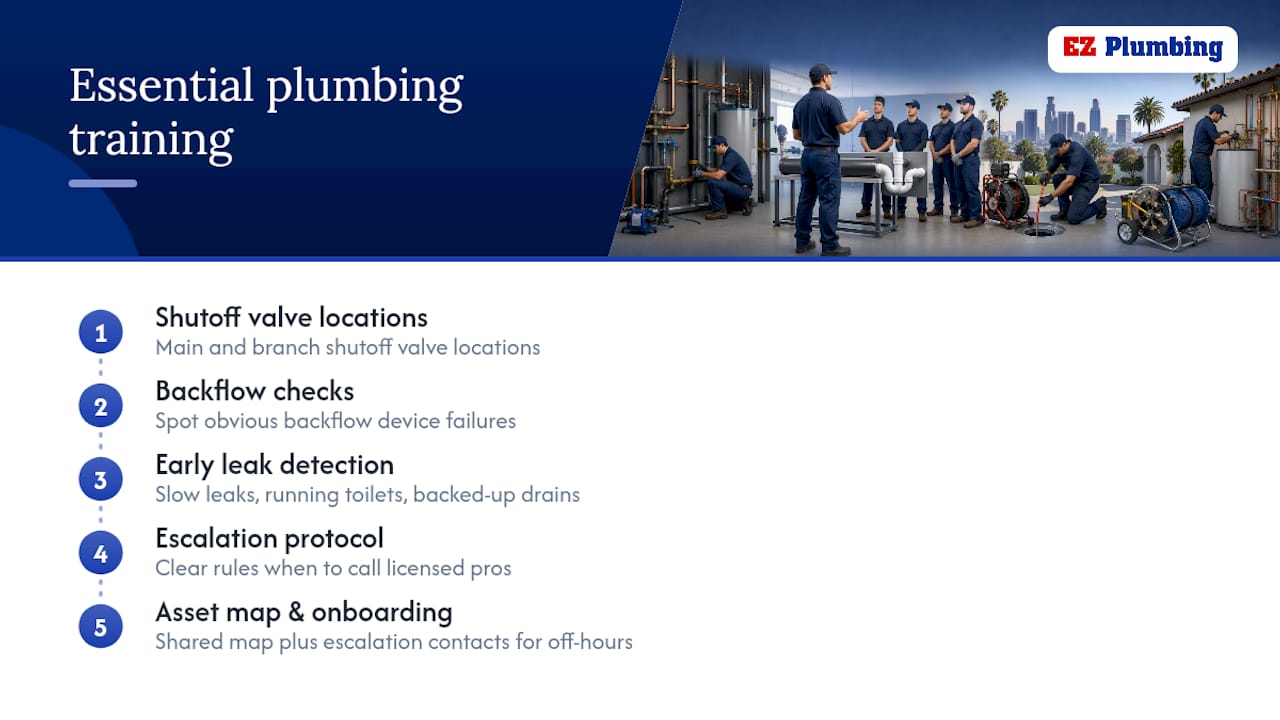
Cross-training maintenance staff with the building’s plumbing asset map closes a common gap: the person on-site during an off-hours emergency is often not the same person who did the last scheduled inspection. If both have access to the same documentation, the response time on an actual failure drops substantially. Facilities that rotate maintenance staff frequently should build a simple onboarding packet around the asset map and the escalation contact list, so institutional knowledge doesn’t walk out the door with one employee.
How Does Water Quality Affect Commercial Plumbing Maintenance?
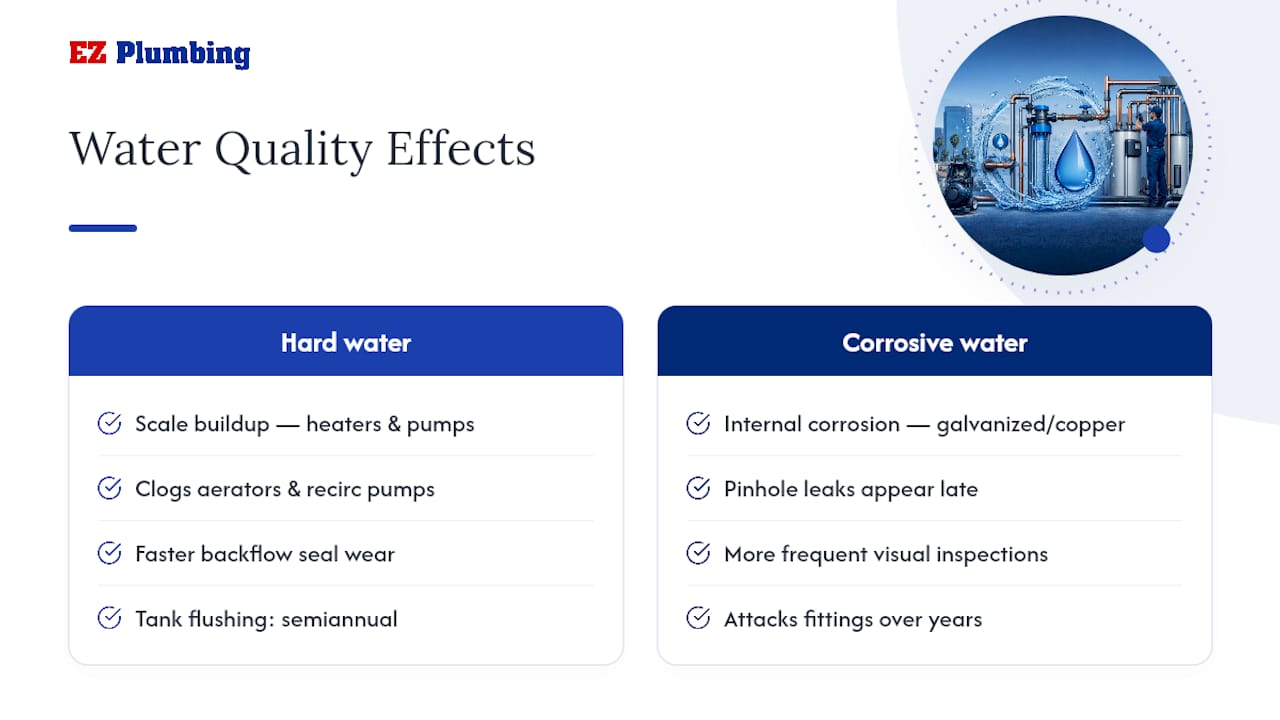
Water chemistry drives a large share of the wear your plumbing system experiences, and it varies significantly by region and even by building age. Hard water, high in dissolved calcium and magnesium, accelerates scale buildup inside water heaters, recirculation pumps, and fixture aerators. That scale is a large part of why tank flushing sits on a semiannual, not annual, cadence in most maintenance schedules.
Corrosive or acidic water has the opposite failure mode. It attacks galvanized piping and copper fittings from the inside, sometimes for years before a leak becomes visible. Buildings on older galvanized supply lines need more frequent visual inspection precisely because internal corrosion doesn’t announce itself until a pinhole leak shows up in a ceiling.
High mineral content also affects backflow prevention devices, which rely on internal seals and springs that degrade faster in mineral-heavy water. That’s one more reason annual backflow certification isn’t just a regulatory checkbox. It’s a mechanical necessity. Facility managers dealing with known hard water conditions should ask their maintenance provider whether water softening or filtration upstream of sensitive equipment makes financial sense, since the cost of treating the water is often lower than the cost of replacing scaled-out water heaters every few years.
Why Planned Maintenance Beats Reactive-Only Plumbing
Reactive-only plumbing guarantees downtime at the worst possible moment, along with after-hours emergency premiums and disrupted tenants or customers. A planned program flips that: fewer emergency calls, predictable spend, and a documented history you can hand to an owner or auditor without scrambling.
If you’re not ready to commit a whole portfolio, run a pilot at one site. Request a baseline survey, see what it turns up, and decide from there.
— EZ
Get a Baseline Survey From EZ Plumbing
Scheduled commercial maintenance programs built around documented inspections, backflow testing, water heater servicing, and drain cleaning are often tracked with photo-rich reports you can hand to an owner or an auditor without translation. Professional plumbing services typically provide a licensed team that knows how to sequence a multi-system visit without shutting down your building for a day.
Every visit produces the kind of record a facility manager actually needs at budget time, not a generic invoice. If a water heater on your property is due for replacement rather than another flush, our water heater installation services team can fold that into the same maintenance relationship. Requesting a baseline plumbing survey or a quote on a maintenance contract can provide an asset map and inspection schedule from the initial visit.
Sources
- Commercial Plumbing Maintenance Plans | JMJ Plumbing
- Commercial Plumbing Maintenance | ISS Mechanical
- Plumbing maintenance guide & checklist | ServiceChannel
FAQ
What Is the 135 Rule for Plumbing?
There’s no universally recognized rule like “135” in commercial plumbing maintenance standards. If you’ve encountered it referencing a specific code section or manufacturer spec, check that source directly, since terminology like this often varies by region or vendor.
What Does Commercial Plumbing Maintenance Include?
It includes routine inspections of fixtures and drains, water heater flushing and T&P valve checks, backflow prevention testing, pump and lift station testing, and valve exercising, all documented with checklists, photos, and certificates.
What Should Be Included in a Maintenance Plan?
A solid plan includes an asset map of shutoffs and backflow devices, a risk-based inspection schedule, documented cadences for each system, an escalation protocol for emergencies, and a reporting process that captures photos and meter readings at every visit.
What Are Five Items That Regularly Scheduled Maintenance Will Check?
A typical visit checks water heater temperature and pressure relief valves, backflow device function, floor drains and grease interceptors, sump pump and float switch operation, and shutoff valve condition.
How Often Should Backflow Devices Be Tested?
Most jurisdictions require annual backflow testing and certification, though some high-risk facilities test more frequently based on local water authority requirements.