
How to Tell If You Have a Slab Leak (Simple Checks)
You notice it in a quiet moment. The water bill looks wrong, or a section of floor feels oddly warm every morning, or you hear water when the house is still. Instead of immediately suspecting a slab leak, a toilet, a faucet, or a billing error is often assumed.
That hesitation is understandable. A slab leak is hidden by design. It happens under or within the concrete foundation, so the early signs are usually indirect. The good news is that how to tell if you have a slab leak doesn't start with tearing up floors or calling for emergency demolition. It starts with a few simple checks that cost nothing, then a more careful look at the clues your house is already giving you.
Table of Contents
- What Is a Slab Leak and Why It Matters for Your Property
- The Water Meter Test A Simple DIY Slab Leak Check
- Searching for Sensory Clues Visual and Auditory Signs
- Red Flags That Mean You Need Emergency Plumbing Service
- Professional Inspection Repair Options and Typical Costs
- Your Next Step Contact a Los Angeles Slab Leak Expert
What Is a Slab Leak and Why It Matters for Your Property
You walk into the kitchen first thing in the morning, the house is quiet, and the water bill on the counter is far higher than it should be. No faucet is running. No toilet is overflowing. That is one of the common ways a slab leak first shows up.
A slab leak is a leak in a pressurized water supply line beneath or inside a concrete foundation. Because that line stays under pressure, water can keep escaping around the clock, even when no one in the house is using it.

What makes slab leaks tricky is where the water goes. It may travel under flooring, follow the edge of the slab, or soak into the soil before you see obvious interior damage. Homeowners in Los Angeles often call after noticing one small clue that does not quite add up, such as a warmer patch of floor, a damp seam near a wall, low water pressure, or the sound of water when every fixture is off. As AxsomAir explains in its overview of slab leak warning signs and detection methods, plumbers now confirm these leaks with less destructive tools than they used to, including electronic listening equipment and infrared imaging.
Why the stakes are higher than a simple plumbing fix might suggest
A slab leak is not just a pipe problem. Left alone, it can affect flooring, baseboards, paint, cabinets, and indoor air conditions if moisture starts feeding mildew. In some cases, long-term water movement under the slab can also contribute to soil shift that shows up as cracked finishes or sticking doors.
The practical issue is timing. Catch it early, and the repair conversation is usually narrower and easier to control. Wait too long, and you may be dealing with plumbing work, drying, flooring repairs, and schedule disruption at the same time.
That is why the right first move is not panic. It is a clean diagnosis. Start with no-cost checks that can tell you whether water is moving when it should not. If you are not sure how to verify that at the meter, this guide on how to read a water meter for leaks will help you do that correctly.
One more point matters here. Every unexplained high water bill is not a slab leak. Toilets, irrigation lines, appliance supplies, and hose bibs can create the same suspicion. The goal is to rule out the easy causes first, then look for supporting signs before you pay for invasive work or assume the worst.
The Water Meter Test A Simple DIY Slab Leak Check
If I could only have a homeowner do one thing before calling about a possible slab leak, it would be the water meter test. It costs nothing, takes a little attention, and gives you stronger evidence than guessing based on one warm tile or one damp area.
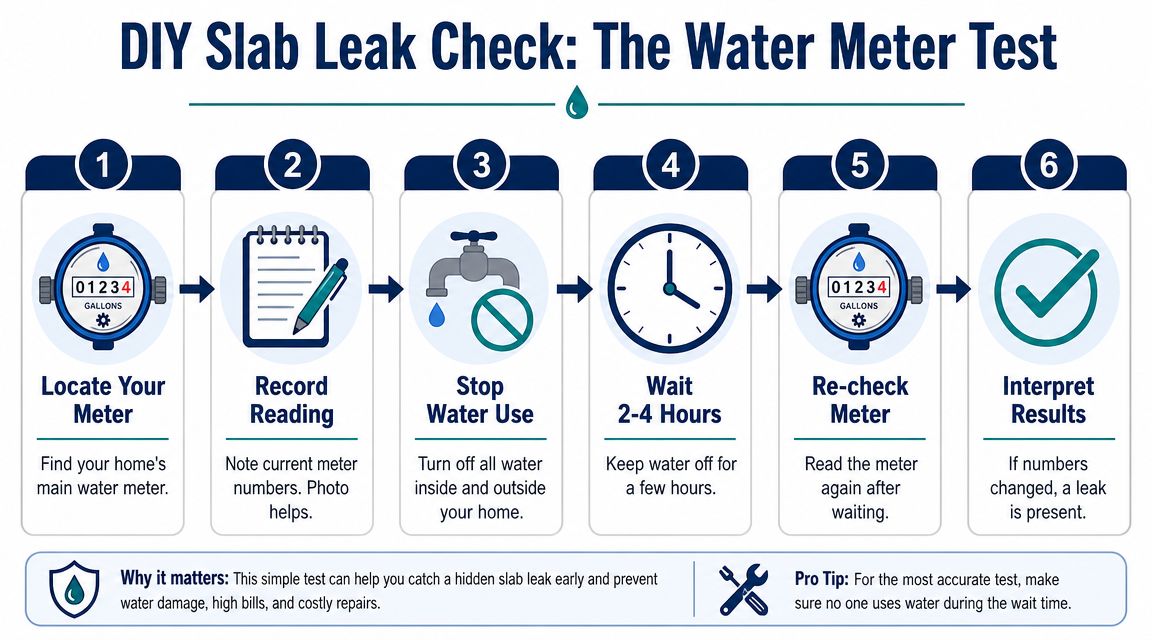
Near the start of your check, it helps to see the process laid out visually.
Start by ruling out the obvious
Before you blame the slab, eliminate the common mimics. A running toilet, dripping faucet, refrigerator ice maker, softener cycle, washing machine fill valve, or irrigation system can all move the meter and send you in the wrong direction.
Shut off all faucets, appliances, toilets, ice makers, and irrigation before you test. If anything in the house is still using water, the meter result isn't clean.
Walk the property once. Listen at toilets. Check under sinks. Make sure no hose bib is left on. If you have automatic sprinklers, keep them off for the entire test window.
A lot of homeowners aren't comfortable identifying the meter face itself. If you need a quick visual reference, this guide on how to read a water meter for leaks helps you locate the important parts before you begin.
How to run the meter test correctly
The professional workflow starts here. A no-use meter test is a standard first move because, when done properly, it tells you whether the pressurized system is losing water. Field guidance from plumbers says that if the meter's low-flow indicator, often a star, triangle, or sweep hand, keeps moving after everything is shut off, that's strong evidence of an active leak, as explained in Call Mother Plumbing's slab leak warning guide.
Use this order:
- Find the main water meter. It's usually near the curb or property edge under a utility lid.
- Photograph or note the reading. A phone photo is better than memory.
- Confirm zero water use. Inside and outside.
- Watch the low-flow indicator. Many meters have a small moving symbol that reacts to very slight flow.
- Wait with the water off. Leave the system undisturbed for a while.
- Check the meter again. Compare the numbers and indicator movement.
Later in the process, this short video gives a useful visual refresher before you recheck your meter:
How to read the result
If the meter doesn't move, that doesn't always clear the slab completely. Some leaks are intermittent, and some only show up under certain demand conditions. But a still meter lowers the odds that you have an active pressurized leak at that moment.
If the indicator keeps turning or the reading changes while all water is off, something is leaking. At that point, the question becomes location. It may be under the slab, or it may still be somewhere more accessible.
One useful field check applies when you have warm-floor symptoms. If the water heater's cold inlet is isolated and the meter stops, the leak is more likely on the hot-water side. That's a good clue. It still isn't a reason to start breaking concrete on your own.
A moving meter tells you water is going somewhere. It doesn't tell you where. That's the line between a good DIY test and a professional leak location.
Searching for Sensory Clues Visual and Auditory Signs
Once the meter gives you reason to suspect a hidden leak, the next step is to gather a pattern, not chase one isolated symptom. Good slab leak diagnosis works like detective work. You look for clues that line up with each other.

Technicians don't rely on one sign because one sign can mislead you. As Brandenburg Plumbing explains in its slab leak diagnostic guide, the strongest indicators usually come as a cluster that includes unexplained water-bill increases, low pressure, damp or warm floor zones, and hissing or whooshing sounds when the home is quiet.
What you can see and feel
A hot-water slab leak often gives itself away through the floor first. In tile homes, you may notice one patch in the kitchen or hallway that always feels warmer than the surrounding floor. On wood or laminate, the sign may be subtler. Slight cupping, swelling, staining, or a soft spot that seems to come back after drying.
Look along baseboards and lower wall edges too. Musty odor, discoloration, or mildew that doesn't make sense in an otherwise dry room can point to moisture moving out from below. If persistent dampness has become part of the issue, it also makes sense to learn how to stop insulation mold problems so moisture damage doesn't spread into wall and insulation assemblies while the plumbing issue is being sorted out.
Outside, the clues can be easy to dismiss. One strip of grass stays greener. Soil near the foundation stays soft. A small low spot forms where there wasn't one before. None of those prove a slab leak by themselves, but they belong in the pattern.
What you can hear when the house is quiet
This is the part many homeowners mention almost apologetically. “I think I hear water, but I'm not sure.” That's worth paying attention to.
Late at night or early in the morning, stand still in the quietest part of the house. If all fixtures are off and you hear a faint hiss, whoosh, or running-water sound from the floor or wall base, don't ignore it. Pressurized line leaks often make themselves known acoustically before they show themselves visually.
A slab leak can also affect how water behaves at fixtures. Pressure may seem lower than normal, or it may fluctuate in a way that wasn't happening before. Again, one symptom alone isn't enough. But when low pressure shows up with meter movement and floor clues, the case gets stronger.
The house usually whispers before it shouts. Warm floor, musty smell, faint hiss, and pressure drop together mean more than any one of them alone.
Red Flags That Mean You Need Emergency Plumbing Service
Not every slab leak is a middle-of-the-week scheduling issue. Some are active enough that waiting until tomorrow is a mistake.
The hardest call for homeowners is deciding when to stop investigating and start responding. A slow leak can sometimes show up through secondary signs before it becomes dramatic. But a constantly spinning meter or a rapidly rising water bill points to active, significant water loss that calls for immediate shutoff and emergency dispatch, according to Reliant Plumbing's guidance on slab leak urgency.
Signs that move this out of watch-and-wait territory
If you see any of the following, treat the situation as urgent:
- The meter is spinning continuously: You shut everything down, double-checked the house, and it still moves.
- Water pressure drops sharply: Not a mild difference. A real change that affects multiple fixtures at once.
- You hear rushing water: A faint hiss is one thing. The sound of active flow under the floor is another.
- Water is showing on finished surfaces: Pooling, spreading dampness, or moisture that is actively worsening.
- Warm floor area is growing: A hot-water leak that seems to be expanding usually isn't waiting for your schedule to clear.
What to do right away
If those signs are present, shut off the main water line. That's the move that limits damage while you wait for a plumber. Then call for emergency help instead of booking a routine estimate.
For local response, homeowners in the area can use this page for a Los Angeles emergency plumber when the leak appears active and immediate action is needed.
Don't keep testing, don't run appliances “one more time,” and don't assume the slab will contain the problem. Water under pressure doesn't stay politely in one place. It finds cracks, edges, flooring seams, and wall cavities.
Professional Inspection Repair Options and Typical Costs
By the time you call a plumber, the job changes from suspicion to proof. The goal is to confirm that water is escaping under or near the slab, locate the failed section with as little disruption as possible, and recommend a repair that fits the condition of the line, not just the symptom you noticed first.
That usually starts with testing, not demolition. A competent technician may use acoustic listening equipment, thermal imaging, pressure testing, tracer gas, pipe locating, and, on some properties, ground-penetrating radar. The mix depends on the pipe material, whether the leak is on a hot or cold line, how much finish flooring is in the way, and how clearly your earlier DIY checks pointed to a hidden supply leak. Homeowners who want to see what that service typically involves can review slab leak repair and detection services from a Los Angeles provider that handles this type of work.
How a plumber narrows it down
A good inspection has two parts. First, confirm there is a slab leak and not a fixture issue, irrigation problem, or drain-related moisture source. Second, isolate the location closely enough that the repair plan is based on evidence instead of guesswork.
That matters because repair decisions are rarely one-size-fits-all.
A pinhole leak on one accessible copper line is a different problem from aging piping with multiple weak spots. The first case may justify a targeted repair. The second often pushes the conversation toward rerouting or a broader pipe solution, especially if you have already had one leak under the slab.
If you're budgeting for the visit and the repair discussion that follows, this guide to understanding plumber expenses gives useful context on how plumbers commonly structure service, diagnostic, and repair charges.
Costs vary widely based on access, flooring type, pipe material, and whether the repair stays local or expands into rerouting. Detection is usually the smaller part of the bill. The primary cost difference arises from how the leak is repaired and how much concrete, flooring, drywall, or cabinetry has to be opened and restored afterward.
Slab Leak Repair Options Compared
| Repair Method | Typical Cost Pattern | Invasiveness | Best Fit |
|---|---|---|---|
| Direct access or spot repair | Lower upfront if the leak is isolated and easy to reach | Higher at the leak point because slab and finish materials may need to be opened | One confirmed failure in an otherwise healthy line |
| Pipe rerouting | Often higher upfront, but can avoid future slab access on the same run | Moderate to high, depending on the new route | Poor under-slab access, repeat leaks, or older piping with a weak section |
| Epoxy pipe lining | Case-dependent and not available for every system | Lower surface disruption in some homes | Certain existing pipe systems that meet lining requirements |
A few trade-offs matter here:
- Spot repair works best when the rest of the pipe still deserves your trust. If the line is old, corroded, or has a leak history, a single patch can turn into a short-term fix.
- Rerouting avoids reopening the slab in the same path. In Los Angeles homes with finished floors, tight schedules, or occupied living space, that can be the more practical decision even when the initial price is higher.
- Epoxy lining has limits. It depends on pipe condition, layout, and whether the system is a suitable candidate after inspection.
I tell homeowners to compare total outcome, not just invoice total. The cheapest repair on day one is not always the lowest-cost choice six months later if another weak section fails nearby.
Your Next Step Contact a Los Angeles Slab Leak Expert
A slab leak call usually starts the same way. The homeowner has seen one or two warning signs, but they are not sure whether it is a fixture issue, a irrigation problem, or a leak under the foundation. The right next step is to narrow that down in order, starting with the checks that cost nothing and ending with a professional inspection only when the evidence supports it.
Use the meter test first. Then confirm what you are noticing in the house. If those signs line up, bring in a licensed plumber before minor water loss turns into damaged flooring, cabinet swelling, or moisture that lingers under finished surfaces.
In Los Angeles, the repair decision is rarely just about stopping the leak. Access matters. Floor type matters. Occupancy matters. A good plumbing company should be able to confirm the leak, locate it accurately, and explain whether a targeted repair, reroute, or another option makes the most sense for your property instead of pushing a one-size-fits-all fix.
If your meter is moving with all water off, or you are hearing water and cannot tie it to a fixture, call a licensed plumber who handles slab leak work regularly, uses precise detection methods, and can tell you how urgent the situation really is.
You can reach EZ Plumbing at (818) 908-2710 for service in Los Angeles, or schedule online through their website.
If you think a hidden leak may be under your foundation, contact EZ Plumbing for professional slab leak diagnosis and repair. They serve Los Angeles homes, HOAs, property managers, and commercial properties with same-day scheduling and 24/7 emergency response when the situation cannot wait.