
Leak in Wall? Find & Fix It Fast
You walk past a wall, catch that damp smell again, and notice the paint looks slightly bubbled. Or maybe you hear a faint drip when the house is quiet. That's the point where it's common to feel stuck. Is this a small plumbing issue, a roof problem, or the start of a much bigger repair?
A leak in wall is stressful because the stain you see is rarely the whole story. Water moves, spreads, and shows up where it's easiest, not always where it started. The good news is that you can do a lot of useful triage before anyone cuts drywall. If you stay calm, check the right clues in the right order, and know when to stop, you can protect the property and avoid a lot of unnecessary damage.
Table of Contents
- The First Signs of a Hidden Wall Leak
- How to Pinpoint the Leak's Source Without Tearing Down Walls
- Is It a Plumbing Pipe or a Building Envelope Leak
- Temporary Mitigation and Knowing Your DIY Limits
- When to Call a Professional Plumber for a Wall Leak
- Your Emergency Action Plan for Wall Leaks in Los Angeles
The First Signs of a Hidden Wall Leak
If you're worried you're overreacting, you're probably not. Hidden leaks often start with small clues, and those clues are easy to dismiss until the wall gets soft or the floor starts to warp.
Los Angeles' municipal utility warns that even small plumbing leaks can waste up to 10,000 gallons of water per household per year, and one of its key warning signs is unexplained water meter movement when all fixtures are off, which can point to a hidden leak inside a wall or connected supply line, as explained in LADWP's guidance on detecting a water leak.
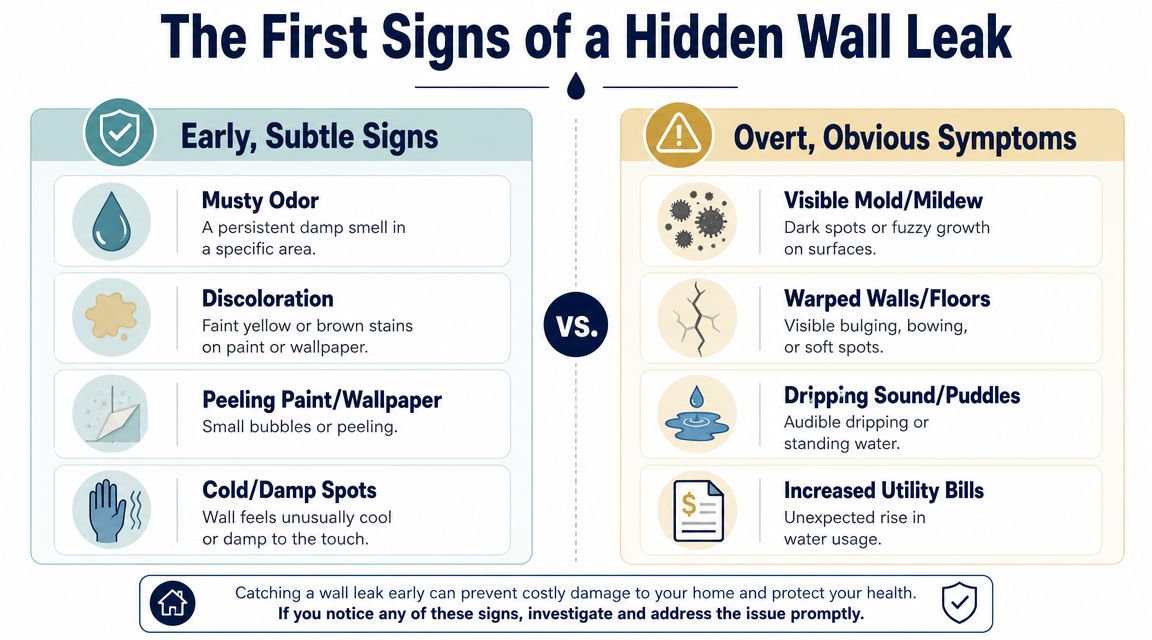
Early signs that deserve attention
These are the clues I tell people not to ignore:
- Musty odor in one area: A persistent damp smell usually means moisture is staying trapped somewhere it shouldn't.
- Faint yellow or brown staining: Light discoloration often shows up before active dripping.
- Paint bubbles or peeling wallpaper: Moisture breaks the bond between the finish and the wall surface.
- A cool or damp patch: Evaporation can make part of a wall feel colder than the surrounding area.
A lot of homeowners assume a small stain means a small problem. That's not always true. Water can move inside a wall cavity, travel along framing, and appear well away from the source.
Practical rule: The stain tells you where water stopped. It doesn't reliably tell you where water started.
Red flags that mean faster action
Some symptoms mean the leak has likely been active long enough to damage building materials:
- Soft drywall
- Warped flooring near the wall
- Visible mold or mildew
- A dripping sound behind the wall
- Actual water appearing on the surface
When those show up, treat it as more than a cosmetic issue. At that point, it's smart to think about both plumbing and moisture damage response. If the wall has been wet long enough that materials may need professional drying or cleanup, this overview of water and mold remediation helps clarify what usually comes next.
Don't assume it's always plumbing
A wall leak doesn't always come from a pipe. If the stain gets worse after rain, appears near an exterior wall, or shows up around windows or near the ceiling line, you may be looking at exterior water intrusion instead. That's where it helps to review common signs of roof leaks so you don't open the wrong wall and chase the wrong repair.
How to Pinpoint the Leak's Source Without Tearing Down Walls
The best leak investigation starts like a detective job, not a demolition job. Before anybody grabs a saw, confirm whether water is actively moving, then narrow the source.
Start with the simplest test. BlueBot's wall-leak workflow recommends a zero-demand meter test: shut off all faucets, toilets, hoses, and water-using appliances, then watch for meter movement over a 1 to 2 hour window. If it still moves, that strongly suggests a hidden leak. The same workflow also recommends scanning the wall with a moisture meter and warns that visible stains can mislead because water can travel horizontally, as outlined in this wall leak detection guide.
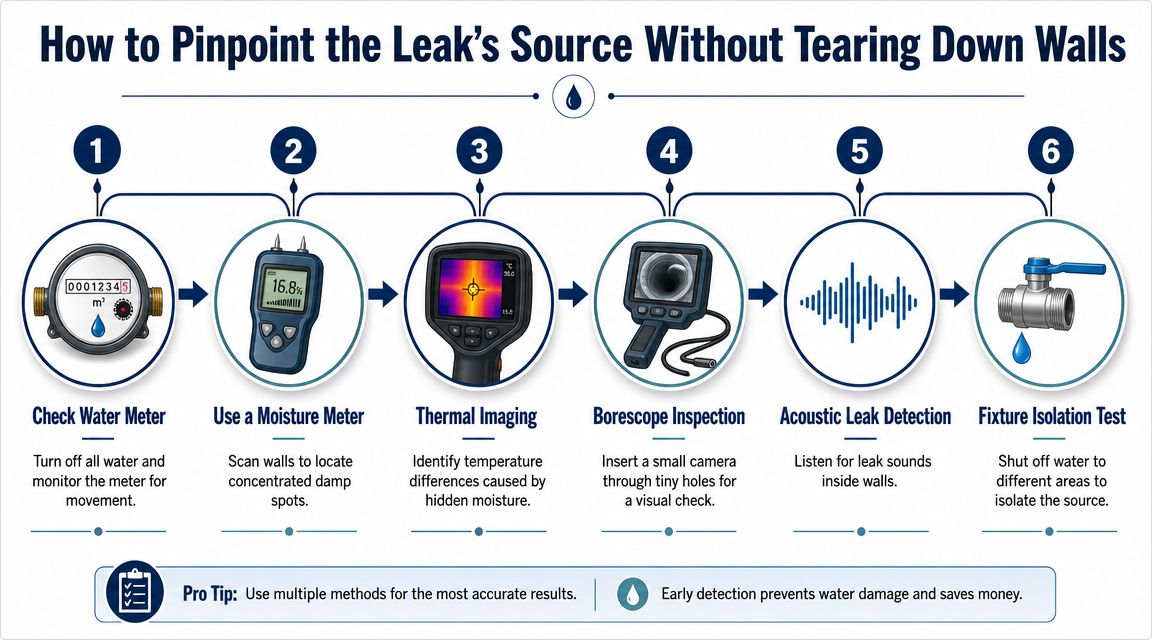
Step one is always the meter
If you skip the meter test, you're guessing. You might be looking at old water damage, condensation, or a one-time spill rather than an active leak.
If you aren't comfortable reading the dial or low-flow indicator, a plain-language walkthrough on how to read a water meter for leaks can help you do the test correctly.
Isolate by fixture before opening anything
Once meter movement suggests an active hidden leak, isolate likely branches one at a time. Shut off fixture valves individually where possible. Toilets, sinks, washing machines, dishwashers, and refrigerator lines are common starting points.
What you're looking for is a change in meter behavior after a valve is shut. If the meter stops moving after isolating one branch, you've narrowed the problem area without touching the wall.
Here's a simple field sequence:
- Turn everything off: Faucets, irrigation, appliances, and hose bibbs.
- Watch the meter: Confirm whether it still registers movement.
- Shut fixture valves one by one: Track which shutoff changes the meter behavior.
- Mark suspect walls: Don't rely on memory once multiple rooms are involved.
A basic moisture meter is often enough for the next step. Consumer models are commonly sold for about $30 to $50 in the BlueBot workflow above, and they can help you map where moisture is strongest.
Map the wall instead of chasing the stain
Use the moisture meter in a grid. Check left to right, then higher and lower. Write down readings or mark painter's tape on the wall. The wettest surface point often gets you closer, but not always all the way to the leak.
Water follows framing, fasteners, insulation gaps, and gravity. A dark spot on paint can be a symptom, not the breach.
If you want a broader homeowner-oriented overview of non-destructive methods before calling someone out, this guide to water leak detection for homeowners gives a useful outside perspective on the process.
Later in the investigation, video inspection tools or thermal checks can help, but they work better after you've already narrowed the suspect area. That's also the right time to watch a visual example of wall leak tracing in practice.
Is It a Plumbing Pipe or a Building Envelope Leak
It's common for people to lose time and money. They call a plumber for a roof leak, or a roofer for a supply-line problem. The wall doesn't care where the water came from, but the repair path does.
Roto-Rooter notes that separating plumbing failures from building-envelope leaks is a common challenge and recommends checking ceilings, window frames, and roof-to-wall junctions because water can travel far from its entry point, making the wall stain itself a poor guide, as described in this FAQ on finding a water leak inside a wall.
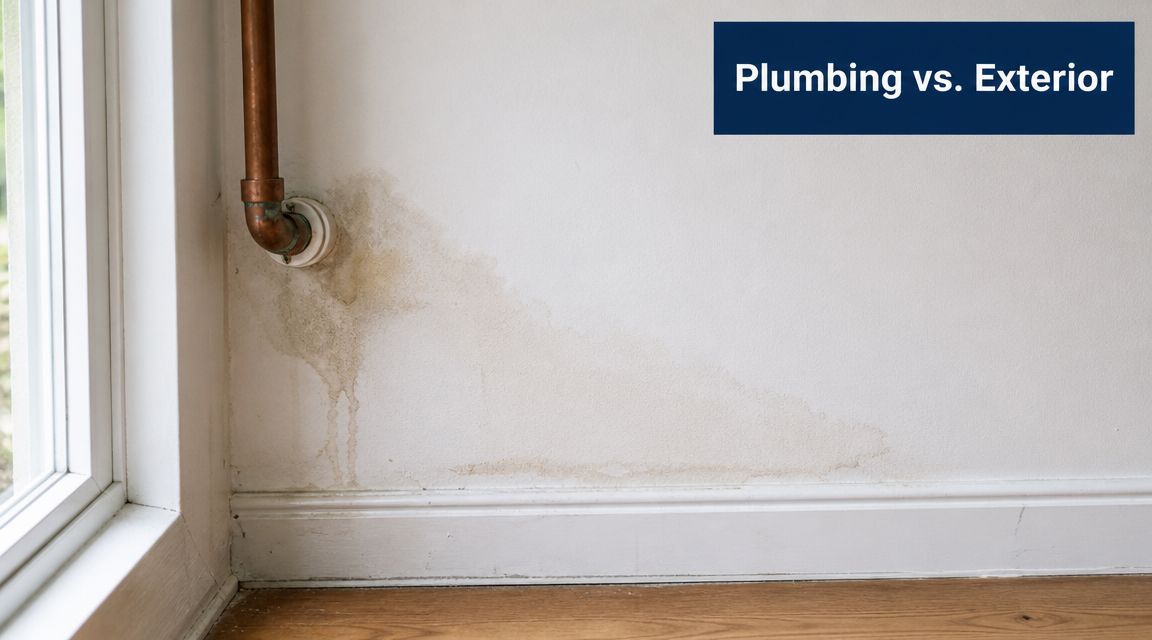
Signs that point more toward plumbing
A plumbing leak is more likely when the problem behaves like this:
- The stain grows even in dry weather
- The issue is near a bathroom, kitchen, laundry, or water heater
- You hear hissing or dripping when no rain is falling
- Meter testing suggests active water use with everything off
Signs that point more toward exterior intrusion
A building-envelope leak is more likely when the problem follows weather or exterior conditions:
- The stain appears or worsens after rain
- Damage is near a window, exterior door, chimney area, or roofline
- The ceiling and upper wall are involved together
- The problem shows up on an outside-facing wall
If the leak pattern follows storms, start by questioning the exterior shell of the building, not just the pipes inside it.
That distinction also matters if you're thinking ahead to documentation and claims. If you're sorting out responsibility and scope, especially in a condo, rental, or multi-unit setting, this explanation of homeowners insurance water damage is useful for understanding how different causes are often treated.
Temporary Mitigation and Knowing Your DIY Limits
Once you suspect a leak in wall, your first job is damage control. Don't start by cutting drywall. Stop the water if it's a plumbing issue, protect the area, and keep people safe.
What to do right away
Use this order:
- Shut off the main water if the leak appears active, sudden, or hard to isolate.
- Turn off power to the affected area if water is near outlets, switches, or appliances, and only if you can do it safely from the panel.
- Contain the water with towels, buckets, and plastic bins.
- Move furniture, rugs, and valuables away from the wet wall.
- Take photos and short videos before cleanup changes the scene.
- Start airflow with fans if the area is safe and the leak is under control.
If you know the problem is tied to one fixture and that fixture has its own shutoff valve, use that first. It lets you keep water on to the rest of the building while you investigate.
What you can do yourself
There are a few cases where basic DIY is reasonable. Most of them involve exposed plumbing, not hidden plumbing.
| Scenario | Recommended Action |
|---|---|
| Drip from an exposed shutoff valve under a sink | Tighten gently if the connection is obviously loose, then monitor |
| Small leak from a visible supply hose to a toilet or faucet | Shut off that fixture and replace the hose if you're comfortable doing so |
| Damp wall with no confirmed source | Investigate non-destructively first. Don't cut yet |
| Active leak behind drywall | Shut water off and call a pro |
| Water near electrical outlets or panel-fed devices | Stop, secure the area, and get professional help |
| Repeated staining after rain | Check exterior conditions and call the right trade |
| Multi-unit building wall leak | Notify management and bring in qualified help quickly |
Where DIY usually goes wrong
Most bad outcomes come from one of three mistakes:
- Opening the wrong spot: Water often travels before it shows itself.
- Fixing the symptom, not the source: Paint, caulk, and patching don't solve an active hidden leak.
- Waiting because the leak seems minor: Wet drywall and insulation don't improve on their own.
If you can reach the leaking part without opening a wall and the repair is straightforward, DIY may be reasonable. Once the leak is concealed, affecting multiple materials, or mixed with rain-related intrusion clues, that's where a homeowner should stop.
When to Call a Professional Plumber for a Wall Leak
Call a professional when the leak is active, hidden, recurring, or unclear. That's the point where experience saves material, time, and unnecessary demolition.
Action Craft Experts describes the standard professional approach clearly: technicians use thermal imaging to identify temperature anomalies caused by moisture evaporation and acoustic detection to listen for pressurized water movement or escape sounds, helping them locate leaks within walls before cutting and reducing secondary repair scope, as explained in this overview of water leak location methods.
Clear triggers for a service call
You shouldn't wait if any of these are true:
- You confirmed unexplained meter movement earlier
- The wall is soft, swollen, or actively dripping
- The leak keeps returning after cosmetic repairs
- The affected wall is shared with another unit
- Water is near electrical components
- You can't tell whether it's plumbing or exterior intrusion
Those situations move beyond casual troubleshooting. At that point, you need someone who can test, locate, and open only what needs to be opened.
What a good professional process looks like
A careful plumber doesn't start by tearing out a large section of drywall. The better sequence is targeted and deliberate:
- Confirm active leak conditions
- Use moisture and temperature clues to define the suspect zone
- Refine the location with listening tools if pressurized piping is involved
- Make a limited access opening once the likely point is narrowed
A good leak search isn't about proving that water exists. It's about finding where to open the wall with the least collateral damage.
For Los Angeles property owners, this is also where one practical option is a local company that handles leak detection and repair without unnecessary demolition. EZ Plumbing offers emergency plumbing service and planned leak work in the area, which is useful when the issue needs both diagnosis and repair under one scope.
Your Emergency Action Plan for Wall Leaks in Los Angeles
When a wall is wet, speed matters. Not panic. Just speed.
For Los Angeles owners and managers, the smartest response is a controlled one: stop the water, document the damage, and get the right trade on site. Professional wall-leak investigation has become more structured over time. Leak-detection specialists in Los Angeles reference ASTM E2128 and related testing standards when evaluating water intrusion, using a scientific process that reduces unnecessary demolition and provides documentation that matters for repairs, especially for HOAs and property managers, as described in this page on building wall water leak testing in Los Angeles.
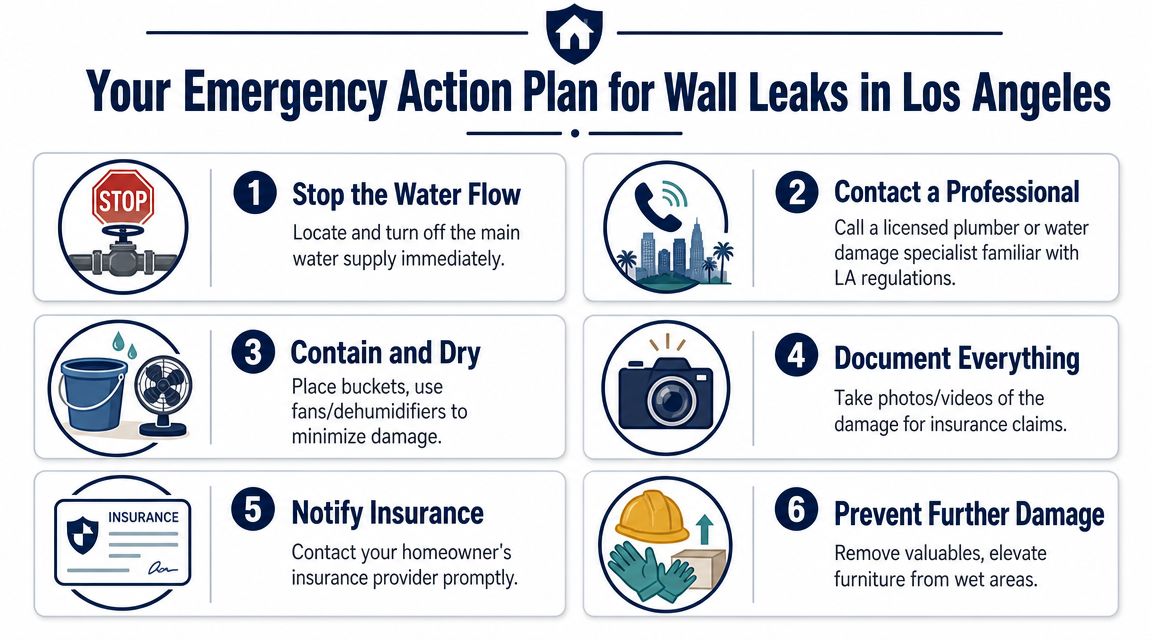
The six moves that protect the property
Keep this list simple and in order:
- Shut off the main water supply
- Contain any visible water
- Photograph the wall, floor, and any damaged contents
- Move vulnerable items away from the area
- Notify the appropriate parties, including tenants, HOA contacts, or insurance if needed
- Schedule emergency plumbing help through a Los Angeles emergency plumber
What property managers should do differently
A single-family homeowner can make decisions fast. In a condo, apartment, or mixed-use building, you also need a record.
Document the exact unit, wall location, first observed time, whether the damage changes with fixture use or weather, and whether adjacent units are affected. That information helps the responding technician decide whether the issue is likely domestic water, drain waste, or envelope-related intrusion before opening anything.
In multi-unit buildings, the first mistake isn't always the leak itself. It's failing to document enough detail to direct the right repair team.
For Los Angeles service areas such as Beverly Hills, Pasadena, and the San Fernando Valley, the practical goal is the same. Limit water spread, avoid blind demolition, and bring in someone who can separate plumbing failure from exterior intrusion with a disciplined process.
If you've got a leak in wall and need help now, contact EZ Plumbing. Shut off the water first if you can do it safely, then call (818) 908-2710 for emergency service in Los Angeles. They work with homeowners, HOAs, property managers, and commercial properties, and they can help locate the source, limit unnecessary wall opening, and get the repair moving in the right direction.