
The essential role of plumbers in Los Angeles renovations
Renovation surprises in Los Angeles rarely announce themselves politely. More often, they reveal themselves mid-project, behind a freshly demolished wall or beneath a concrete slab, as a corroded pipe, an undocumented water line, or a plumbing rough-in that was never properly tested. Many homeowners believe their renovation is moving along smoothly, only to face a failed LADBS (Los Angeles Department of Building and Safety) inspection or a costly water damage repair that halts progress for weeks. Understanding what licensed plumbers actually do during a renovation, and why LA’s specific conditions make their role so critical, can save you significant time, money, and frustration.
Table of Contents
- Why professional plumbers are critical in LA renovations
- Plumbers’ responsibilities through every renovation stage
- Costs: Common scenarios and what drives your plumbing budget
- Edge cases: What trips up LA renovations (and how plumbers solve it)
- What most people (and contractors) overlook about plumbing in renovations
- Upgrade your Los Angeles renovation with certified plumbing expertise
- Frequently asked questions
Key Takeaways
| Point | Details |
|---|---|
| LA plumbing requires pros | Renovations in Los Angeles need licensed plumbers for permits, code, and safety. |
| Hidden costs add up fast | Slab leaks and corroded pipes can multiply renovation budgets if undetected. |
| Permitting isn’t optional | Even minor changes must pass LADBS inspections and require proper documentation. |
| Edge cases are common | Issues like seismic retrofits and hillside surcharges are everyday realities in LA home upgrades. |
| Early planning prevents headaches | Starting with a professional plumber from day one saves time, money, and future repairs. |
Why professional plumbers are critical in LA renovations
Los Angeles is not a typical renovation environment. The combination of aging housing stock, expansive clay soils, seismic activity, and layered municipal codes creates a landscape where plumbing mistakes are both easy to make and expensive to fix. A general contractor or a handyman may be skilled at many things, but LA seismic and soil conditions specifically demand a licensed plumber’s knowledge to avoid failures that show up months or years later.
Here are the key LA factors that make plumbing in renovations uniquely challenging:
- Expansive and shifting soils throughout the LA basin cause ground movement that stresses underground supply and drain lines.
- Seismic code requirements under the California Plumbing Code mandate flexible connections, seismic gas shutoffs, and braced water heater installations.
- Permitting through LADBS requires licensed contractors to submit riser diagrams, fixture schedules, and other technical documentation before any work begins.
- Aging infrastructure in neighborhoods like Silver Lake, Echo Park, and Highland Park often means encountering galvanized steel supply lines or clay sewer laterals that predate modern standards.
- Multiple code update cycles mean that work permitted under older codes may need to be brought up to current standards when a full renovation triggers a new permit.
Understanding plumbing pricing in Los Angeles begins with understanding why these factors add complexity, and therefore cost, to every project. It is not just about running pipe. It is about doing it correctly in a city that presents technical challenges from every direction.
Pro Tip: Even a small misalignment in your rough-in, the initial phase where supply and drain lines are positioned before walls close, can create repeated failures after your renovation is finished. A quarter-inch slope error in a drain line, for example, can lead to chronic slow drains or backup that no amount of cleaning will permanently fix.
Rough-in quality is the single most important factor in long-term plumbing performance. Licensed plumbers who understand local soil behavior and code requirements are the only professionals equipped to get that foundation right. Skipping this expertise rarely saves money. It just delays when you pay for the mistake.
This is especially relevant when you look at commercial plumbing insights, where the consequences of rough-in failures scale up considerably. But even for residential projects, the principle is the same: invest in quality at the rough-in stage, or pay more later.
With the stage set for why plumbing is not just a basic task, let’s dig into exactly what professional plumbers actually do during renovations.
Plumbers’ responsibilities through every renovation stage
One of the most persistent misconceptions about renovation plumbing is that a plumber “just shows up to hook things up.” In reality, a licensed plumber is involved at every phase of a renovation, from the earliest planning conversations through final sign-off.
Here is how that process typically unfolds:
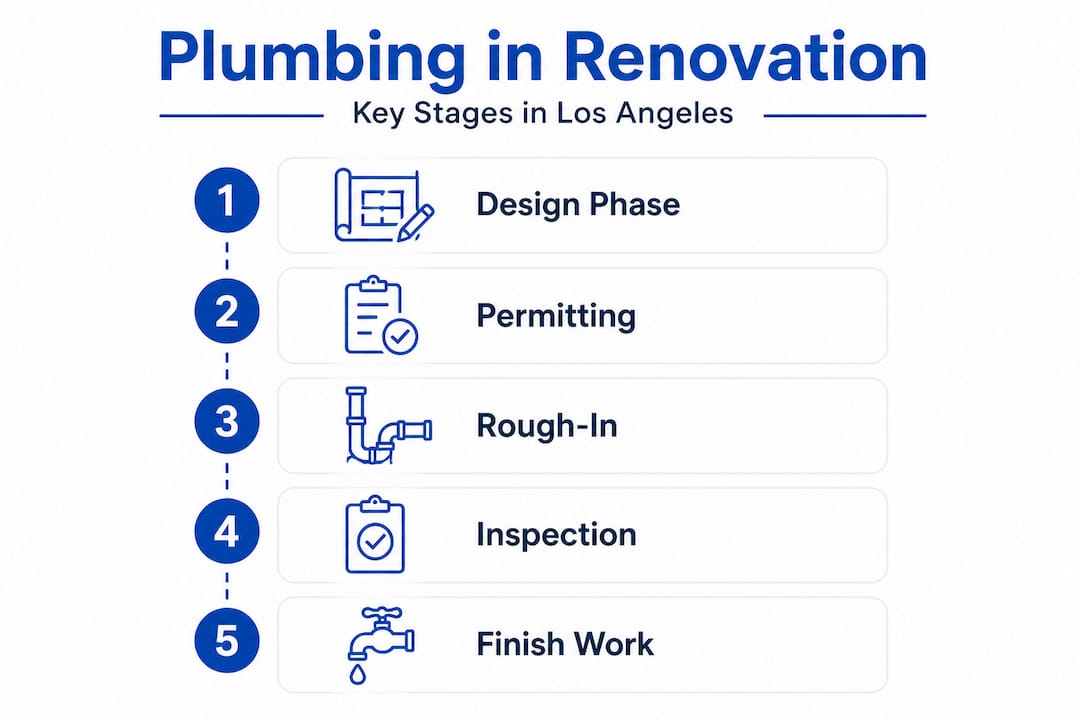
- Planning and design review: The plumber reviews your renovation plans, identifies fixture locations, and flags any conflicts with existing drain or supply lines before demolition begins.
- Permit submission: As noted in the Los Angeles Plumbing Permit and Inspection Guide, plumbers obtain and manage plumbing permits required for fixture relocation, new lines, repiping, or water heater replacements, submitting riser diagrams, fixture schedules, and coordinating LADBS inspections.
- Rough-in installation: This is where the actual pipe work happens, supply lines, drain, waste, and vent (DWV) systems are positioned and connected while walls and floors are still open.
- Inspection coordination: The plumber schedules and manages LADBS inspections for rough-in, often requiring the inspector to visually verify exposed pipe work before walls are closed.
- Finish plumbing: Once inspections pass and construction closes the walls, the plumber returns to connect fixtures, install appliances, set trim, and test all systems under operating pressure.
- Final closeout: The plumber confirms code compliance, signs off on the permit, and provides documentation for your records and future sale disclosures.
The table below maps typical tasks by renovation stage to the corresponding permits and inspections required in Los Angeles:
| Renovation stage | Typical plumbing tasks | Permits or inspections required |
|---|---|---|
| Design | Fixture layout review, line conflict analysis | Permit application, plan check submission |
| Demolition | Capping old lines, exposing existing systems | Pre-demolition inspection (if required) |
| Construction | Rough-in DWV and supply, slab penetrations | Rough-in inspection by LADBS |
| Final | Fixture connections, pressure testing, appliance hookup | Final plumbing inspection |
Each stage builds on the last, which is why delays at one point, particularly during LADBS scheduling, can ripple through your entire renovation timeline. The stages of plumbing roles during a renovation are interconnected in ways that make early coordination essential.
Pro Tip: LADBS inspection scheduling in Los Angeles can take one to three weeks during busy periods. Start your permit process as early as possible, ideally before demolition, so inspection delays do not stall your project at critical milestones.
Understanding the mapped roles sets up the next practical question: what do those steps cost, and how do LA factors impact your budget?
Costs: Common scenarios and what drives your plumbing budget
Plumbing costs in Los Angeles renovation projects vary widely depending on scope, location, and what you discover once walls come down. Having realistic cost expectations going in protects you from budget shock and helps you make smarter decisions about sequencing your project.
The table below outlines typical cost ranges for common plumbing tasks in LA renovations:
| Task | Typical cost range |
|---|---|
| Permit fees | $150 to $1,500 |
| Fixture relocation (per fixture) | $300 to $900 |
| Full repipe (copper or PEX) | $5,000 to $20,000 |
| Slab leak detection and repair | $1,200 to $6,000 |
| Water heater replacement | $900 to $2,500 |
| Sewer line repair or replacement | $3,000 to $15,000+ |
These ranges reflect Los Angeles plumbing costs as documented by local industry sources, and they illustrate why plumbing is rarely the place to cut corners in a renovation budget.
Several factors drive costs above the baseline:
- Hillside properties in areas like Laurel Canyon, Bel Air, or the Hollywood Hills add 15 to 30 percent to labor costs due to access difficulty and longer pipe runs.
- Slab foundations require saw-cutting or tunneling to access buried lines, which significantly increases both labor and restoration costs.
- Older fixture counts in pre-1980 homes mean more potential replacements and more permit line items.
- Soil conditions in clay-heavy areas require more careful joint design and flexible connection points to accommodate ground movement.
- Timeline compression if you are working against a hard deadline, after-hours or expedited work can increase labor rates by 20 to 40 percent.
The average repipe in a Los Angeles home runs between $8,000 and $14,000 depending on square footage and pipe routing complexity. Slab homes consistently land toward the top of that range because access requires breaking up concrete, a process that adds both time and material costs. You can review current Los Angeles plumbing cost details to get a clearer picture of what your specific project scope might look like.
Seeing the price reality, it is crucial to anticipate issues unique to LA, especially those hidden problems that can derail even well-planned projects.
Edge cases: What trips up LA renovations (and how plumbers solve it)
Even well-planned renovations encounter unexpected plumbing conditions once demolition begins. In Los Angeles, certain issues come up with enough regularity that experienced plumbers factor them into their initial assessments. Knowing what these are ahead of time helps you budget realistically and make faster decisions when they surface.
The most common edge cases in LA renovations include:
- Slab leaks: Common in LA’s older slab-on-grade homes, these occur when supply or drain lines beneath the concrete slab corrode or shift. Slab leak detection and repair costs range from $1,200 to $5,000 or more depending on depth, pipe material, and how much concrete needs to be removed.
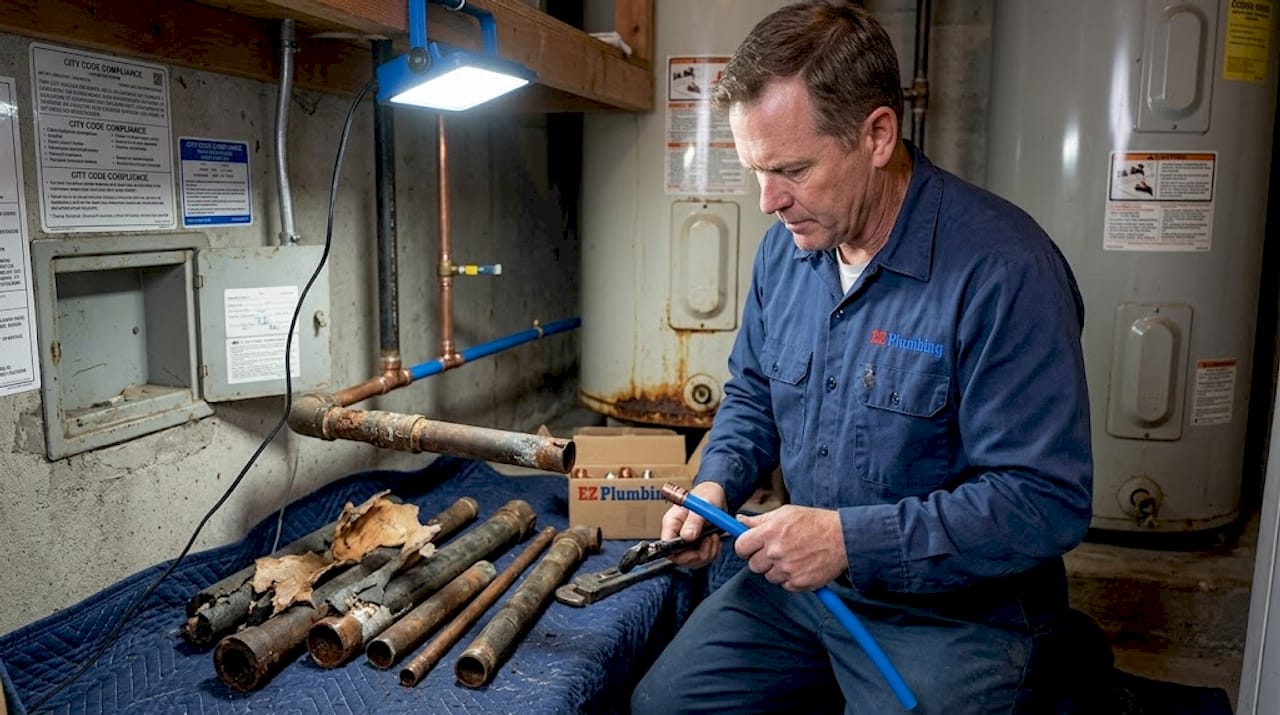
- Corroded galvanized pipes: Homes built before 1970 frequently have galvanized steel supply lines that have narrowed internally due to rust accumulation, reducing water pressure to a trickle. A full repipe using copper or PEX (cross-linked polyethylene) tubing corrects this, but at $5,000 to $20,000 it is one of the more significant unplanned costs a renovation can uncover.
- Hillside access premiums: Properties in hillside neighborhoods require longer pipe runs, more complex anchoring, and sometimes crane or pulley access for equipment, adding 15 to 30 percent to standard labor rates.
- Seismic retrofit requirements: If your renovation triggers a permit review of existing systems, older homes may need seismic gas shutoff valves, flexible water heater connections, and updated strapping to meet current California standards.
- Old system integration challenges: Connecting new PEX or copper to original cast iron drain stacks or clay sewer laterals requires specialized fittings and careful transition work to avoid joint failures.
Detecting hidden leaks before closing walls is one of the highest-value services a plumber provides during a renovation. Electronic leak detection and pressure testing can identify failures in DWV systems and supply lines that would otherwise remain hidden until a ceiling stains or a floor buckles.
Pro Tip: Fixing a corroded pipe or a small slab leak before your renovation is finalized costs a fraction of what it costs after walls are closed and finishes are in place. Ask your plumber to conduct a full pressure test on supply lines and a video inspection of drain lines before any walls are sealed. Addressing corroded pipe repair at this stage is always the smarter financial move.
With common and edge-case challenges addressed, let’s bring these threads together in terms of real-world decision-making and long-term performance.
What most people (and contractors) overlook about plumbing in renovations
Here is something we have observed consistently across hundreds of Los Angeles renovation projects: the plumbing problems that cause the most grief are almost never dramatic failures. They are quiet, incremental issues that were technically avoidable, but skipped in the interest of speed or cost savings at the rough-in stage.
Most homeowners focus on visible outcomes. Tile choices, cabinet finishes, lighting fixtures. General contractors are often managing multiple trades simultaneously and may not prioritize the invisible infrastructure beneath the surface. The result is that DWV rough-in work, the drain, waste, and vent system that determines how wastewater moves through your home, is sometimes installed quickly and never properly tested before walls close.
A surprising number of renovation callbacks we handle involve code violations or missed leak tests that could have been caught at the rough-in inspection stage. When an inspector passes work visually but a pressure test was never performed on the supply side, small pinholes in copper joints or improper PEX crimp connections can weep slowly for months before the damage becomes visible.
Proper materials and systematic pressure testing before wall closure are the most significant invisible value a licensed plumber delivers. These steps cannot be rushed or skipped without transferring risk directly to the homeowner. Only a pro with current plumbing insights for renovations and knowledge of local conditions can identify what tests are required and what rough-in quality standards actually mean for long-term performance.
Our strong recommendation: before you sign off on any phase of plumbing work in your renovation, ask your plumber three direct questions. Did you pressure test the supply lines? Did you conduct a smoke or water test on the DWV system? Is all work compliant with current LADBS codes, including seismic requirements? A licensed plumber with nothing to hide will answer all three without hesitation.
Upgrade your Los Angeles renovation with certified plumbing expertise
When you partner with a licensed plumbing professional early in your renovation, you are not just buying pipe installation. You are buying permit management, code compliance, LADBS coordination, and the kind of proactive problem-solving that keeps your project on schedule.

EZ Plumbing (C-36 License #583868) serves homeowners and property managers throughout the greater Los Angeles area with the full range of renovation plumbing services. From main sewer repair and slab leak specialists to water heater replacement, our team handles every phase of the renovation plumbing process with complete code compliance and careful inspection coordination. Reach out today to discuss your project and get professional guidance before your renovation begins.
Frequently asked questions
Do I need a plumber for minor renovations in Los Angeles?
Yes. Los Angeles requires permits and inspections for tasks like moving fixtures or adding new lines, and only licensed plumbers can submit the required documentation and coordinate with LADBS.
How much does it cost to move plumbing fixtures during an LA renovation?
Permit fees range from $150 to $1,500, while more complex jobs involving repiping or slab leaks can range from $5,000 to over $20,000 depending on scope and access.
Why can’t my general contractor or handyman do plumbing work in Los Angeles?
Only licensed plumbers can ensure work meets current code and passes LADBS inspections, particularly given LA’s seismic and soil conditions that require specialized knowledge of flexible connections and pipe anchoring requirements.
What plumbing issues are most likely to surprise homeowners during renovations?
Slab leaks, galvanized pipe corrosion, and hillside access fees are among the most common hidden issues that increase renovation costs if they are not identified and addressed before walls are sealed.