
Manage plumbing repairs in Los Angeles: step-by-step guide
A plumbing leak discovered on a Saturday morning in a Silver Lake rental unit or a Woodland Hills family home is not just an inconvenience. It is a direct threat to your property’s structural integrity, your tenant relationships, and your long-term investment value. Los Angeles properties face a unique combination of aging infrastructure, seismic stress on pipe joints, expansive clay soils that shift sewer laterals, and hard water that accelerates galvanized corrosion inside supply lines. Knowing how to respond quickly, prepare correctly, and execute repairs with the right level of professional support is what separates a manageable repair from a five-figure restoration project.
Table of Contents
- Assessing plumbing emergencies versus routine repairs
- Tools, materials, and preparation for plumbing repairs
- Executing safe repairs and choosing the right approach
- Regulatory and financial realities for plumbing repairs in Los Angeles
- The real secret to stress-free plumbing management
- Connect with Los Angeles plumbing repair experts
- Frequently asked questions
Key Takeaways
| Point | Details |
|---|---|
| Act fast on leaks | Quick water shutoff and cleanup minimize damage and save money. |
| Know your responsibilities | Some plumbing work in Los Angeles legally requires permits and inspections. |
| Routine beats emergency | Proactive inspections and pattern tracking prevent most costly plumbing surprises. |
| Budget wisely | Typical main repairs cost $400–$1,897 and restoration can be much more. |
Assessing plumbing emergencies versus routine repairs
The first and most important skill any LA homeowner or property manager can develop is the ability to accurately classify a plumbing problem the moment it appears. Misclassifying an emergency as a routine issue, or panicking over something minor, both carry real costs. A clear framework saves time, money, and structural damage.
A plumbing emergency is any situation where water is actively escaping in a way you cannot control, where sewage is backing up into living spaces, or where a failure puts the structure or its occupants at immediate risk. Burst pipes, a water heater releasing water onto a floor, a sewer backup reaching bathroom tile, or a supply line that has separated behind a wall all qualify. These situations require you to act within minutes, not hours.
A routine repair, by contrast, is a slow drip from a faucet, a toilet that runs intermittently, a showerhead with reduced pressure, or a drain that clears slowly. These are real problems that will worsen over time and cost more if ignored, but they do not demand a midnight call or immediate water shutoff.
The table below gives you a fast reference for the most common scenarios:
| Situation | Classification | First action |
|---|---|---|
| Burst pipe with active spray | Emergency | Shut off main water supply immediately |
| Sewage backup in bathroom | Emergency | Stop using all fixtures, call a plumber |
| Slow-draining kitchen sink | Routine | Schedule drain cleaning within days |
| Dripping faucet | Routine | Schedule leaky faucet fixes |
| Water heater leaking at base | Emergency | Shut off water and gas/power to unit |
| Running toilet | Routine | Inspect flapper and fill valve |
| No hot water | Urgent but not emergency | Inspect pilot light or circuit breaker first |
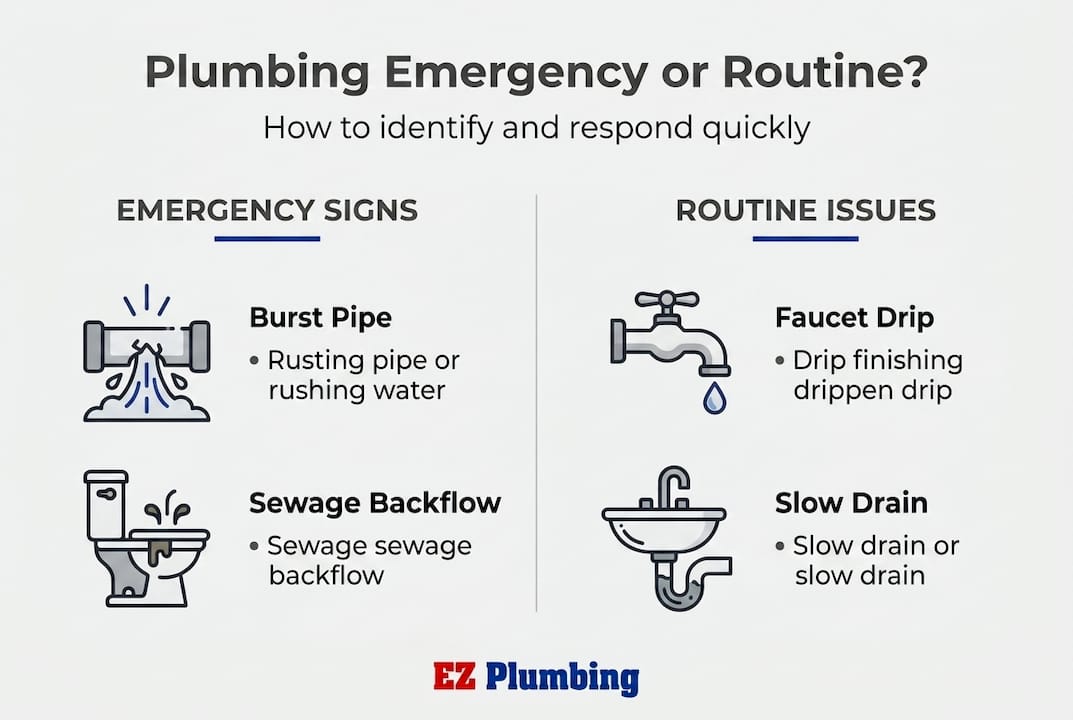
For active leaks and plumbing emergencies, shut off the water at the main or an isolation valve to minimize water damage, then drain pressure by opening faucets, and clean up standing water immediately to prevent mold and structural damage.
Once the water is off and the immediate threat is contained, you have a window to assess whether you can manage the next steps yourself or whether you need emergency plumbing help from a licensed contractor. For anything involving concealed pipes, main lines, or sewage, call a professional before attempting further investigation. For visible, accessible fixture issues, a careful DIY assessment is reasonable.
Important: Even after you stop the water flow, standing water left for more than 24 to 48 hours creates conditions for mold growth. In Los Angeles’s climate, mold can establish itself quickly. Document the damage with photos before cleanup begins, as this record will matter for insurance claims.
Tools, materials, and preparation for plumbing repairs
Once you know what you are dealing with, the next factor that determines your outcome is preparation. Homeowners and property managers who have already organized their tools, documented their systems, and established inspection habits respond faster and more effectively when problems arise.
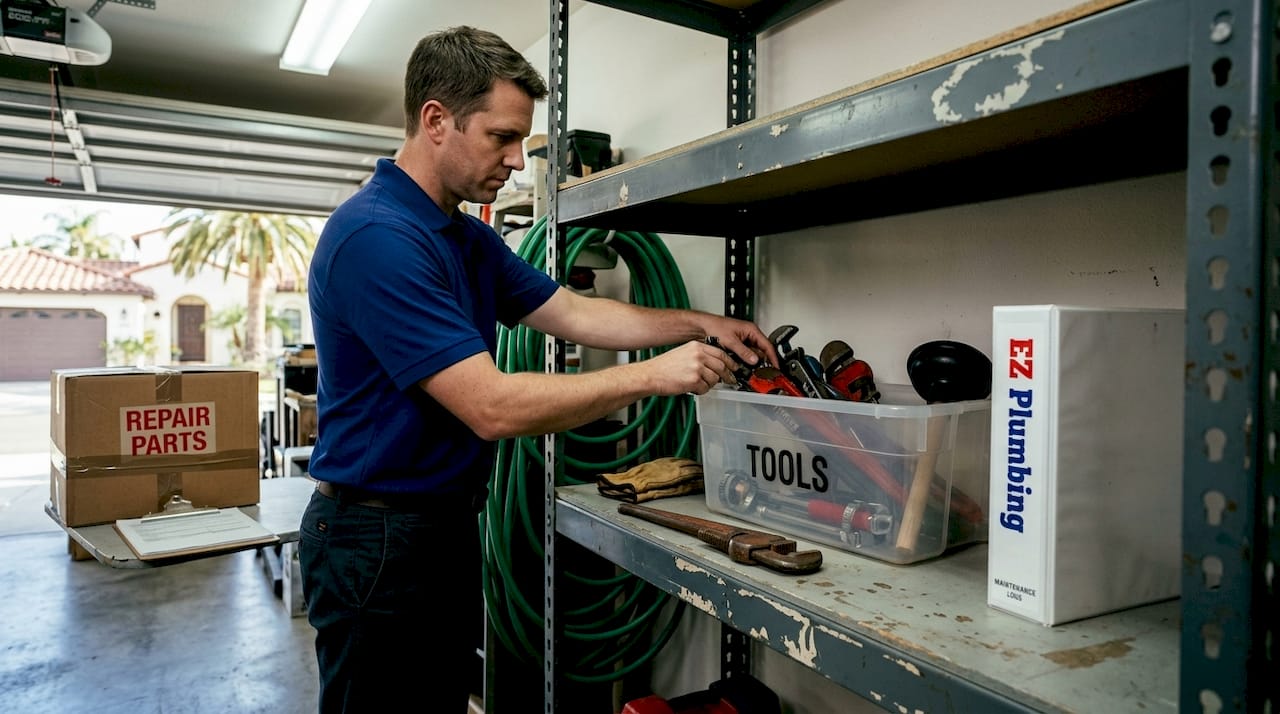
The foundation of good preparation is knowing your shutoff valve locations before you need them. Every property has a main shutoff, typically located near the water meter at the street or at the point where the supply line enters the building. Beyond that, individual fixture shutoffs are located under sinks, behind toilets, and near appliances. Labeling these valves clearly and writing down their locations takes about 30 minutes and can save thousands of dollars in a crisis.
Your basic plumbing toolkit for routine repairs and emergency response should include:
Essential tools: An adjustable wrench, channel-lock pliers, a pipe wrench, a drain snake or hand auger, a plunger (both cup and flange styles), a utility knife, and a pipe cutter for copper or PVC work.
Repair materials: Replacement washers and O-rings in common sizes, pipe repair clamps for temporary fixes, plumber’s tape (PTFE tape), PVC primer and cement, push-fit fittings for quick repairs, and a supply of replacement flappers and fill valves for toilets.
Personal protective equipment: Waterproof gloves, safety glasses, and waterproof knee pads for working under sinks or in crawl spaces.
Shifting from reactive to proactive plumbing tips is one of the highest-value changes a property manager can make. Proactive planning and routine inspections reduce emergency plumbing calls by catching early warning signs like slow drains, musty odors, recurring small leaks, and unusual water pressure changes before they become failures.
Pro Tip: Create a simple maintenance log for each property or unit. Record the date, the issue observed, the action taken, and any parts replaced. Over time, this log reveals patterns. If the same drain clogs every four months, the cause is systemic, not coincidental, and a camera inspection will find it before it becomes a sewer backup.
Documentation is especially valuable in multi-unit properties. When you can show a licensed plumber a history of recurring issues in a specific area of the building, diagnostics become faster and more accurate, which reduces your labor costs.
| Repair category | Recommended tool | Material needed |
|---|---|---|
| Faucet drip | Adjustable wrench | Replacement washer or cartridge |
| Toilet running | None | Flapper, fill valve |
| Clogged drain | Drain snake | Enzyme drain cleaner |
| Pipe patch (temporary) | Pipe wrench | Repair clamp, rubber sleeve |
| Toilet seal leak | Wrench, putty knife | Wax ring, closet bolts |
Executing safe repairs and choosing the right approach
With preparation in place, you are ready to address the actual repair. The decision tree here matters as much as the technical steps. Choosing the wrong approach, whether that means attempting a repair beyond your skill level or calling a plumber for something you could safely handle yourself, wastes time and money.
A practical three-step workflow applies to nearly every repair situation:
-
Stop the leak and control damage. Turn off the appropriate supply valve, remove standing water, and protect adjacent materials like flooring, cabinetry, and drywall from further exposure. This step is always first, regardless of what caused the problem.
-
Assess the root cause, not just the symptom. A wet cabinet under a kitchen sink might indicate a loose supply connection, a failing drain basket, or a pinhole leak in the supply line. Each has a different fix. Treating the symptom without identifying the cause leads to repeat failures. For major plumbing work, a camera inspection or pressure test gives you a definitive diagnosis before you commit to a repair strategy.
-
Choose repair versus replacement based on scope. Isolated damage to a single accessible fitting or fixture is a repair. Systemic issues, like galvanized corrosion throughout a supply line, recurring root intrusion in clay sewer laterals, or pinhole leaks appearing in multiple locations, call for replacement. Patching individual spots in a failing system is a temporary fix that delays an inevitable larger expense.
For home plumbing repair, the DIY boundary is generally this: fixture-level work on accessible components is manageable for a prepared homeowner. Replacing a faucet, a toilet fill valve, a showerhead, or a visible drain trap falls within this range. Anything involving the main supply line, the sewer lateral, concealed pipes inside walls or under slabs, or gas-connected appliances requires a licensed plumber.
Pro Tip: When a plumber uses diagnostic tools like a camera inspection or a pressure test, ask for a copy of the findings. This documentation becomes part of your maintenance record and supports insurance claims or disclosure requirements if you sell the property.
Warning: Never attempt to repair or modify concealed plumbing lines, main sewer connections, or gas-adjacent water heater supply lines without a licensed contractor and the required permits. Unpermitted work on these systems creates liability exposure, can void your homeowner’s insurance, and will surface as a problem during any future property sale or refinance.
Regulatory and financial realities for plumbing repairs in Los Angeles
Even when you execute a repair correctly from a technical standpoint, Los Angeles’s regulatory environment adds a layer of requirements that directly affect your costs, your legal standing, and your property’s resale value. Understanding these requirements before you start work prevents expensive surprises.
The financial picture for plumbing repairs in LA is significant. Main water line repair in Los Angeles averages around $1,149, with a typical range of $400 to $1,897 depending on the extent of the damage, the pipe material, and access difficulty. Permitting and inspection fees add another $200 to $500 on top of repair costs. Emergency service premiums, which apply when you need a plumber outside of standard business hours, typically add 25 to 50 percent to the base labor rate.
For context on what happens when a repair is delayed, water leak repair costs pale in comparison to water damage restoration. The average restoration project in Los Angeles runs approximately $3,728, with a range of $1,567 to $5,960 depending on the extent of structural damage and whether mold remediation is required.
In Los Angeles, the following types of plumbing work require permits and inspections before walls are closed or work is concealed:
Water heater replacements, sewer line repairs and replacements, whole-house repiping, backflow preventer installation, and any modifications to supply or drain/waste/vent lines all fall under permit requirements. The inspection must occur before the work is covered by drywall, concrete, or other materials. Scheduling that inspection is the contractor’s responsibility in most cases, but confirming it happened is yours.
Financial and legal note: Unpermitted plumbing work can void your homeowner’s insurance coverage for related claims, result in compliance fines from the City of Los Angeles, and create mandatory disclosure obligations that complicate or derail property sales. Buyers’ inspectors routinely identify unpermitted work, and lenders may refuse to fund a purchase until violations are corrected.
Budgeting for plumbing repairs in LA should account for the full cost picture: the repair itself, any required permits, the inspection fee, and a contingency for related damage discovered during the repair. Experienced property managers typically reserve one to two percent of a property’s value annually for maintenance and repair, with plumbing representing a significant portion of that budget in older construction.
The real secret to stress-free plumbing management
Here is something most fix-it guides will not tell you: the difference between a property owner who handles plumbing crises smoothly and one who faces repeated, costly emergencies is rarely about technical skill. It is about systems and information.
Most guides focus on which wrench to use or how to replace a flapper. That knowledge is useful, but it is not what protects your property. What protects your property is knowing where your main shutoff is at 2 a.m. when a pipe fails, having a maintenance log that tells your plumber exactly what was repaired six months ago, and having a service contact you trust before you need one urgently.
An isolation-first emergency protocol, where you know both the main shutoff and individual fixture isolation valves and follow a rapid sequence of shutoff, cleanup, and documentation, reduces both your restoration cost exposure and your liability for delays. That protocol, practiced and documented, is worth more than any single repair skill.
Pattern recognition, supported by trend analysis in plumbing emergencies, is the other undervalued asset. When your maintenance log shows three slow-drain calls in the same building wing over 18 months, that is a sewer lateral problem, not bad luck. Addressing it proactively with a camera inspection and hydro-jetting costs far less than the emergency sewer backup it would otherwise become.
Managing plumbing well is ultimately about managing knowledge: valve locations, repair histories, service contacts, permit records, and inspection dates. That information, organized and accessible, is what makes every subsequent repair faster, cheaper, and less stressful.
Connect with Los Angeles plumbing repair experts
If a repair is beyond your comfort level or LA’s permit requirements call for licensed work, the right move is to connect with a plumber who knows the local code landscape and your neighborhood’s infrastructure.
EZ Plumbing (C-36 License #583868) serves homeowners and property managers throughout the greater Los Angeles area with the full range of services you need, from sewer line repairs and whole-house repiping to professional leak detection using camera inspection technology and expert drain cleaning including hydro-jetting for stubborn blockages. We handle permit coordination, inspection scheduling, and code-compliant installation so you do not have to navigate LA’s regulatory requirements alone. Contact us to schedule a consultation or to set up a proactive maintenance plan for your property.
Frequently asked questions
What are the first steps after discovering a plumbing leak?
Shut off the main or fixture isolation valve immediately, open faucets to drain residual pressure from the line, and begin cleanup to limit water exposure and prevent mold from establishing within 24 to 48 hours. Shutting off water quickly is the single most important action you can take to minimize damage.
When do plumbing repairs in Los Angeles require a permit?
Permits are required for water heater replacements, main and sewer line repairs, repiping, backflow preventer installation, and changes to supply or waste lines, and all permitted work in LA must be inspected before walls or slabs are closed.
How much does plumbing repair cost in Los Angeles?
Main water line repair averages about $1,149 in Los Angeles, with most projects falling between $400 and $1,897, plus permit and inspection fees of $200 to $500 depending on the scope of work.
How can I prevent repeated emergency plumbing calls?
Shifting to proactive maintenance through routine inspections, a detailed maintenance log, and pattern-based troubleshooting of early warning signs like slow drains, odors, and recurring small leaks is the most effective way to reduce emergency calls over time.
What’s the average cost for water damage restoration from leaks in LA?
Water damage restoration in Los Angeles averages approximately $3,728, with most projects ranging from $1,567 to $5,960 depending on the severity of structural damage and whether mold remediation is required.